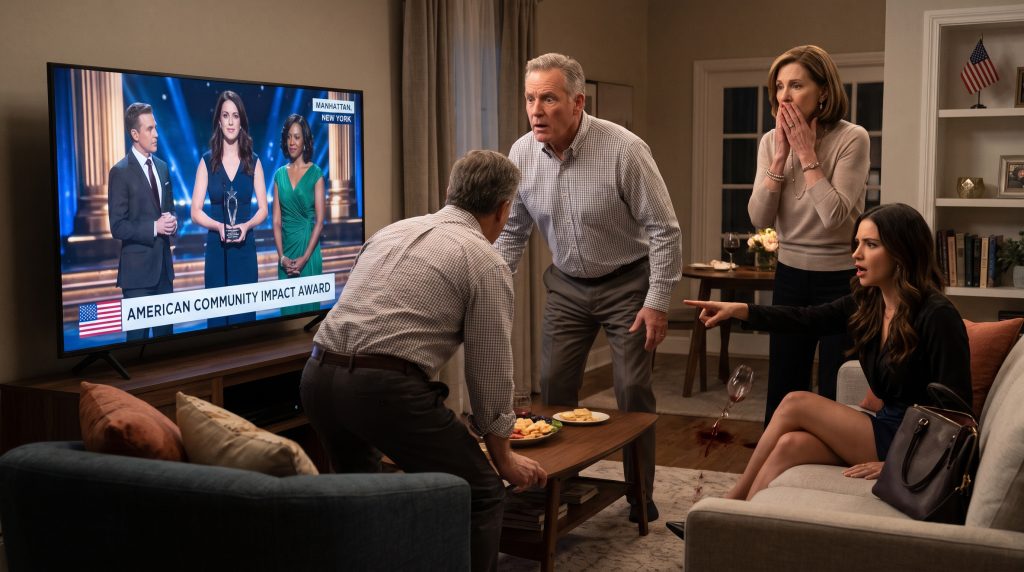
I nodded, gripping the crystal base with both hands. “Thank you. It’s going to change everything for our waiting list this winter.”
He glanced down toward Table Four, his expression warm and conversational. “Your guests down here in the front row haven’t stopped crying since the video started. That’s Rosa, Ben, and Angela, right?”
“They’re the heart of Second Door,” I said into the mic, my voice steadying as I looked at them. “I wouldn’t be standing here without them.”
Then he asked the question. It wasn’t malicious—in fact, I learned later that a junior segment producer had seen “4 Family Seats Reserved” on the initial intake sheet from September and hadn’t cross-checked the guest names.
“We always love honoring Midwest roots on this broadcast,” the host smiled. “Are your parents and family here from Columbus tonight to see this?”
There it was.
Under the hot white wash of the stage lights, time seemed to slow down to the rhythm of my own pulse. I knew the red tally light on Camera One was live. For one full second, thirty-four years of family conditioning rose up in my throat. I could have lied. It would have been the easiest thing in the world to smile, nod graciously, and say, They’re watching from home in Ohio tonight, and they send their love. I could have protected Richard and Diane and Madison the way I had been protecting their image at church coffees and holiday dinners since I was twelve years old.
Then I thought about sitting alone in the Kroger parking lot with a bag of bruised apples while the pregame show blared over my father’s phone. I thought about my mother’s eight o’clock steak reservation. I thought about Madison telling me nobody wanted to watch me embarrass myself.
Something inside me wasn’t angry anymore. It was just done carrying their luggage.
“No,” I said softly into the microphone. “My family isn’t here tonight.”
The host’s smile faltered slightly, sensing the shift in the air. He waited politely, giving me room to explain if someone was ill.
I swallowed once and looked out over the dark sea of faces.
“When I called home to invite them,” I said, my voice clear and quiet in the vast hall, “my father told me this award was absurd and that he had real work to do. My mother already had dinner reservations with friends. And my sister asked me not to make them feel guilty.”
A low, audible murmur rippled across the orchestra section. Down at Table Four, Rosa reached out and gripped Angela’s wrist.
I immediately shook my head, raising one hand slightly against the crowd’s sympathy. “Wait—please. I didn’t say that for pity, and I don’t want tonight to be about bitterness. I spent a very long time believing that if I just worked hard enough, or fixed enough broken things, or won something big enough, the people who shared my last name would finally look across the table and see me.”
I looked directly down at Angela, who was staring up at me with tears shining on her cheeks.
“Then, sitting in my car last week, I realized something,” I continued, and for a second my voice caught before I pulled it back. “Sometimes the people who see you most clearly aren’t the people you’re related to. Sometimes family is the office manager who stays until nine p.m. begging a landlord to give a single mom three more days. Sometimes it’s the volunteer who drives a borrowed truck through a January blizzard to haul a crib up three flights of stairs. And sometimes it’s the mother who walked out of a shelter four years ago, put herself through nursing school, and came back tonight to hold your hand so you wouldn’t be scared on television.”
The applause started in the middle rows and swelled until the entire room was on its feet again.
I lifted the crystal doorway slightly toward Table Four. “My parents aren’t in these seats tonight. But I have never felt less alone in my life.”
When the ovation finally began to die down, I took a breath, stepped back half a pace, and prepared to walk toward the stage-left exit. I thought that was the emotional peak of my life.
The host held up a hand, stopping me at center mark.
“Emily, hold on just a second,” he said, smiling broadly now as he touched his earpiece. “Before we let you go back to that table, there is one more piece of business tonight.”
I blinked at him under the lights. “What?”
He turned and gestured toward the forty-foot LED screen behind us. “Earlier this week, the rough cut of Angela’s interview was screened for one of our broadcast’s founding partners. Someone who wanted to speak to you directly tonight.”



