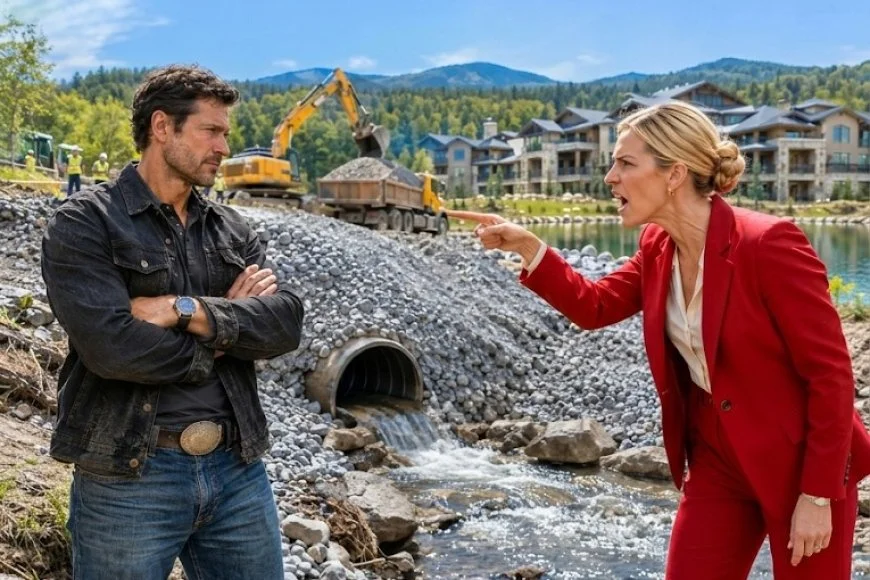
Below the new development, in a ravine that had been dry for as long as I owned the farm, we found water.
Cold water.
Running from a fresh outlet in the hillside.
Willa tested it.
Then tested the surviving pools in Gray Pine Run.
She stared at the readings.
“Almost identical temperature signature.”
“You think it’s my creek?”
“I think somebody needs to explain why cold groundwater disappeared here and appeared there on the same day.”
That afternoon, I called Eliza Newcomb at the state environmental office.
She listened.
Then gave me the answer I didn’t want.
“Right now, I have a property dispute and circumstantial evidence.”
“They buried a stream.”
“I believe you.”
“Then stop them.”
“I need evidence that lets me act legally and survive the challenge afterward.”
I hung up furious.
Willa didn’t flinch.
“She’s right.”
“I know.”
“That’s why you’re angry.”
That evening, we spread maps across my kitchen table.
The original stream alignment.
The HOA drainage plan.
Elevation contours.
Then Willa placed her finger where the two routes crossed.
Directly beneath the ninety tons of gravel.
I stared at the map.
“What if they didn’t bury the water?”
“What do you mean?”
“What if they captured it?”
The next morning, I drove to Ridgeline Aggregate.
The gravel supplier.
After my attorney sent a preservation request, the yard manager released the job summary connected to the Highcrest project.
Ninety tons of crushed stone.
Exactly.
Then I reached the next line.
Thirty-inch drainage pipe.
Flexible couplings.
Two industrial flow-control valves.
I read it again.
Stream-bank stabilization didn’t need a buried thirty-inch pipeline.
I hired an independent engineer, Russell Kincaid.
He reviewed the elevations.
The pipe order.
The public drainage plan.
Then drove the public road overlooking Highcrest Vale’s new ornamental lake.
That lake had been half-empty all spring.
Now it was rising.
Russell traced a line on the topographic map.
“If a pipe starts under Gray Pine Run here…”
His finger moved downhill.
“…gravity carries it directly to this lake.”
I looked through the trees.
The resort development surrounded that water.
Luxury homes.
Terraces.
Sales banners.
Then I saw one.
NATURALLY SPRING-FED WATERFRONT LIVING.
That evening I attended Highcrest Vale’s investor showcase.
White tents.
String lights.
Champagne.
Lavinia stood beside the ornamental lake smiling for photographs.
I walked up.
“Is Gray Pine Run feeding this lake?”
Her smile held.
“Good evening, Cyrus.”
“Are you diverting my stream?”
Several guests turned.
Lavinia lowered her voice.
“That water is benefiting an entire community.”
“That wasn’t my question.”
“You should be grateful someone finally put it to productive use.”
There it was.
Not a denial.
I looked at the lake.
Then at the homes being marketed around it.
“You’re selling my water.”
Her face changed.
“Security.”
Two guards approached.
I left without resisting.
At the edge of the terrace, I photographed the sales brochure.
PRISTINE MOUNTAIN LAKE.
NATURAL SPRING INFLOW.
PREMIUM WATERFRONT LOTS.
Two days later, the developer himself came to my farm.
Barton Phelps.
Sixty-one.
Expensive boots that had never stepped in manure.
He spread engineering drawings across the hood of his truck.
“Everything is permitted.”
At the bottom of the final sheet was a professional engineer’s stamp.
Signed.
Sealed.
I studied it.
If that stamp was genuine, someone with a license had approved the diversion.
If it wasn’t, this was bigger than an HOA president making bad decisions.
Then Barton pointed at the drawing.
“This system protects everybody.”
I looked at the ninety tons of gravel covering the stream.
“No.”
Then at the storm forecast.
“Not when that rain gets here.”
That night, an unfamiliar number called.
A man’s voice said:
“I drove those gravel trucks.”
I sat up.
“You need to know what they buried before we covered it.”
“Who is this?”
“Meet me at the old weigh station on Hollis Gap Road.”
“When?”
“One hour.”
Then he hung up.
Outside, lightning flashed beyond the mountains.
The storm was less than forty-eight hours away.
And for the first time, somebody from Lavinia’s crew was ready to tell me what was underneath the creek…
The man waiting at the abandoned weigh station was Hugh Bickford, the site foreman. He handed me a manila envelope filled with revised construction drawings, emails, and one document that changed everything: the project engineer had warned the developer in writing not to divert Gray Pine Run without additional permits and hydraulic review.
The engineer’s stamp on Barton’s presentation drawings was real. The design beneath it wasn’t. The approved drawing had later been altered to extend a buried pipe across my property, and the engineer had objected when he discovered the change.
Hugh also showed me the schedule. The lake had to reach a minimum showcase level before investors arrived, and a consulting company connected to Lavinia would receive a substantial success payment if the development met its financing milestone.



