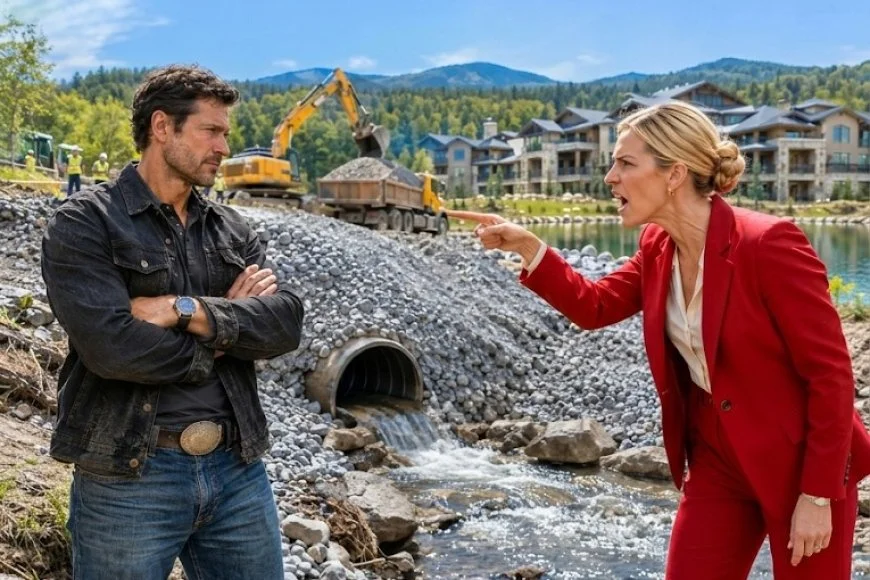
Mud slumped toward the county road.
Russell shouted coordinates.
The pump crew shifted.
A state excavator began cutting the approved relief path.
Slowly.
Foot by foot.
No dramatic wall of water.
No reckless tearing into the gravel.
Just controlled work under floodlights while rain hammered everyone flat.
At 1:06, water began entering the relief channel.
Pressure against the failed bank stabilized.
At 1:22, the upstream sensor reached its peak.
Then leveled.
At 1:47, the crack stopped growing.
The county road remained open.
Nobody was injured.
I stood beneath a tree watching mud run off my sleeves.
Eliza came beside me.
“That was close.”
“How close?”
She looked toward the slope.
“Closer than I want in my report.”
By dawn, Highcrest Vale’s ornamental lake had dropped several feet.
The grand terrace overlooked exposed mud.
Investor tents flapped in the rain.
The showcase was canceled.
Nobody cared.
State personnel sealed the diversion site.
Construction stopped.
All project drawings, electronic files, work orders, gate logs, communications, and financial records connected to the drainage project were ordered preserved.
The gravel stayed where it was until engineers could remove it safely.
I walked home after sunrise.
For the first time since Tuesday, I stopped beside Gray Pine Run without trying to solve anything.
The stream was still buried.
But underneath the stone, water was moving toward daylight again.
The investigation lasted months.
That mattered.
I had no interest in pretending one storm produced instant justice.
Engineers excavated test sections.
Surveyors mapped the unauthorized pipeline.
The state compared the permitted plan with the altered construction drawings.
The project engineer confirmed his original design had never authorized capturing Gray Pine Run.
His written warning had been genuine.
Hugh eventually testified through the proper process.
Beatrice Mullen produced financial records showing project spending the full HOA board had not approved.
Barton’s development company turned over investment documents.
That was where investigators found the financial structure Lavinia had failed to disclose.
A consulting company associated with her stood to receive a large performance payment if the resort achieved certain financing milestones.
One condition depended on the ornamental lake reaching a marketable operating level before investor review.
The lake had been chronically low.
Gray Pine Run had become the solution.
Not on paper.
Not officially.
But in practice.
Then came another discovery.
The project financing included an environmental restoration guarantee.
The developer had promoted the resort as environmentally responsible.
To secure financing, it had established a multimillion-dollar guarantee available if project activity caused qualifying ecological damage.
Beatrice found the certification.
Lavinia had signed it.
GRAY PINE RUN IDENTIFIED AS CRITICAL COLD-WATER RESOURCE.
PROTECTION REQUIRED.
I read that line three times.
The woman who later dismissed the stream as my “fishing spot” had previously signed a financing document recognizing its ecological importance.
That ended any argument that she simply didn’t understand.
The restoration hearing filled the county courthouse.
Highcrest homeowners sat behind Lavinia.
Most looked exhausted.
Some looked angry at me.
I understood why.
Rumors said the state might impose millions in cleanup costs.
Families were terrified of special assessments.
Lavinia used that fear.
She stood before the hearing officer.
“My residents should not be financially destroyed because one landowner refuses to compromise over a creek.”
Willa’s face tightened beside me.
I stayed seated.
Eliza presented the technical findings.
The illegal diversion had disrupted approximately one hundred fifty feet of stream directly and affected habitat farther downstream.
Brook trout spawning gravel had been buried.
Cold-water flow had been redirected.
Banks had destabilized.
Sediment had entered downstream reaches.
The unauthorized pipe and gravel structure had increased flood risk.
Restoration would require far more than removing stone.
Then came the cost estimate.
Emergency stabilization and diversion removal.
Channel reconstruction.
Bank restoration.
Native vegetation.
Habitat rebuilding.
Multi-year monitoring.
Contingency.
Approximately four million dollars.
Murmurs filled the room.
Lavinia stood immediately.
“You’re asking ordinary homeowners to pay four million dollars!”
Several residents reacted.
Then Beatrice rose from the second row.
“No.”
Everyone turned.
She held a binder.
“The project guarantee covers qualifying environmental restoration.”
Lavinia went still.
Beatrice continued.
“The board was never shown the complete guarantee documents.”
Barton’s attorney objected.
The hearing officer allowed her to continue only within authenticated records.
That was enough.
The bank representative confirmed the guarantee existed.
The state’s violation findings triggered procedures for accessing it.
The homeowners would not simply receive a four-million-dollar bill because Lavinia wanted them afraid.
Responsibility would be allocated among the developer, contractors, applicable coverage, financial guarantees, and other legally responsible parties.
It was more complicated than revenge.
It was also fairer.
Then my attorney, Margaret Hale, presented the timeline.
Lavinia’s ecological certification.
The engineer’s warning.
The altered construction plan.
The gravel deliveries.
My written complaints.
The diversion.
The filling lake.
The investor deadline.
No shouting.
Just dates.
When Margaret finished, the room was silent.



