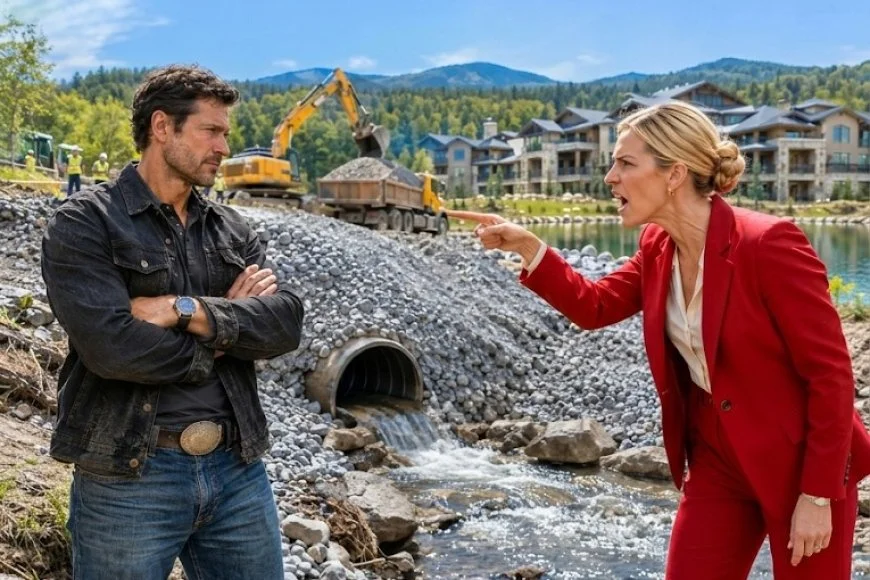
Then Highcrest treasurer Beatrice Mullen contacted my attorney. She had found HOA flood-reserve money paying invoices that the full board had never approved. For the first time, the construction records and the financial records were pointing in the same direction.
Eliza Newcomb changed her position immediately.
“We inspect before the storm.”
Russell Kincaid ran the flood calculations.
His conclusion was worse than I expected.
The thirty-inch pipe could carry ordinary flow.
It could not carry a mountain flood.
With the natural stream channel packed under ninety tons of stone, rising water would back up behind the gravel and search for another path.
The weakest path was a saturated slope above the county road.
If it failed, mud, rock, and floodwater could hit homes below.
The storm was now eighteen hours away.
Highcrest had one way to reduce pressure: lower its ornamental lake through the outlet structure.
Lavinia ordered the outlet gate locked.
Investors were arriving the next morning.
At 11:18 p.m., my upstream sensor sent an emergency alert.
Gray Pine Run was rising faster than any event I had recorded in twenty years.
Then the ground beside the buried channel cracked open…
PART 3
I heard the crack before I saw it.
A deep tearing sound under the rain.
Not thunder.
Earth.
My flashlight caught a jagged line opening through the saturated soil beside the gravel cap.
Water pushed through it in brown pulses.
I called Russell Kincaid.
“Bank is moving.”
“How much?”
“Crack’s maybe twenty feet and widening.”
“Get away from it.”
“I’m moving.”
“Cyrus, I mean now.”
I backed uphill.
Then called Eliza.
She was already mobilizing the emergency team.
The plan we had built that afternoon was simple in theory.
Nobody touched the gravel until engineers controlled the pressure.
Temporary sediment barriers would protect the tributary.
Pumps would draw down trapped water.
A controlled relief channel would be cut only under state supervision.
And the ornamental lake had to be lowered.
That last part required access through Highcrest Vale.
At 11:43, state trucks arrived at my lower gate.
I unlocked everything.
No paperwork.
No argument.
“Farm road goes left,” I told them. “Stay high after the barn. Soft ground below the walnut stand.”
Eliza climbed out wearing rain gear.
“You staying with us?”
“I know every monitoring point.”
“You stay where I tell you.”
“Fair.”
Willa arrived ten minutes later with sampling equipment.
Russell brought updated flow calculations.
The rain became a wall.
Upstream, Gray Pine Run was trying to return to a channel somebody had erased.
The water reached the gravel and had nowhere to go.
Some entered the buried pipe.
Most didn’t.
Pressure spread sideways.
At midnight, the emergency team reached the Highcrest boundary.
Locked steel gate.
Security guards.
And Lavinia.
She stood beneath a black umbrella while rain hammered the pavement.
“You are not entering private association property.”
Eliza stepped forward.
“I’m Eliza Newcomb with the state environmental response office.”
“I know who you are.”
“We need access to the lake control structure.”
“The lake is stable.”
“It needs to be drawn down.”
“Absolutely not.”
Russell leaned toward me.
“She’s going to kill her own slope for a sales photograph.”
Eliza held out an emergency order.
Lavinia didn’t take it.
“Our attorneys will challenge this.”
“You can challenge it tomorrow.”
Then Eliza pointed behind her.
“Tonight, open the gate.”
A sheriff’s deputy stepped forward.
Lavinia looked toward her security staff.
Nobody moved.
Then headlights appeared behind us.
Barton Phelps skidded to a stop in his pickup.
He jumped out without a coat.
“What’s happening?”
Eliza answered.
“Your diversion is backing floodwater against an unstable slope.”
Barton turned toward Lavinia.
“You said the system was cleared.”
“You approved it.”
“I approved the lake connection after your consultants said—”
“Your team built it.”
“You pushed the deadline.”
Their argument exploded in front of everyone.
No careful wording.
No lawyers.
Just two frightened people suddenly realizing the storm did not care whose idea had been worse.
Lavinia shouted:
“You agreed the lake had to be full!”
Barton answered:
“Because you told me the water rights were handled!”
I looked at Eliza.
She had heard enough.
“So did my recorder,” she said.
The gate opened.
The outlet structure sat below the terrace, protected by a new concrete headwall and steel control mechanism.
A technician showed the team the operating system.
Eliza ordered a controlled release.
Lavinia stepped between them.
“That lake is worth millions.”
I stared at her.
“Then you should’ve filled it with water you owned.”
The gate began opening.
Water rushed through the lawful outlet toward the engineered drainage corridor.
The lake level dropped inch by inch.
At the same time, crews installed temporary pumps near Gray Pine Run and built sediment controls along the weak bank.
At 12:31, the crack widened another six feet.



