Barton later reached agreements connected to restoration obligations and project losses.
The original resort expansion was never completed as planned.
Several premium lots were redesigned.
The lake itself had to change.
Lavinia was removed as HOA president after an internal association process.
Her undisclosed financial interests and project directives were referred to the appropriate authorities and civil proceedings.
I followed the cases only as far as necessary.
By then, I had stopped caring whether Lavinia felt punished.
I wanted the stream back.
That proved harder.
The first excavator entered Gray Pine Run under state supervision six months after the storm.
Every bucket mattered.
Remove too much too quickly and trapped sediment could destroy downstream habitat.
Remove too little and the stream remained strangled.
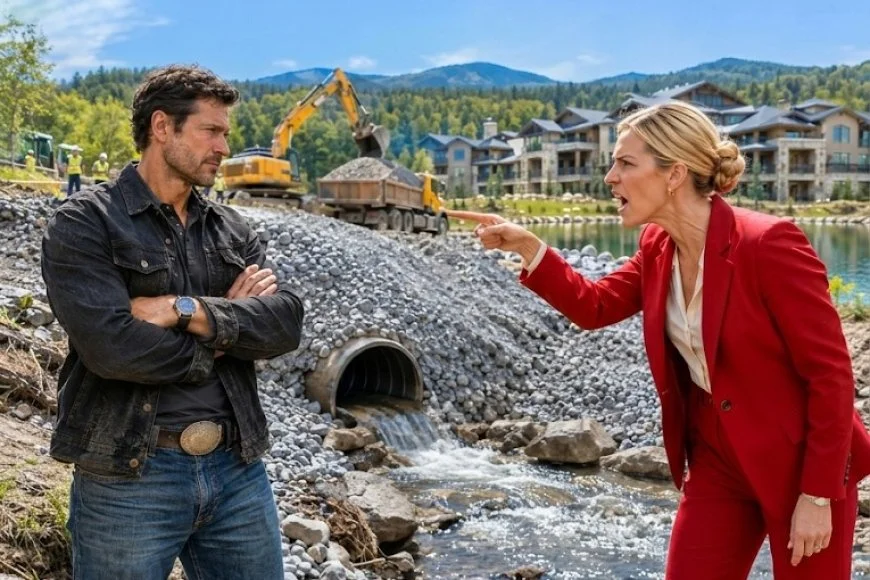
Crews first exposed the diversion pipe.
Thirty inches wide.
Exactly as the quarry records showed.
The pipe crossed my property beneath the gravel cap, intercepted the creek, then disappeared downhill toward Highcrest.
I stood beside Willa when they uncovered the first control valve.
“There,” she said.
I had imagined that moment for months.
I expected rage.
Instead, I felt tired.
A steel valve.
That was all.
Something manufactured.
Installed.
Bolted.
Ordinary hardware used to redirect something alive.
The pipe came out section by section.
Then the gravel.
Truck after truck.
Some material had mixed with native streambed.
That had to be separated or replaced.
Russell designed a restored channel using the original elevations, historic photographs, my monitoring data, and Willa’s habitat surveys.
That was where twenty years of boring records became priceless.
I had photographs of flood years.
Drought years.
Bank positions.
Pool depths.
Temperature ranges.
Riffles.
Spawning beds.
People joked for years that I documented the creek as if it were a family member.
Now those records showed engineers what “before” actually looked like.
The restoration did not try to create a decorative stream.
No perfect stone borders.
No concrete channel.
They rebuilt complexity.
Deep pools.
Shallow riffles.
Large woody debris.
Natural bends.
Clean gravel beds.
Bank vegetation.
Tree roots.
Places for water to slow.
Places for it to accelerate.
Places for trout to hide.
The first winter looked terrible.
Bare branches.
Fresh soil.
Construction scars.
Then spring came.
Willows leafed out.
Native shrubs took hold.
Insects returned.
Willa found the first trout in the restored reach eleven months after major construction ended.
She called me from the creek.
“Cyrus.”
“What happened?”
“Bring your boots.”
I ran downhill.
She was kneeling beside a shaded pool.
One brook trout hovered beneath a submerged root.
Small.
Maybe six inches.
But alive.
I crouched.
“Did you put that there?”
She looked offended.
“I’m a scientist.”
“That wasn’t a no.”
She laughed.
“No. I did not put your fish there.”
We watched it until it disappeared beneath the bank.
Monitoring continued.
One fish wasn’t recovery.
Neither were ten.
Willa reminded everyone that ecological restoration takes years.
Temperatures had to stabilize.
Aquatic insects needed to recolonize.
Spawning success had to return.
Banks needed roots.
The stream had to survive another storm.
The next big rain came eighteen months after the disaster.
I woke before dawn.
Same farmhouse.
Same steel thermos.
For a second, fear hit me before I even reached the window.
Then I heard it.
Water.
Gray Pine Run.
Loud.
Full.
Moving.
I walked down in rain gear.
The stream was high, but it stayed in its restored channel.
Floodwater spread naturally into a small designated floodplain area.
The banks held.
The road below remained safe.
Highcrest’s old ornamental lake had been redesigned too.
Part of it became a constructed wetland that stored runoff and filtered sediment before water left the development.
Lavinia had wanted a luxury lake.
The restoration turned part of it into something less glamorous and far more useful.
A buffer.
A wetland.
A place built to work with water rather than steal it.
After the restoration passed its major inspection, a private sporting company approached me.
They wanted to lease Gray Pine Run.
Exclusive trout access.
Luxury guided fishing.
High annual payment.
Years earlier, I would have considered it.
Instead, I signed a conservation easement with an independent land trust.
The stream corridor would remain protected even after I died or sold the farm.
No development capable of materially harming the cold-water system.
Scientific monitoring allowed under controlled conditions.
Limited access for restoration.
No resort.
No luxury fishing compound.
No second chance for someone to decide a healthy stream was wasted space.
Margaret asked whether I understood how much future value I was giving up.
“Yes.”
“Any hesitation?”
I looked at the water.
“None.”
The easement signing took twenty minutes.
Restoring Gray Pine Run had taken nearly two years.
Protecting it permanently took one signature.
On an October morning, Willa joined me beside the flat rock where I had first found the gravel.
Young trees shaded the bank.



