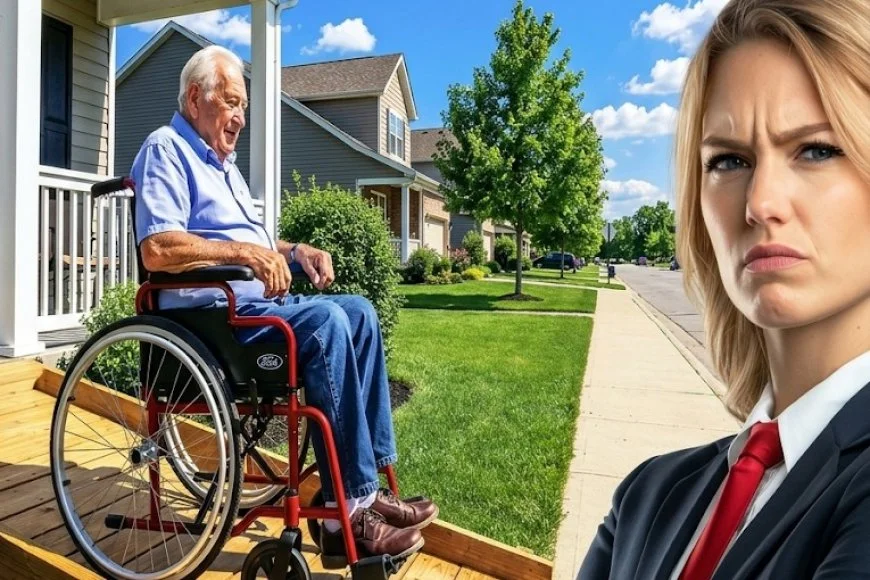
The letter said I had fourteen days to remove my father’s wheelchair ramp.
After that, the HOA would fine me two hundred dollars.
Every single day.
I read the notice twice, then walked outside and stared at the ramp I’d built with my own hands.
Pressure-treated lumber.
Proper footings.
Non-slip treads.
A handrail.
A gradual slope so my seventy-three-year-old father could roll from the driveway to the front porch without needing another person to lift him.
The HOA called it an “unauthorized exterior structure.”
My father called it the reason he could leave the house.
My name is Michael Turner, and until that letter arrived, I barely thought about our homeowners association.
My neighborhood was the usual planned suburban community.
Trim your grass.
Don’t leave garbage cans outside all week.
Submit a form before painting the house purple.
Annoying sometimes, but nothing I couldn’t live with.
Then my father moved in.
Dad had spent most of his life working with his hands.
Cars.
Roof repairs.
Plumbing.
Anything that broke, he fixed.
He was also the kind of man who would rather crawl across broken glass than admit he needed help.
Then a medical problem put him in a wheelchair.
After weeks in the hospital and rehab, he could stand briefly if he had something solid to hold, maybe pivot from a chair to a bed, but walking any useful distance was over.
His old house wasn’t designed for that life.
Narrow halls.
Steps everywhere.
A bathroom barely wide enough for one person.
So I asked him to move in with me.
He gave me the speech I expected.
“I don’t want to be a burden.”
“You’re not.”
“I can figure something out.”
“You already figured things out for everybody else for seventy years. Let somebody else do it once.”
He hated that answer because he knew I was right.
My house worked reasonably well once we rearranged furniture.
Except for the front entrance.
Four steps.
That was all.
Four ordinary steps that might as well have been a brick wall.
I considered a portable aluminum ramp, but the safe slope would’ve made it long and awkward. I’d have to drag it out, align it, secure it, then put it away.
Dad would still depend on someone else every time he wanted outside.
So I called the city building department.
I explained exactly what I planned to construct.
The employee emailed me residential accessibility guidelines covering width, slope, landing space, rail height, and basic safety requirements.
For a small ramp attached to an existing porch, he told me no additional permit was required in our situation.
Just build it safely.
So I did.
I measured everything three times.
Built it over a weekend.
When Dad rolled up the finished ramp for the first time, he stopped on the porch.
He didn’t say anything for several seconds.
Then:
“Didn’t think I’d be going up steps again.”
Technically, he wasn’t.
But I understood what he meant.
That porch became his favorite place.
Coffee in the morning.
Complaining about the heat.
Watching delivery trucks.
Talking to anyone who walked past.
For the first time since the hospital, he had a little independence back.
It lasted eight days.
Then the HOA letter arrived.
UNAUTHORIZED EXTERIOR MODIFICATION.
Failure to receive architectural approval.
Alteration inconsistent with neighborhood appearance standards.
Fourteen days to remove or correct.
Fine after deadline:
$200 per day.
I called the management company.
The woman who answered pulled up my address.
“What exactly is wrong with the ramp?”
“The board determined it was installed without architectural approval.”
“It’s a wheelchair ramp.”
“I understand.”
“My disabled father needs it to enter the house.”
“I understand, but exterior modifications require prior approval.”
“Does the HOA intend to fine me two hundred dollars every day because I won’t remove his wheelchair ramp?”
Silence.
Then:
“That is the current fine schedule for unresolved exterior violations.”
Dad had heard most of the conversation.
When I hung up, he stared at his hands.
“We can figure out another way.”
“No.”
“I don’t want you getting fined because of me.”
That sentence made me angrier than the letter.
“This isn’t because of you.”
“They could bring me through the garage.”
“No.”
“Mike—”
“You are not getting hidden in the garage because somebody doesn’t like seeing a wheelchair.”
That night, I finally read the entire HOA covenant binder.
Yes, exterior changes required architectural approval.
Fences.
Sheds.
Paint.
Additions.
Visible structural alterations.
Nothing specifically addressed disability access.
So I created a folder.
HOA notices.
City emails.
Ramp photographs.
Dates.
Names.
Every phone call.
Then I emailed the board explaining the situation and asking what specific standard the ramp violated.
No response.
I asked to be added to the next meeting agenda.
No response.
So I went anyway.
About twenty homeowners sat in folding chairs facing five board members.



