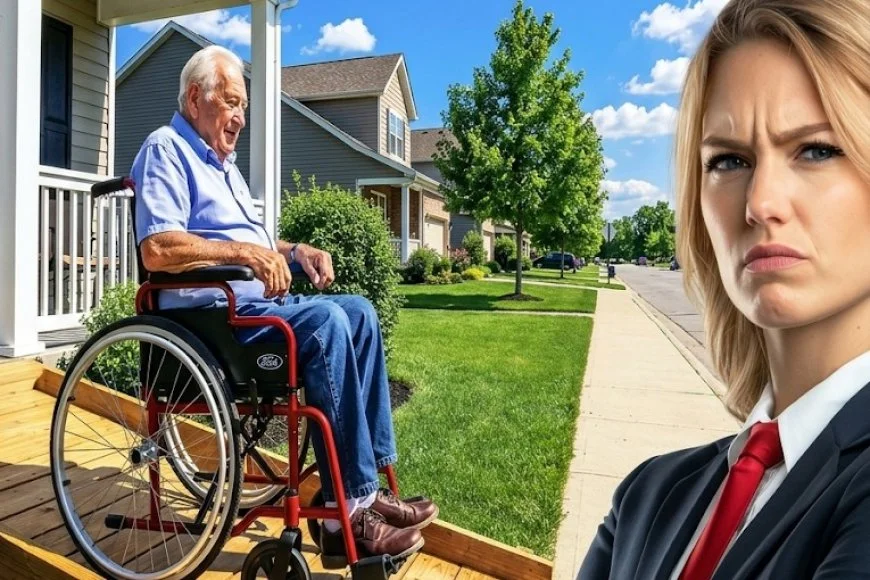
People weren’t waiting patiently for the board to tell them what happened.
They had questions.
One homeowner asked:
“Why wasn’t the accommodation request approved once the city confirmed the ramp was safe?”
Another:
“Why did we threaten two-hundred-dollar daily fines?”
Another:
“Who decided appearance mattered more than access?”
Diane remained composed for the first twenty minutes.
She described the dispute as a procedural misunderstanding.
She said the board had never intended to discriminate against anyone.
She emphasized that architectural rules existed to protect property values.
Then an older woman near the back stood using a cane.
“I care less about my property value than I do about knowing I can get into my own house if I end up in a wheelchair.”
People applauded.
Diane waited.
Then said:
“Nobody ever suggested a disabled resident should be excluded.”
I looked at Dad.
He looked at me.
Neither of us spoke.
We didn’t need to.
Several people in that room had heard the meeting recording.
The vote followed.
It wasn’t close.
Diane was removed as president.
The treasurer, who had supported the enforcement decision throughout the dispute, was removed from the board.
Another director resigned the following week.
New candidates ran.
Most weren’t radicals.
They didn’t promise to abolish rules or eliminate the HOA.
They promised boring things.
Clear notices.
Published procedures.
Legal review before escalating expensive disputes.
Actual accommodation policies.
That sounded excellent to me.
The new president was a retired accountant named Rebecca Martin.
Her first conversation with me happened on my porch.
Dad was sitting beside us.
Rebecca looked at the ramp.
“So this is the famous structure.”
Dad nodded.
“Terrifying, isn’t it?”
She laughed.
Then she handed me the updated accommodation policy.
“We’re asking you to review this from a homeowner perspective.”
“I’d rather not become the neighborhood ramp consultant.”
Dad spoke up.
“I’ll do it.”
We both stared at him.
“What?” he asked. “I’ve got experience.”
He actually read it.
Every page.
His biggest complaint involved response times.
“This says the board can take thirty days.”
Rebecca explained that complicated requests might require professional review.
Dad pointed at the paragraph.
“Fine. But if somebody is coming home from rehab, thirty days is a long time.”
She considered that.
They added an emergency interim process.
Temporary approval when immediate access was medically necessary, followed by normal review afterward.
That change meant more to Dad than the settlement check.
Months later, a FOR SALE sign appeared outside Diane’s house.
There was no neighborhood celebration.
No dramatic goodbye.
One week the house was occupied.
A few weeks later, it wasn’t.
I never learned exactly why she moved.
Maybe the recall embarrassed her.
Maybe she had other reasons.
It didn’t matter.
Dad was still there.
That was what mattered.
He used the ramp every morning.
His strength improved a little.
Not enough to walk independently.
Enough to transfer more easily.
He learned how to maneuver the wheelchair backward through the front doorway without clipping the frame.
He considered this a major athletic achievement.
His porch routine became predictable.
Coffee at eight.
Complain about temperature at eight-fifteen.
Criticize my lawn maintenance by eight-thirty.
One morning, a delivery driver rolled a hand truck up the ramp carrying two heavy boxes.
Dad watched him.
“See?”
“What?”
“My ramp is improving commerce.”
“You’re a public servant.”
“I should charge tolls.”
I laughed.
That ordinary conversation was worth every letter.
Every meeting.
Every legal call.
Because during the worst part of the dispute, Dad had begun acting as though his disability was causing problems for everyone else.
He apologized when I had to drive him places.
Apologized when furniture needed moving.
Apologized for the ramp.
The HOA didn’t create that guilt.
But it fed it.
Every violation notice quietly reinforced the idea that his access was an inconvenience the rest of the neighborhood had to tolerate.
The settlement helped.
The recall helped.
But what really changed him was time.
Months of watching neighbors stop at the porch and talk.
Children using the ramp because running up it was more fun than taking the steps.
Delivery drivers using it without thinking.
Friends rolling coolers up it during cookouts.
It became boring.
That’s the best thing an accessibility feature can become.
Ordinary.
A year after the first violation letter, Rebecca asked whether Dad and I would attend the annual meeting.
I groaned.
“Why?”
“We’re presenting the updated policies.”
“You don’t need us.”
“I know.”
“Then why?”
“Because your father specifically asked whether we’re still wasting money.”
I looked toward him.
He was smiling.
At the meeting, the legal-expense line had dropped dramatically.
No active accommodation disputes.
No major enforcement lawsuits.
Dues were stable.
Rebecca presented the numbers.
Then Dad raised his hand.
Everybody looked at him.
He pointed toward the budget.
“Looks cheaper than fighting a piece of lumber.”



