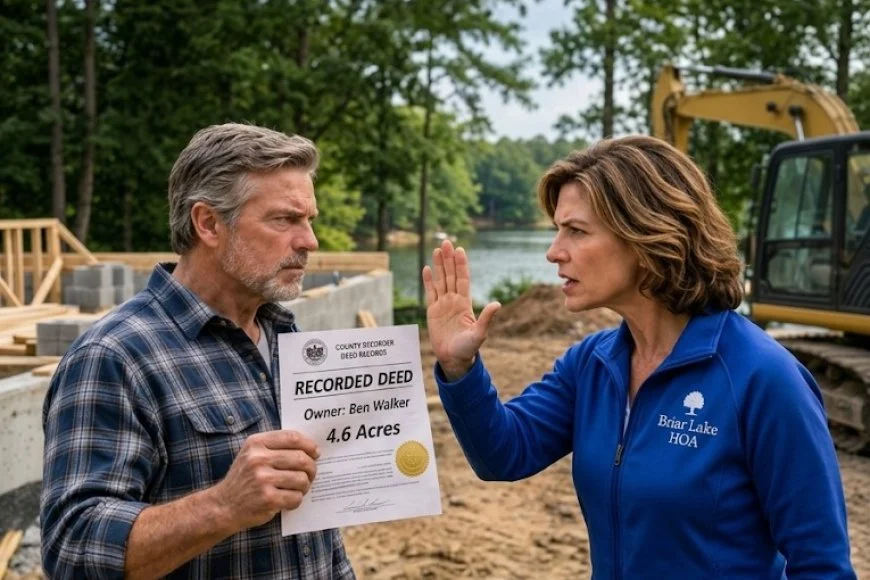
“You’re building on the lot we bought.”
I looked at the plan again.
“Mark, according to this drawing, you bought my living room.”
He didn’t appreciate that.
Rachel did not smile either.
They left angry.
But they didn’t look dishonest.
They looked scared.
The following afternoon, another car arrived.
A widow named Linda Brooks stepped out carrying a brochure titled:
THE EIGHT COTTAGES AT BRIER LAKE.
She had bought Lot Six.
She had used money from her late husband’s life-insurance policy for the deposit.
“He always wanted a place near the water,” she told me. “I thought I’d bring the grandchildren.”
Her voice broke.
I didn’t know what to say.
She pointed toward my old oak tree.
The brochure showed it behind her future cottage.
Eight lots.
Eight private drives.
Eight lake views.
All spread across land I legally owned.
That evening, Sarah called.
She had gone deeper into the title history.
Susan’s company had tried to buy the property from the previous owner before I did.
The deal never closed.
No deed transferred.
No purchase was completed.
The owner later sold the land to me.
But Lake Crest had kept marketing the cottage project anyway.
Eight promised lots.
Roughly $760,000 in future sales.
About $120,000 already collected in deposits.
I sat at my kitchen table holding the phone.
“So she planned the project before she owned the land.”
“Yes.”
“And then kept selling it after the purchase failed.”
“That’s what the records appear to show.”
I looked at my house plans.
For months, Susan had been selling families a future on my property.
Now my foundation was rising right in the middle of that future.
And suddenly I understood why she had been desperate enough to call the sheriff.
Susan didn’t need to stop construction because my house violated her HOA rules.
She needed to stop construction because every wall I built proved something far worse.
She had been selling land she never owned…
Susan couldn’t stop my house directly, so complaints started arriving through other channels. She reported drainage issues, construction access concerns, and alleged conflicts with the neighborhood development plan. Most went nowhere, but one county inspector did find a legitimate drainage-control detail near our temporary entrance that needed correction.
Normally, Tom and I would have fixed it and moved on. Instead, the delay cost us our concrete crew, which pushed the schedule back weeks. I set aside $15,000 from my construction budget for legal costs and crossed the stone fireplace and screened porch off my plans.
My daughter Emily watched me erase them.
“This isn’t fair.”
“No.”
“Maybe stop building until it’s over.”
For the first time, I considered it.
Then I looked at the porch I’d spent years imagining.
“The fireplace can wait. The screens can wait.”
I picked up the pencil.
“The house stays.”
Meanwhile, Rachel Collins started checking records herself. Susan had told some buyers the land acquisition was complete and others that it was still being finalized. All eight families eventually compared their contracts and emails.
Their stories didn’t match.
Mine did.
I had a recorded deed.
Susan had brochures.
Then her attorney made me an offer.
Lake Crest wanted to buy my land for substantially more than I’d paid.
But the offer depended on financing, required me to release claims, and included confidentiality terms.
I asked for proof they could actually fund the purchase.
They couldn’t provide it.
A few days later, the offer disappeared.
That was when Sarah looked across her desk at me and said:
“Ben, I think it’s time we let a judge decide who owns your property.”
PART 3
Sarah filed the civil action the following week.
Our goal was narrow.
Establish title.
Stop Lake Crest from claiming development rights over my property.
Document the construction losses directly caused by interference.
We weren’t filing on behalf of the buyers.
Their deposits were separate contracts.
Their attorneys would handle those.
That distinction mattered.
I was angry at Susan.
But I didn’t want anger turning every problem into one giant lawsuit.
Tom and I corrected the drainage issue.
Then we rebuilt the schedule around whichever crews were still available.
The foundation continued.
Slowly.
Every morning, I arrived with bad coffee and a folder that kept getting thicker.
Emails.
Daily logs.
Inspection reports.
Legal letters.
Buyer brochures.
At fifty-nine, I had finally become the most annoying type of client I’d dealt with throughout my career.
The one who saved everything.
Then Rachel Collins returned.
This time, Mark wasn’t with her.
She pulled up beside the site office carrying two coffees.
“I brought my own.”
“That hurts.”
“Yours tastes like road tar.”
“Strong coffee builds character.”
“It probably removes paint.”
She sat beside me.
For the first time, she looked more tired than angry.
“I went to the register of deeds.”



