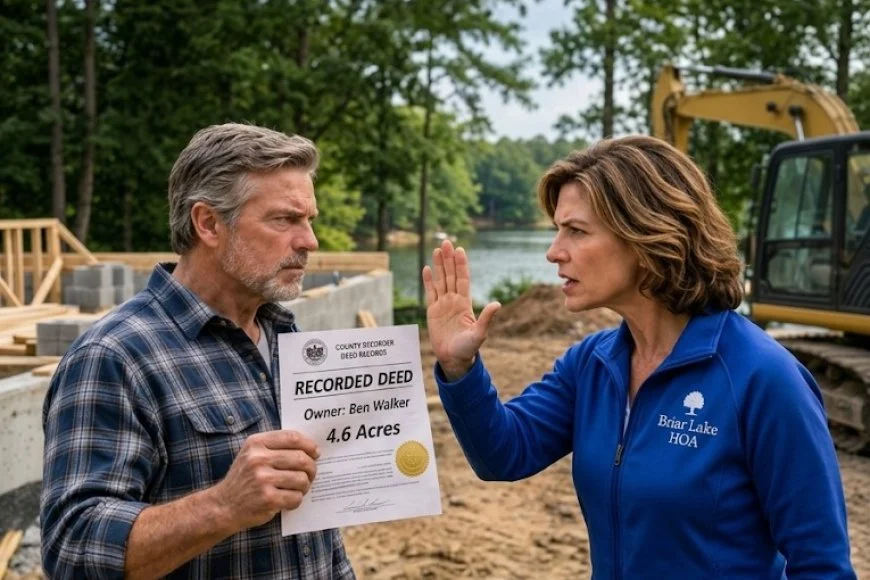
“Good.”
“I hired an attorney.”
“Better.”
“I asked Susan for the document showing Lake Crest bought the property.”
I waited.
Rachel shook her head.
“She wouldn’t give me one.”
“Because there isn’t one.”
“I know that now.”
She stared at the unfinished foundation.
“Mark doesn’t want to accept it.”
“I understand.”
“He thinks accepting it means admitting we were stupid.”
“You weren’t stupid.”
Rachel looked at me.
“You mean that?”
“Yes.”
They had trusted a woman who presented herself as an HOA president, a developer, and someone with official plans.
Most people do not ask a seller to prove the seller owns the land beneath every brochure.
They assume the basic part is true.
Rachel opened her folder.
“I started comparing emails with two other buyers.”
She laid three printed messages on the table.
One said:
LAND ACQUISITION COMPLETE.
Another:
FINAL CLOSING STEPS UNDERWAY.
The third:
PROPERTY SECURED FOR DEVELOPMENT.
All three had been sent during roughly the same period.
“Those aren’t the same thing,” Rachel said.
“No.”
“That’s what my lawyer said.”
She gathered the papers.
“I owe you an apology.”
“You don’t owe me one.”
“Mark and I came here accusing you.”
“You thought I was building on what you’d bought.”
“Still.”
She smiled faintly.
“Next time I visit, I’m bringing coffee.”
“That’s fair.”
After she left, I looked toward the old oak tree.
Susan had used that tree in nearly every brochure.
Each cottage was promised some version of the same sunset.
Same shoreline.
Same oak.
Same future.
She had sold one view eight times.
A week later, Linda Brooks came with Rachel and another buyer named Daniel Mercer.
They spread brochures across the hood of my truck.
Lot Four.
Lot Six.
Lot Seven.
Each advertised an “exclusive sunset view.”
Each photograph featured my oak tree.
I laughed despite myself.
“That tree has a better real-estate agent than I do.”
Daniel smiled.
Linda didn’t.
She ran a finger along the edge of her brochure.
“My husband died last year.”
Nobody said anything.
“We talked about retiring near water for twenty years.”
Her voice stayed steady.
“When I saw this place, I thought maybe I could still have some version of that.”
I looked at the unfinished house behind me.
Suddenly the conflict felt different.
I’d lost money.
Time.
A fireplace.
Some porch screens.
Linda had bought a future with someone who was no longer alive.
And Susan had taken money for it.
“Take every email to your lawyer,” I said. “Don’t rely on my case to solve yours.”
Daniel nodded.
“We’re contacting all eight buyers.”
“Good.”
“Mark too.”
Rachel sighed.
“Eventually.”
Mark came back about ten days later.
Alone.
He didn’t get out of his truck immediately.
When he finally did, he looked embarrassed.
“Susan says you knew about the cottage project before you bought the land.”
“I didn’t.”
“She says the previous owner had an agreement.”
“A proposal.”
“She says that means the deal was basically done.”
“Then ask her for the deed.”
Mark looked toward the house.
“Rachel keeps saying that.”
“Rachel’s right.”
He crossed his arms.
“We planned summers here.”
“So did I.”
He looked at me.
That caught him.
“I spent thirty years building things for other people, Mark. This was supposed to be mine.”
His expression changed.
Not friendly.
But less certain.
“I’m still angry.”
“You should be.”
“Just maybe not at you.”
“That’s between you and the person who took your money.”
He left without another word.
A few days later, Sarah called.
“Susan’s attorney has proposed buying your property.”
The number surprised me.
It was high enough to cover what I’d paid.
The site work.
Legal costs.
A significant amount beyond that.
For about one minute, I imagined taking it.
Sell.
Walk away.
Find another lake.
Build somewhere nobody had drawn eight fake cottages across my yard.
Then Sarah explained the conditions.
Financing contingency.
Release of civil claims.
Confidentiality.
No guaranteed closing.
“No proof of funds?”
“Not yet.”
“Then what are they buying with?”
“An intention.”
I’d had enough intentions.
We met with Susan and her lawyer anyway.
She wore the same blue jacket she’d worn the morning she called the sheriff.
“Mr. Walker,” she said, “I’m glad we’re finally discussing a reasonable solution.”
“We’re discussing whether your offer is real.”
Susan’s attorney went through the terms.
Sarah asked for funding verification.
Susan leaned forward.
“We have interested investors.”
Sarah nodded.
“Interested isn’t committed.”
“We have a process.”
That phrase again.
Everything Susan couldn’t prove became a process.
I looked directly at her.
“What happens to the buyers’ deposits?”
“Those are separate contractual matters.”
“Rachel and Mark paid fifteen thousand dollars for a lot where my living room is going.”
Her expression changed slightly.
“I can’t discuss individual accounts.”
“Then discuss the project.”
“Ben—”
“Your company collected money for land it didn’t own.”



