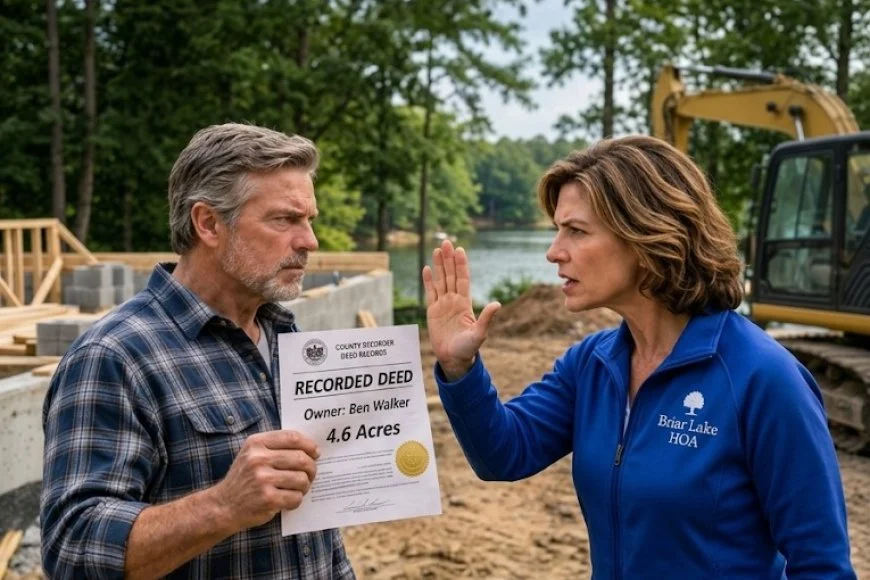
Her lawyer stepped in.
He correctly said that no one at the table should make unsupported accusations.
Sarah agreed.
So did I.
That was important.
We didn’t need exaggeration.
The documents were enough.
“I’ll consider a real purchase offer,” I said. “But show me you can pay. And I’m not signing anything that requires me to hide information from investigators.”
Susan stared at me.
“You’re being unreasonable.”
I thought about the fireplace I’d removed from my plans.
The lost concrete crew.
The buyers.
The sheriff.
“No.”
I folded the proposal.
“I’m asking you to prove what you’re selling.”
The offer was withdrawn days later.
No proof of funding ever arrived.
Sarah and I continued with the civil case.
The process was slow.
Requests.
Responses.
Title documents.
Old purchase proposals.
Company records.
Construction schedules.
Susan’s attorneys argued that Lake Crest had acquired development rights through earlier agreements.
Sarah asked them to produce the recorded instrument.
They couldn’t.
Meanwhile, investigators had started looking at the deposits.
Victor Hale, the HOA treasurer, had helped promote the cottages.
For months, he had reassured potential buyers that the project was moving forward.
Then Susan began blaming him for paperwork problems.
I ran into Victor at the courthouse one morning.
He was standing beside his attorney.
“Mr. Walker.”
“Victor.”
“I didn’t think this would get this far.”
“Eight families paid deposits for property your company didn’t own.”
His jaw tightened.
“Susan is telling everyone I handled the documentation.”
“Did you?”
“My lawyer says I shouldn’t discuss details.”
“Then listen to him.”
He hesitated.
Then said quietly:
“Susan has a way of making things sound like someone else’s responsibility.”
“I’ve noticed.”
Victor eventually cooperated with investigators through his attorney.
Whatever responsibility he carried would be handled separately.
I wasn’t interested in turning him into a hero simply because he became useful once the pressure reached him.
Late that summer, my civil case reached its decisive hearing.
Sarah had warned me not to expect drama.
Courts care about evidence.
Not speeches.
I liked that.
Susan sat with her lawyers.
No blue jacket this time.
No clipboard.
No sheriff standing behind her.
Just documents.
My deed was entered.
The recorded survey.
Title history.
Lake Crest’s failed purchase proposal.
The cottage brochures.
Susan’s claimed development materials.
Construction logs showed specific delays.
Invoices showed costs.
We didn’t pretend every inconvenience was worth money.
Normal construction expenses remained normal construction expenses.
That made the real losses easier to defend.
When I testified, Susan’s attorney asked whether I knew she had been negotiating with the previous owner before I bought the property.
“No.”
“If you had known, would that have changed your decision?”
“Only if she’d actually bought it.”
He paused.
“You’re aware development planning can take place before closing.”
“Of course.”
“You supervised construction.”
“For thirty years.”
“So planning does not establish ownership.”
“No.”
I almost smiled.
“That’s actually the point.”
The judge eventually issued the ruling.
My title stood.
Lake Crest had no established right to subdivide or sell cottage lots on my land.
The company could not interfere with my construction based on its internal development plan.
I recovered some documented costs.
Not everything.
Sarah had warned me that being right didn’t magically reimburse every dollar.
But the part that mattered most was clear.
My house no longer depended on Susan Blake’s version of reality.
Outside the courthouse, Sarah asked:
“How do you feel?”
“Tired.”
“That’s common.”
“I thought I’d feel victorious.”
“You might after lunch.”
I called Tom.
“Think you can get my crews moving?”
He laughed.
“I’ve been waiting for this call.”
“I’d like to finish before I’m ninety.”
“With your coffee, that’s optimistic.”
I hung up on him.
The buyers’ problem continued.
Their claims did not disappear simply because I won mine.
But something had changed.
They were no longer fighting one another.
They were looking in the same direction.
All eight families eventually exchanged documents through their attorneys.
And once their statements were compared, the contradictions became difficult to explain.
One buyer had been told acquisition was complete.
Another was told closing was imminent.
Another had been told ownership was already secured.
Deposits continued being accepted while Lake Crest still lacked title.
The criminal investigation focused on one critical issue.
Not whether Susan once hoped the development would happen.
She clearly did.
The question was what she knew at the time she accepted each buyer’s money.
Months later, the criminal case went to trial.
I attended portions of it.
Not because I wanted to watch Susan suffer.
I wanted to understand how a woman could stand on my construction site, call the sheriff, and act as if I was interfering with her property when the records said the opposite.
The prosecution built a timeline.
Negotiations with the previous owner.
Failure of the purchase.
Continued marketing.



