Buyer deposits.
Emails.
Representations.
Susan’s defense argued that she genuinely believed another acquisition opportunity would materialize.
The project, they said, had failed.
It had not been conceived as fraud.
That argument deserved consideration.
Bad business isn’t automatically criminal.
Failed projects happen.
Deals fall apart.
People make optimistic promises.
Then the prosecution showed a notice documenting that the earlier land purchase would not proceed.
After that date came another buyer deposit.
And another sales communication.
Then Rachel testified.
She described being told the property was secured.
Linda testified about using her husband’s life-insurance money.
Daniel described the representations made before his deposit.
Other buyers followed.
Not everyone had been told exactly the same story.
That became part of the problem.
Susan sat motionless.
The woman who had once spoken as though authority alone could settle questions was now sitting in a room where every claim required support.
The jury eventually returned guilty verdicts on fraud-related charges connected to the cottage sales.
The court later imposed its sentence and financial obligations.
Not every buyer immediately recovered every dollar.
Real life rarely ties money back into neat packages.
Some losses remained.
Other proceedings continued.
Victor’s responsibility was handled separately.
I did not pretend I knew every detail.
What I knew was simpler.
Susan could no longer sell my property.
And she could no longer tell the families who trusted her that the problem was the man building his own house.
Several weeks later, Mark Collins came back.
By then, the house had walls.
Windows.
A roof.
The porch was beginning to look like a porch instead of lumber on a drawing.
Mark stepped out of his truck.
“Ben.”
“Mark.”
He looked at the house.
“Coming along.”
“Slowly.”
He put his hands into his pockets.
“Rachel told me what happened in court.”
I nodded.
“I owe you an apology.”
I waited.
“I blamed you because you were right there.”
He looked toward the lake.
“Susan gave me somebody to be angry at.”
“I understood why you were angry.”
“That doesn’t make what I said right.”
“No.”
He nodded.
“We’re still trying to recover the deposit.”
“I’m sorry.”
“Yeah.”
He looked at the porch.
“I hope you enjoy the place.”
“Thanks.”
He held out his hand.
I shook it.
We didn’t become friends.
We didn’t go fishing.
But he drove away no longer believing I had stolen his summer home.
That mattered.
Susan had done enough damage without leaving everyone she hurt angry at one another forever.
Construction moved quickly after that.
The stone fireplace never came back into the budget.
Neither did the porch screens.
Those would wait.
But the house survived.
The old oak survived.
And so did the porch.
The first Saturday after I moved in, Emily arrived carrying pastries.
I was sitting outside with two mugs of coffee.
She stopped in the doorway.
“You actually finished.”
“Try sounding less surprised.”
“I’m impressed you beat ninety.”
“Tom has been talking to you.”
She laughed and sat beside me.
Then she saw the small wooden sign she’d given me.
DAD’S BAD COFFEE CORNER.
“You actually hung it.”
“Best room in the house.”
She took one sip.
Her face twisted.
“Dad.”
“What?”
“You fought an HOA president, went through a property lawsuit, survived months of construction delays, and built an entire lake house.”
“Correct.”
“How are you still this bad at making coffee?”
“Some skills require patience.”
“You’ve had fifty-nine years.”
“Then I’m close.”
For a while, we sat quietly.
No sheriff.
No lawyers.
No contractors waiting for instructions.
No strangers arriving with contracts for rooms I hadn’t built yet.
Just water moving against the shore.
The oak tree shifting in the breeze.
The same oak Susan had used to sell eight families a future.
Emily leaned back.
“Was it worth it?”
I thought about the money.
The legal fees.
The fireplace.
The screens.
The lost time.
The mornings I wondered whether I’d be better off selling the whole property and walking away.
Then I looked at the lake.
At my daughter.
At the porch I’d imagined for years.
“Every bit of it.”
She raised her mug.
“To Dad’s Bad Coffee Corner.”
I tapped mine against hers.
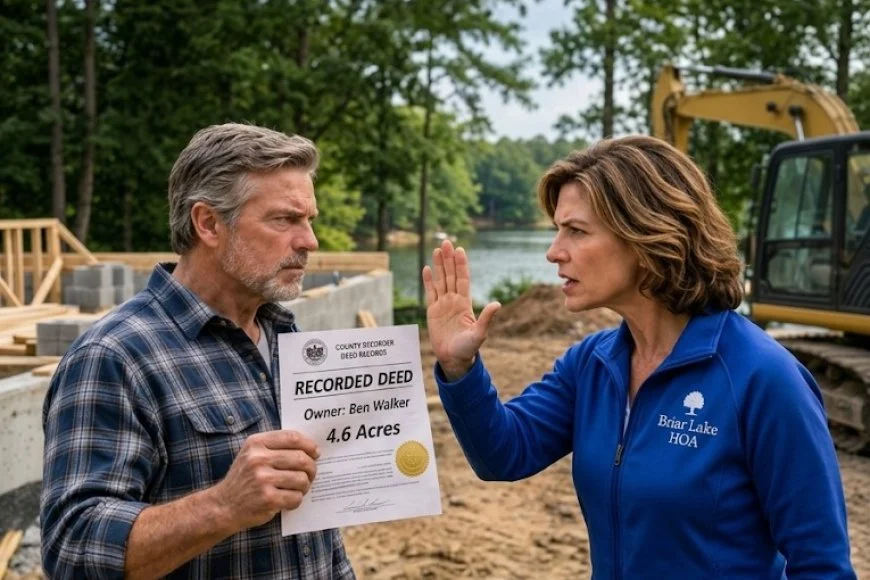
The morning Susan Blake came onto my land, she believed the right tone of voice, the right brochure, and the right HOA title could make her development plan more real than my deed.
For months, that confidence cost other people money.
It cost me time.
It cost eight families pieces of futures they thought they’d already bought.
But confidence isn’t ownership.
A brochure isn’t a deed.
And saying something is “approved” doesn’t make it yours.
Susan called the sheriff because I was building on land I owned.
Now the house is finished.
The porch faces the lake.
The oak tree is still standing.



