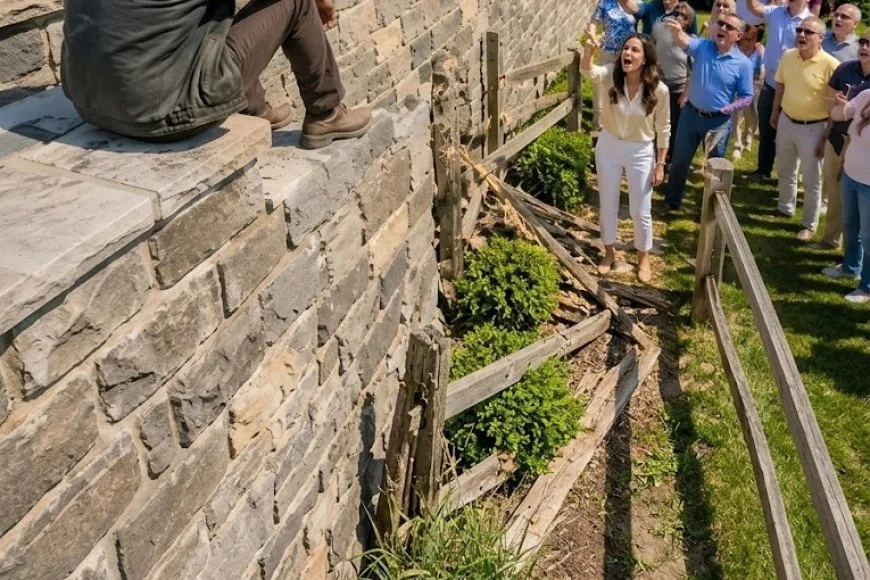
Brenda Castellano stood at the edge of my property with both hands on her hips and watched a crew cut down the fence I had built with my own hands.
By nine that morning, three hundred eighty feet of cedar lay stacked across my lawn like firewood.
She had promised me it would happen.
I just hadn’t believed she would be foolish enough to do it.
My name is Garrett Slade. I’m fifty-four years old, and I’ve spent most of my adult life building things that are supposed to outlast me. Stone walls. Chimneys. Foundations. Retaining walls carved into mountain slopes where one bad measurement can cost more than a truck.
I bought fourteen acres on Laurel Lake in western North Carolina twenty years ago.
My wife Ruth and I built our home there slowly.
Fieldstone exterior.
Chestnut porch beams.
River-rock chimney.
The lake sat below the Blue Ridge Mountains, green and still most mornings, with mist hanging over the surface before sunrise.
For nearly two decades, nobody bothered us.
Then Ridgeview Crest Estates appeared on the bluff north of my land.
One hundred forty-eight expensive houses.
Community pool.
Clubhouse.
Private streets.
And one very profitable promise.
The view.
Developers marketed Ridgeview Crest as a luxury lake-view community even though the lake itself belonged to nobody in the subdivision.
Their brochures used photographs taken over my land.
Premium lots along the southern ridge sold for tens of thousands more because buyers could see Laurel Lake.
Then residents began walking across my property as though the brochure had granted them access.
Families wandered down toward the water.
Teenagers used my dock.
One man actually told me, “The community ad says lakefront.”
I showed him my survey.
He left.
After several calls to the sheriff about trespassing, I installed a six-foot cedar privacy fence three feet inside my property line.
Trespassing stopped overnight.
Three weeks later, I received a letter from the Ridgeview Crest HOA.
It demanded that I remove the fence because it obstructed the community’s “protected visual corridor.”
There was one problem.
I was not in Ridgeview Crest.
My property predated the subdivision by decades.
The HOA had no recorded easement over my land and no covenant controlling my fence.
My attorney, Robert Kincaid, sent a simple response.
Private property.
Legal structure.
No HOA jurisdiction.
That should have ended it.
Then Brenda came to my house.
She was fifty-two, polished, controlled, and newly elected as HOA president. She had also worked in high-end real estate before moving to the ridge.
She brought sales reports.
“Three homes have reduced their asking prices since your fence went up.”
“That sounds like a real-estate problem.”
“It’s affecting families.”
“Families who bought a view across land they don’t own.”
Her expression hardened.
“You’re being unnecessarily difficult.”
“No. I’m being very specific.”
She closed her folder.
“You have no idea how uncomfortable this association can make things for you.”
I smiled.
“I’ve laid stone in August heat for thirty-four years. You’re going to need a better threat.”
Ruth watched Brenda leave.
“She’s not finished.”
Neither was I.
Five weeks passed.
Then Ruth and I drove to Asheville to visit our daughter.
At 7:22 that morning, my neighbor Callie called.
“Garrett, there are men cutting your fence.”
We were forty minutes away.
By the time we returned, the crew was gone.
Every cedar section had been removed.
Fresh sawdust covered the grass.
Post holes stood open along the entire property line.
My trail cameras recorded everything.
Workers.
Flatbed truck.
Chainsaws.
And Brenda.
She stood twenty feet away supervising.
At one point, after the final section came down, she walked the cleared line with her phone held up, photographing the restored lake view.
Then she smiled.
Ruth watched the footage once.
“She knew exactly what she was doing.”
“Yes.”
“What now?”
I looked uphill toward Ridgeview Crest.
For the first time since the subdivision was built, their entire southern view was open again.
My house.
My garden.
My dock.
My lakefront.
Everything.
“I build something they can’t cut down.”
Ruth looked at me.
“Stone?”
“Stone.”
But before I touched a single block, I wanted to know why an HOA president would risk thousands of dollars tearing down a legal fence on property outside her association.
Aesthetic complaints did not explain it.
Money did.
Public business records showed Brenda had an ownership interest in a small real-estate referral company connected to the agency handling many Ridgeview Crest resales.
The highest commissions came from the homes marketed with premium lake views.
My fence had reduced the value of Brenda’s most profitable selling point.
Then one HOA resident, a retired accountant named Frank Novak, began asking questions about association spending.
He found two payments that concerned him.
Fourteen thousand dollars for “view corridor restoration.”
That was my fence.



