That distinction mattered.
Brenda’s real-estate activities also came under professional review because clients and regulators wanted to know whether conflicts and neighborhood disputes had been properly disclosed in transactions.
I never learned every detail.
Nor did I need to.
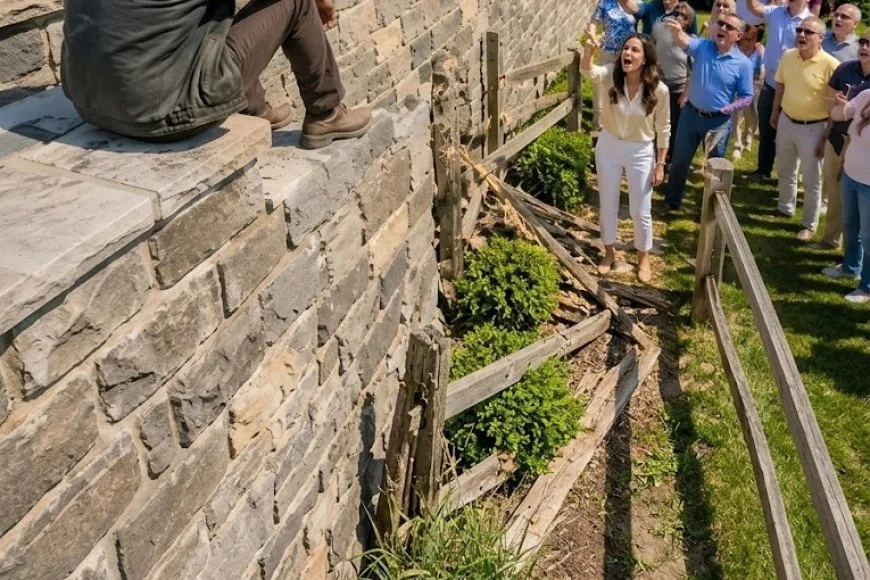
By then, the outcome I cared about was already standing three hundred eighty feet long and twenty feet high.
Nobody was walking through my garden anymore.
Nobody was fishing from my dock.
Ruth could work in her wildflowers without strangers taking photographs twenty feet away.
Our home was private again.
Ridgeview residents were less enthusiastic.
Several view-lot owners put their homes on the market.
Listings changed quickly.
“Panoramic lake view” disappeared.
Agents started using phrases like “mountain setting,” “private rear environment,” and “wooded community character.”
I almost admired the creativity.
One homeowner named Michael Harris came to see me in early spring.
He owned one of the houses closest to the wall.
I expected anger.
Instead, he stood beside my driveway with both hands in his jacket pockets.
“I owe you an apology.”
“For what?”
“When we bought, I assumed access to that view was part of the property.”
“The developer marketed it that way.”
“I know that now.”
He looked toward the stonework.
“My wife hates the wall.”
“I figured.”
“I do too.”
“Fair.”
That made him smile.
Then he said, “But I understand why it’s there.”
That meant more to me than someone pretending to love it.
Over time, Ridgeview rebuilt its board.
Frank refused to become president.
That was probably evidence he was qualified.
Instead, he agreed to serve as treasurer for one year while new financial controls were created.
Related-party transactions had to be disclosed.
Large expenditures required more than one officer’s approval.
Outside-property projects required ownership verification before money could be spent.
Legal counsel had to review any proposal affecting land outside Ridgeview.
Residents also forced the board to clarify something the developer should have made obvious from the beginning:
Lake views were views.
Not property rights.
Not access rights.
Not guarantees.
A person could buy a house overlooking a mountain, field, forest, or lake without owning what happened on the land below.
That sentence eventually appeared in updated resale disclosures.
I considered it the most valuable thing the whole dispute produced.
Ruth and I did one more thing with the wall.
At first, I had planned to leave the Ridgeview side plain forever.
Then Ruth asked me a question.
“Do you really want your best work to have an ugly side just because you’re angry at people you don’t know?”
I hated that she was right.
Most Ridgeview residents had never cut my fence.
Some had supported Brenda.
Many had simply bought houses and believed the marketing.
So the following summer, I finished the upper visible sections with a simpler stone treatment.
Not as elaborate as my side.
But respectable.
No insult.
No message.
No giant sign telling anyone what Brenda had done.
The wall did not need to shout.
Its existence already told the story.
I installed one small bronze plaque near the gate on my side.
**SLADE STONEWORKS**
**BUILT TO PROTECT WHAT WAS ALREADY HERE**
Ruth read it twice.
“Better than the other phrase you wanted.”
I pretended not to know what she meant.
She knew I had originally considered something much less polite.
Years passed.
The granite weathered naturally.
Moss appeared near the shaded base.
Birds began landing on the capstones.
The wall became part of the property the same way the cottage and chimney had.
People eventually stopped driving past just to look at it.
That was when I finally liked it most.
Not when it was famous.
When it became ordinary.
Brenda moved away from Ridgeview.
I heard different stories about what happened afterward.
Some said she returned north.
Some said she stayed in real estate under another brokerage.
Some said the financial investigation ruined her career.
I never checked.
There comes a point where knowing what happens to the person who hurt you stops being justice and starts becoming a hobby.
I had better hobbies.
One autumn evening, I sat on the dock with Ruth while the sun dropped behind the mountains.
The lake turned orange.
The water was so still the reflection looked almost solid.
From Ridgeview Crest, nobody could see it.
For a long time, that fact had felt like victory.
That evening, it felt different.
The lake had never existed for them to see.
It had never existed for me to hide.
It simply existed.
The real problem had never been the view.
It had been the belief that looking at something long enough gave you a claim over it.
Brenda thought property value created authority.
The developer thought marketing language created entitlement.
Some buyers thought paying a premium meant somebody else’s land had to remain frozen forever.



