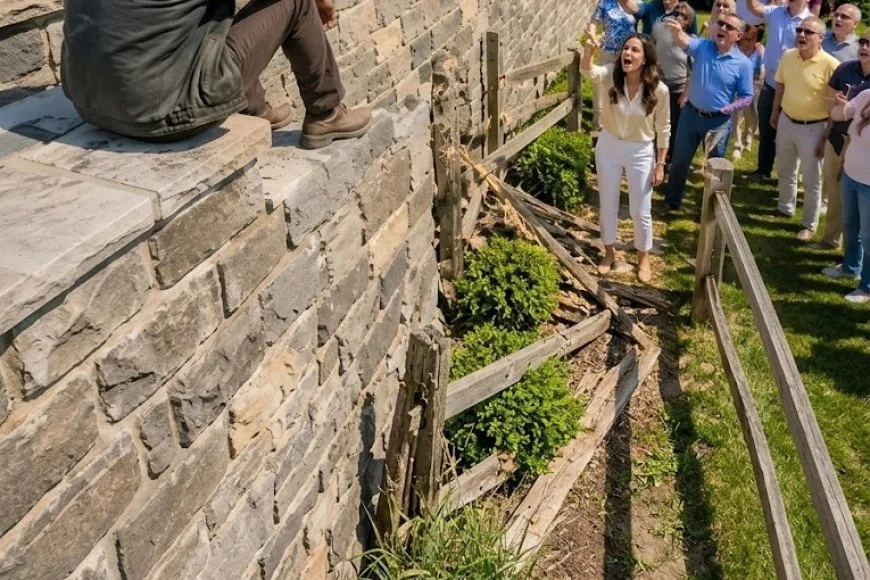
The view they had paid extra for ended at my property line.
I did not celebrate when the final stone went in.
I was proud of the work.
That was different.
Ruth stood beside me when we finished.
“You happy?”
“With the wall?”
“With all of it.”
I looked uphill.
“No.”
She nodded.
“Good.”
That surprised me.
“Good?”
“If destroying her makes you happy, then she still owns too much space in your head.”
Ruth had a talent for saying something in twelve words that took me three weeks to understand.
The next Ridgeview HOA meeting drew almost every homeowner.
Frank had requested time on the agenda to discuss association finances.
Brenda sat at the front beneath a projection screen, dressed like she was preparing to close a luxury sale.
She began with an update about the wall.
The association had exhausted its immediate legal options.
No recorded view easement existed.
The county permit remained valid.
The structure stood entirely on my property.
Then Frank stood.
“I’d like to discuss why association money was used to remove Mr. Slade’s fence.”
Brenda tried to redirect him.
“We’ve already covered that matter.”
“No,” Frank said. “We covered the view dispute. We didn’t cover your financial interests.”
The room changed.
He projected business-registration records showing Brenda’s involvement in a referral company connected to the brokerage handling multiple Ridgeview transactions.
Then he displayed sales information from the southern ridge.
Those homes had been marketed heavily around the lake view.
Brenda had received referral income connected to some resale activity.
Not every transaction.
Not every premium dollar.
But enough to make one question unavoidable.
Had the HOA president spent association funds to improve a selling feature that benefited her private business?
Brenda said her real-estate work had always been separate from HOA decisions.
Then Frank displayed the marketing-consultation payments.
A homeowner near the front raised her hand.
“Did you disclose your connection before the board approved these expenses?”
Brenda paused.
“I disclosed my professional background.”
“That wasn’t the question.”
Another resident spoke.
“Did the board know you could earn money from home sales benefiting from the lake view?”
Brenda’s attorney, sitting beside her, whispered something.
She stopped answering.
Then the trail-camera video played.
I had given Frank permission to use it.
The screen showed the fence crew arriving.
The chainsaws.
The cedar falling.
Then Brenda walking the cleared property line, photographing the view.
Nobody needed commentary.
The video was bad enough.
Finally, Frank played the recording of Brenda offering me money to stop the wall.
Her voice filled the clubhouse.
“Fifty thousand. Seventy-five. Name your price.”
Someone in the back asked, “Whose money was that supposed to be?”
Brenda immediately said it would have been private money.
That may have been true.
But by then, the residents were no longer focused on one offer.
They wanted a complete audit.
They wanted to know which transactions had been disclosed.
They wanted to know why fourteen thousand dollars of association reserves had been spent demolishing a legal structure outside HOA property.
They wanted to know who approved the contractor.
They wanted to know whether legal counsel had warned the board beforehand.
Most importantly, they wanted to know why Brenda had never told them how closely her real-estate income depended on the view she had used their money to restore.
The vote to remove her as president passed overwhelmingly under the association’s procedures.
There was no dramatic applause.
Some residents looked angry.
Others looked embarrassed.
Several looked genuinely betrayed.
Frank later told me that was the part people outside HOA disputes rarely understood.
When bad leadership collapses, a neighborhood does not automatically feel victorious.
People feel stupid for trusting.
They worry about money.
They worry about lawsuits.
They wonder whether they missed obvious warning signs.
The new temporary board ordered an outside financial audit.
That audit took months.
It did not produce the cartoonishly simple story people wanted.
Not every contract was corrupt.
Not every real-estate payment was improper.
Some HOA projects had been legitimate and well documented.
But the auditors found serious governance failures.
Conflicts had not been properly disclosed.
Certain expenses lacked adequate authorization records.
The fence demolition had been approved using broad “view restoration” language even though the HOA had no property right over my land.
Payments to connected vendors required further review.
Those findings went to insurers, attorneys, regulators, and local authorities where appropriate.
My dispute with the HOA settled separately.
The association acknowledged that my fence had been removed without legal authority.
Its insurer covered part of the property damage after reviewing the circumstances, while other costs were resolved between the responsible parties.
I received compensation for the destroyed cedar fence and related expenses.
I did not demand that Ridgeview pay for the granite wall.
That was mine.
I chose to build it.



