Another eighteen thousand dollars for “community marketing consultation” paid to a real-estate company connected to Brenda’s business partner.
Robert studied the documents.
“This is no longer just about your fence.”
I looked at him.
“What do you think I should do?”
“First, preserve everything. Second, let the financial records go through proper review.”
“And third?”
He already knew the answer.
“You’re still planning to build that wall.”
I unfolded a survey.
“Twenty feet.”
Robert stared at me.
“Garrett, that’s not a fence.”
“No.”
I pointed to my zoning classification.
“Accessory walls are permitted with engineering and county approval up to the applicable height limit.”
“You’ve checked?”
“I’m checking everything.”
Ruth leaned over the kitchen counter.
Robert sighed.
“Please tell me you’re not doing this just to punish her.”
I looked through the window at the pile of cut cedar.
“No.”
Then I looked toward the ridge above it.
“I’m doing it because I’m never letting anybody decide again that privacy on my land is optional.”
Nine days later, the county approved the engineered plans.
Ninety-two tons of native granite were ordered.
And when the first truck pulled onto my property, Brenda finally realized the fence she destroyed had been the cheap version…
The wall started with a four-foot-deep reinforced footing running three hundred eighty feet inside my property line.
By day four, the concrete-block core was high enough for Ridgeview residents to understand what was happening.
Brenda called county code enforcement.
The inspector checked my permit, setbacks, drainage plan, engineering drawings, and property survey.
Everything passed.
She complained again.
Same result.
Then the HOA asked a judge to stop construction, arguing that I was building a structure solely to damage neighborhood views.
Robert answered with the trail-camera footage of Brenda supervising the destruction of my cedar fence, trespassing complaints from the previous year, and the approved privacy-wall plans.
The court refused to halt construction.
After that, the wall climbed quickly.
Six feet.
Ten.
Fourteen.
By sixteen feet, the lower ridge homes could no longer see Laurel Lake.
Then Brenda came down alone.
No board members.
No attorney.
No clipboard.
She looked exhausted.
“How much?”
I set down my trowel.
“For what?”
“To stop.”
I stared at her.
“Fifty thousand. Seventy-five. Name it.”
Ruth had told me months earlier to record any future conversation with Brenda on my property when lawful to do so.
My phone was already running.
“I’m not selling you a view.”
“You’re destroying people’s property values.”
“You sold them something you never owned.”
She looked up at the unfinished wall.
For the first time, Brenda seemed to understand that money could not reverse what she had started.
She walked back to her car.
I stopped the recording.
Then Frank called.
“Garrett, you need to see the latest HOA statements.”
The real-estate payments were not isolated.
There were more.
And this time, the money trail led directly back to Brenda…
Part 3
Frank brought the records to my workshop that evening in a cardboard file box.
He had spent thirty years auditing businesses before retiring, which meant he had the irritating habit of refusing to call anything fraud until he could trace every number.
I liked that about him.
He spread bank statements, contracts, invoices, and board approvals across my workbench.
The fourteen-thousand-dollar payment for removing my fence was real. The HOA had categorized it as “view corridor restoration.”
The eighteen-thousand-dollar consulting payment was real too.
But Frank had found additional smaller payments tied to promotional work, resale materials, photography, and “market positioning.”
Some went to vendors with legitimate reasons to be paid.
Others eventually flowed toward businesses connected to Brenda’s real-estate network.
“It’s messy,” Frank said.
“Illegal?”
“I’m not saying that yet.”
Robert nodded from the other side of the bench.
“Good.”
Frank pointed at one invoice.
“What I am saying is the board was never clearly told Brenda had a financial connection to some of these transactions.”
That mattered more than any dramatic accusation.
Conflict of interest.
Failure to disclose.
Association money used on work that directly benefited a board officer’s outside business.
Those were facts that could be investigated.
Robert sent the records to the appropriate parties and advised Frank to request a formal independent audit through the HOA’s governing process.
Meanwhile, I kept building.
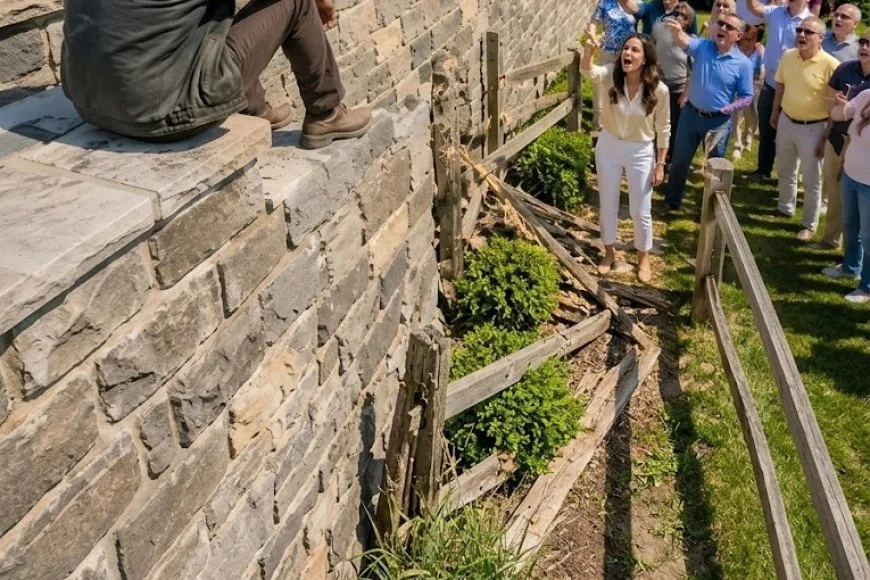
The wall reached twenty feet in late October.
On my side, I faced it with native Blue Ridge granite.
Gray.
Silver.
Pale blue.
I laid each section by hand with my crew.
Three stone arches opened toward Ruth’s garden and my workshop.
A polished capstone ran along the top.
From my property, it looked like part of the mountain had risen out of the ground.
From Ridgeview Crest, residents saw smooth reinforced masonry.
Nothing else.
No lake.
No dock.
No garden.
No sunset reflected in the water.



