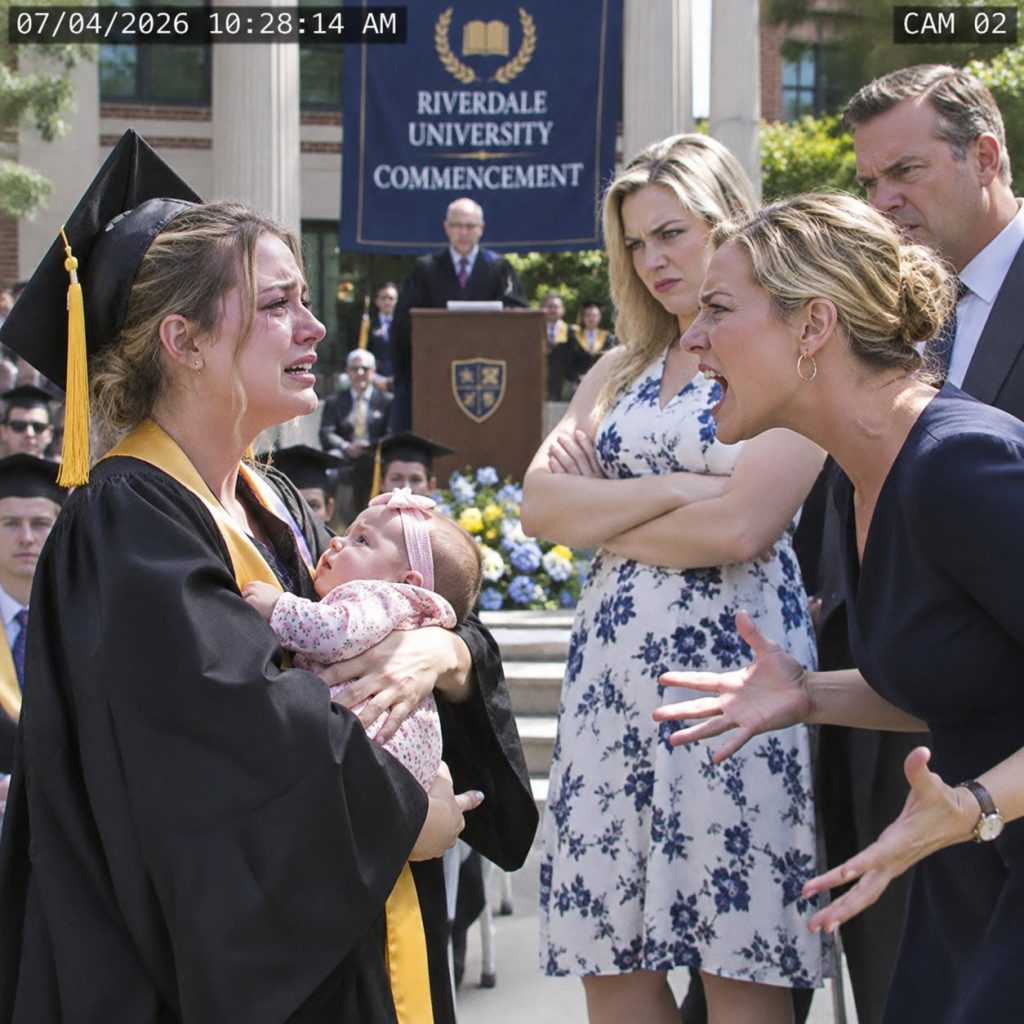
Vance lowered his arm slowly. His eyebrows, thick and tangled like thistle bushes, pulled together until they formed a single horizontal line of white bristles.
“Where did you take your introductory sequence, Miss Bennett?”
“Dual-enrollment through the Huron Community College extension at the county vocational annex,” I said. “Textbook was Loudon’s Sixth Edition. We didn’t have molecular modeling kits, so our teacher had us build the conformations out of copper wire and commercial fish-hooks from the marina.”
A girl in the fourth row gave a short, nervous laugh that died instantly when Vance turned his glare toward the tiers.
The professor walked three paces toward my desk, his boots white with chalk dust, his head tilted as if he were re-evaluating the specific gravity of an unknown compound.
“Copper wire and fish-hooks,” he murmured, more to himself than to the hall.
“Yes, sir,” I said. “The barb on an Eagle Claw number four hook is precisely twenty-four degrees off the shaft. It mimics the dihedral angle of a gauche butane interaction if you bend the shank three millimeters north of the eyelet.”
Professor Vance stared at me for five seconds. Then he turned back to the slate board, brought his chalk down with a single, massive crack that split the yellow stick in two, and began drawing a secondary reaction mechanism that stretched across three panels of slate.
“Take your seat, Miss Bennett,” he said, not looking back over his shoulder. “And ensure you are in the advanced synthesis laboratory at one o’clock this afternoon. I have eight hundred liters of contaminated solvent that needs fractional distillation, and my graduate assistants are apparently incapable of reading a reflux thermometer without a digital interface.”
I sat down.
The varsity swimmer didn’t look at me again. He shifted his iPad three inches to the left, his ears bright red beneath his clean brown hair, while I pulled out my eight-dollar legal pad and began recording the mechanism in blue ballpoint ink that smelled of dry paper and morning work.
Chapter 6 – The Long Nights in Building C
July on the prairie was an entirely different beast from July on the lake.
There was no water to swallow the heat. The temperature sat at ninety-four degrees from noon until nine at night, baking the black asphalt of the bypass until the tar bubbled in the seams like fresh grease. The corn in the experimental plots behind Building C grew four inches a day, its broad, waxy leaves rustling with a dry, papery hiss that sounded like hundreds of people whispering behind a partition wall.
In Apartment 104, the air conditioning unit was an ancient Gibson wall-box that rattled like a tractor engine whenever the compressor kicked in, throwing a thin, lukewarm stream of air that smelled of wet dust and moldy fiberglass.
It was two-thirty in the morning.
Nora lay across my lap on an unzipped cotton pillowcase, her skin hot and damp against my thighs, her breathing congested with the summer croup that had swept through the university daycare center two days earlier. Every twenty minutes, she would wake with a dry, barking cough that shook her whole five-month-old body, her small hands clawing at the neck of her onesie, her eyes wide with that sudden, blind terror that infants get when their airways narrow.
I didn’t turn on the overhead light.
On the folding desk beside the crib, balanced between an open copy of Lehninger’s Principles of Biochemistry and a stack of enzyme kinetic problem sets, sat a small blue desk lamp fitted with a seven-watt nightlight bulb.
I had an ice cube wrapped in a washcloth in my left hand, smoothing it over Nora’s forehead, while my right hand held a three-color pen, calculating the Michaelis-Menten velocity curves for an allosteric inhibitor:
v=V[S]Km1+[I]Ki+[S]
My head throbbed with that dull, rhythmic ache that comes from forty-eight hours of broken sleep—an ache that sat right behind the bridge of my nose, making the black numbers on the graph paper blur into gray smudges that looked like schools of minnows in murky water.
Nora coughed again—a sharp, croupy bark that ended in a ragged, whistling gasp.
“Easy, baby,” I whispered, lifting her until her chin rested on my shoulder, my hand patting the small of her back with that rhythmic, four-count stroke my mother had used on me during the winter of twenty-ten. “Breathe the cool air, Nora. Just breathe.”
A heavy knock sounded on the wall.
Not the door. The shared plasterboard partition between my apartment and 106—the unit occupied by a doctoral candidate in agricultural economics named Miller, whose fellowship depended on finishing his dissertation on corn-futures hedging before the fall term.
Thump. Thump. Thump.
“Quiet in there!” a muffled voice shouted through the three-inch drywall. “Some of us have oral defenses at eight AM! Read the lease regulations!”



