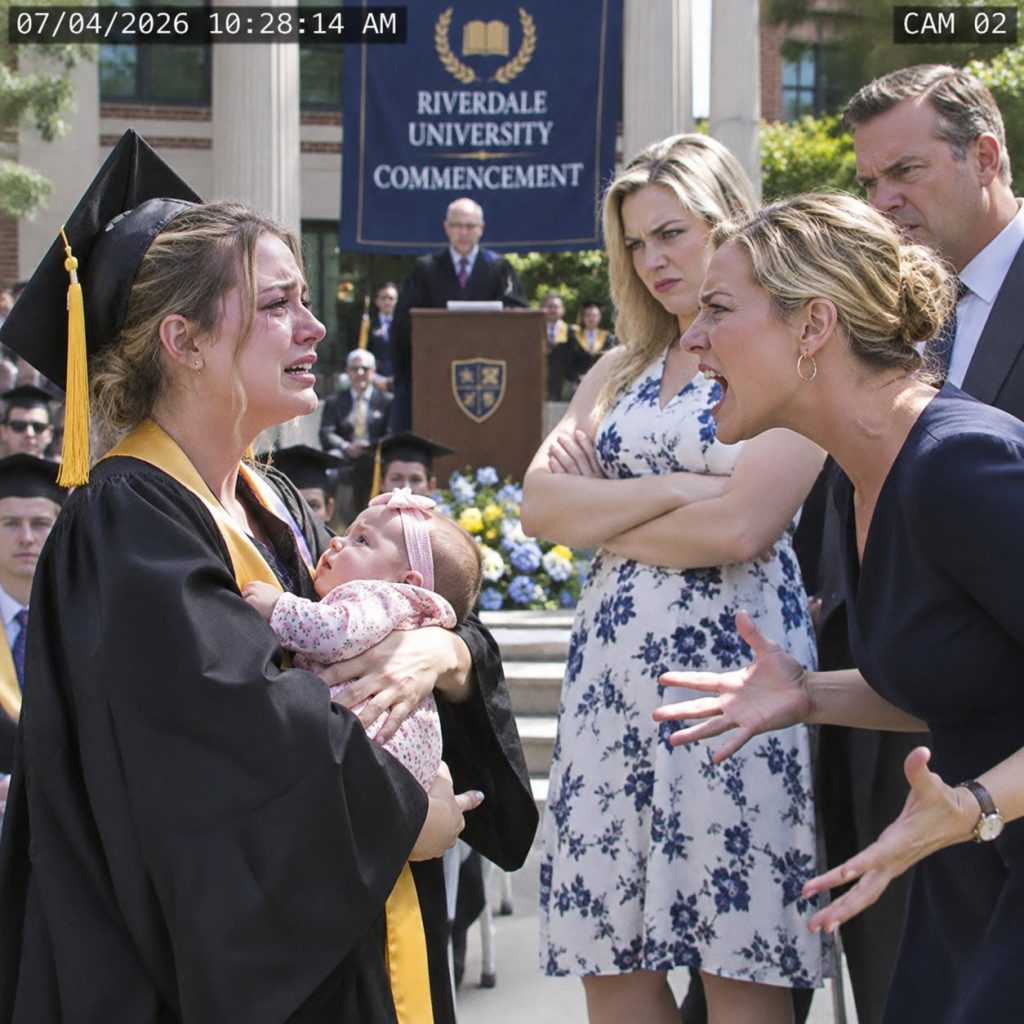
Nora stiffened against my neck, startled by the violence of the vibration against the plaster, and let out a high, thin wail that cut through the room like a whistle.
I stood up.
My knees clicked—that same dry, unhealed pop in the left patella. I walked to the bathroom, turned the brass taps on the clawfoot tub all the way to hot, and pulled the brittle plastic curtain shut until the small, windowless space filled with thick, white steam that smelled of cedar shavings and hot iron.
I sat on the edge of the tub with Nora tucked inside my shirt, her face exposed to the moist vapor, her little lungs drinking in the wet heat until the barking cough slowed, softened, and finally subsided into a long, shuddering sigh.
I looked at the bathroom wall.
Taped to the medicine cabinet mirror was a postcard Clara had sent two weeks ago. It was a photograph of the harbor at sunrise—the old wooden breakwater, the rusted light tower, and two green gill-netters heading out toward the shoals through the morning chop.
On the back, written in Clara’s sharp, uneven handwriting with a purple felt-tip marker from the diner cash register, were three sentences:
The west slip is empty.
David Vance had to sell the trawler to pay his father’s medical liens in Saginaw.
Don’t you come home until they call you Doctor.
I pulled Nora closer against my collarbone. Her skin was cooler now, the fever breaking under the steam, her tiny fingers tangling into the silver chain of the medal my grandmother had given me for my confirmation.
“We aren’t going home, Nora,” I told the mirror, my voice flat, steady, stripped of all tiredness. “There’s nothing back there except eighty miles of cold water and two old men fighting over an empty dock.”
I carried her back into the twelve-foot room, sat down at the folding desk, picked up my three-color pen, and finished the derivation of the Lineweaver-Burk equation before the streetlamps outside the window flickered off in the gray prairie dawn.
Chapter 7 – The Midsummer Review
By the first week of August, the Carter Fellowship committee conducted what was known in the university registry as the “Midsummer Progress Audit”—an academic review designed to eliminate students who had failed to maintain the three-point-eight grade point average required for the second-semester disbursement.
The conference room on the fourth floor of the Administration Tower was chilled by central air conditioning to a crisp sixty-five degrees.
The three committee members sat behind an eight-foot slab of polished white ash that reflected their leather-bound portfolios like ice:
Dr. Aris Thorne, the dean of undergraduate studies—a small, bald man with gold-rimmed spectacles and the dry, precise manner of an actuary;
Dr. Margaret Chen, the chair of the biology department—a woman of sixty who had discovered two strains of nitrogen-fixing bacteria in the Amazon basin and had never been known to smile in the presence of an undergraduate;
And Professor Klaus Vance, who sat at the far end of the table with his tweed jacket unbuttoned, his chalk-stained fingers crossed over his stomach, his eyes half-closed as if he were catching up on sleep he had lost in the laboratory.
I sat in a low, black-leather swivel chair on the visitor’s side of the desk.
I wore my periwinkle linen dress—the one Clara had bought from the consignment rail—ironed flat with the hand-iron from the communal laundry room in Building C, my hair pinned back into a neat knot with two tortoiseshell combs I had bought at the university pharmacy for three dollars.
Nora was not with me; she was in the education building with Mrs. Gable’s niece, who had taken over the afternoon shift at the daycare center after discovering that my notes on cellular respiration were worth twelve hours of free infant care a week.
Dean Thorne turned a page on my file.
“Miss Bennett,” he said, his voice quiet, dry as shredded wheat. “Your academic performance for the summer session is… statistically anomalous.”
I kept my hands folded in my lap, my ankles crossed beneath the leather chair. “Anomalous in what direction, Dean Thorne?”
“You are currently enrolled in nineteen credit hours,” Dr. Chen said, her pen tapping a line on my transcript. “Your grade in Advanced Organic Chemistry is ninety-eight point four percent. Your laboratory evaluation in Cellular Physiology is the highest recorded by an undergraduate since twenty-sixteen. And your calculus instructor noted that you submitted two optional proofs regarding non-linear differential equations that were typically reserved for graduate seminars.”
“The texts were available in the departmental reserve collection,” I said. “I had the four-to-six AM shift while the child was sleeping.”
Dean Thorne leaned back in his chair, his spectacles catching the glare of the recessed LED panels above our heads.



