“What is this place, Ivy?” Dr. Morales asked gently, pointing to the drawing.
Ivy looked up at me, a brilliant, secretive smile spreading across her face.
“That’s Estes Park,” Ivy said. “That’s Mom’s cabin. Dad and I are going to fix the porch this summer.”
“We are,” I confirmed, smiling back at her. “Grandpa Howard already ordered the cedar planks.”
In April, we sold the Lafayette house.
We didn’t want the equity; we didn’t want the memories. We sold it to a young family from Oregon who fell in love with the garden, and we used the proceeds, along with the recovered restitution from Marlene, to buy a 1920s craftsman bungalow on a tree-lined street in Old Town Longmont, three blocks away from Andi’s house and an eight-minute walk from Beverly and Howard’s farm.
The new house had wide, creaking fir floors, a massive covered front porch with a porch swing built for three people, and an attic bedroom with a skylight that looked directly up at Longs Peak.
We painted the front door bright sunflower yellow.
We spent our weekends at the Estes Park cabin with Howard and Andi’s family, clearing overgrown scrub pine, repainting the weathered trim, and replacing the rotting boards on the dock where Natalie had learned to fish when she was a little girl.
Ivy blossomed. The fragile, sparrow-like stillness that had terrified me on Christmas morning vanished. She grew two inches; she joined the school soccer team; she took up watercolor painting with a ferocity that covered every wall of our new kitchen with splashes of vivid cobalt, emerald, and gold.
She stopped asking if she was in the way. She stopped asking if she had permission to be happy.
One evening in late October, as the first autumn frost was turning the cottonwood leaves along the St. Vrain into gold coins, I came home from a ten-hour shift at the hospital.
I walked up the stone path to our yellow door.
Through the large, uncurtained living room window, I could see my father sitting in an armchair, reading a carpentry magazine, while Beverly stood at the stove stirring a pot of potato-leek soup.
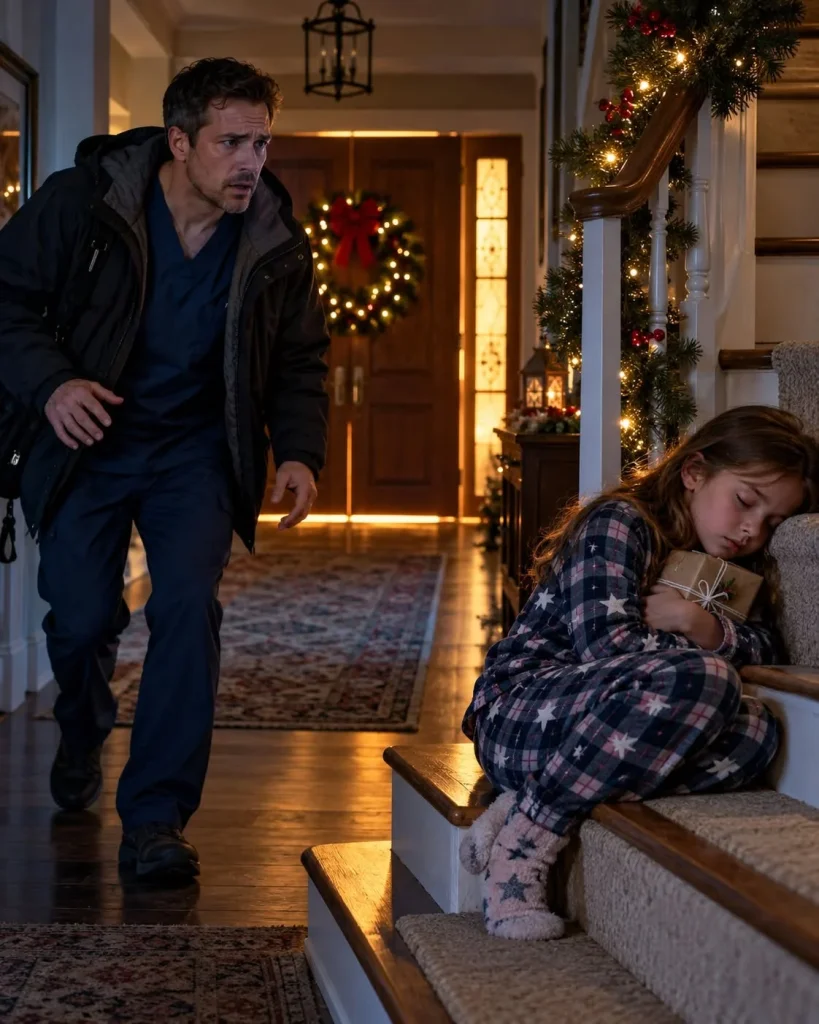
Sitting on the bottom step of our wide wooden staircase was Ivy.
She wasn’t curled into a ball. She wasn’t asleep. She was wearing mismatched neon socks, her knees pulled up comfortably, working on a complex charcoal sketch of a red-tailed hawk.
On the third step sat two thick ceramic mugs, with cocoa mix already measured into the bottom, waiting for the hot milk.
When the front door opened, Ivy looked up.
Her whole face lit up with a brilliant, unconditional light that made my chest expand until I felt like I could fly.
“Dad!” she yelled, dropping her sketchbook onto the stair and leaping to her feet.
She didn’t wait. She ran across the hardwood floor, launched herself into the air, and threw her arms around my neck. I caught her smoothly, swinging her around in a circle while she laughed, her dark curls whipping across my forehead.
“You’re late,” she declared, poking my nose. “By four whole minutes.”
“Trauma Bay Two was backed up, star,” I whispered into her hair, holding her tight, breathing in the scent of cedar, clean soap, and autumn air. “But I told you: I always come back.”
—
Chapter 10 – The Cocoa on the Porch
Wednesday, December 25, 2025. Exactly one year later.
The morning sun rose over Longmont like a slow, golden promise, shattering across eight inches of fresh, pristine snow that had fallen silently through Christmas Eve. The world outside our craftsman bungalow was dazzling, blindingly white against the impossible cobalt blue of the Colorado sky.
I woke up at six-thirty.
For the first time in seven years, I was not coming off a night shift. I had traded two holiday rotations in July so that I could have forty-eight unbroken, sacred hours at home with my daughter.
The house was completely, beautifully quiet, but it was not the suffocating silence of Lafayette. It was the soft, breathing silence of a home that was safe.
Downstairs, the floorboards gave a familiar, gentle creak as I walked toward the kitchen.
The kitchen was already warm. The radiator beneath the window hissed softly, releasing steady, dry heat. On the counter sat the two ceramic mugs—one marked *World’s Okayest ER Doctor*, a joke gift from Andi, and the other hand-painted with blue forget-me-nots that Ivy had made at a local pottery studio.
I measured the whole milk into the small copper saucepan, turned the gas flame to low, and stood by the stove, watching the steam begin to curl off the surface.
“Dad?”
I turned.
Ivy was standing in the archway of the kitchen. She was eleven now, her legs long and gangly in her flannel pajama pants, her dark hair tumbling over her shoulders in wild morning curls.



