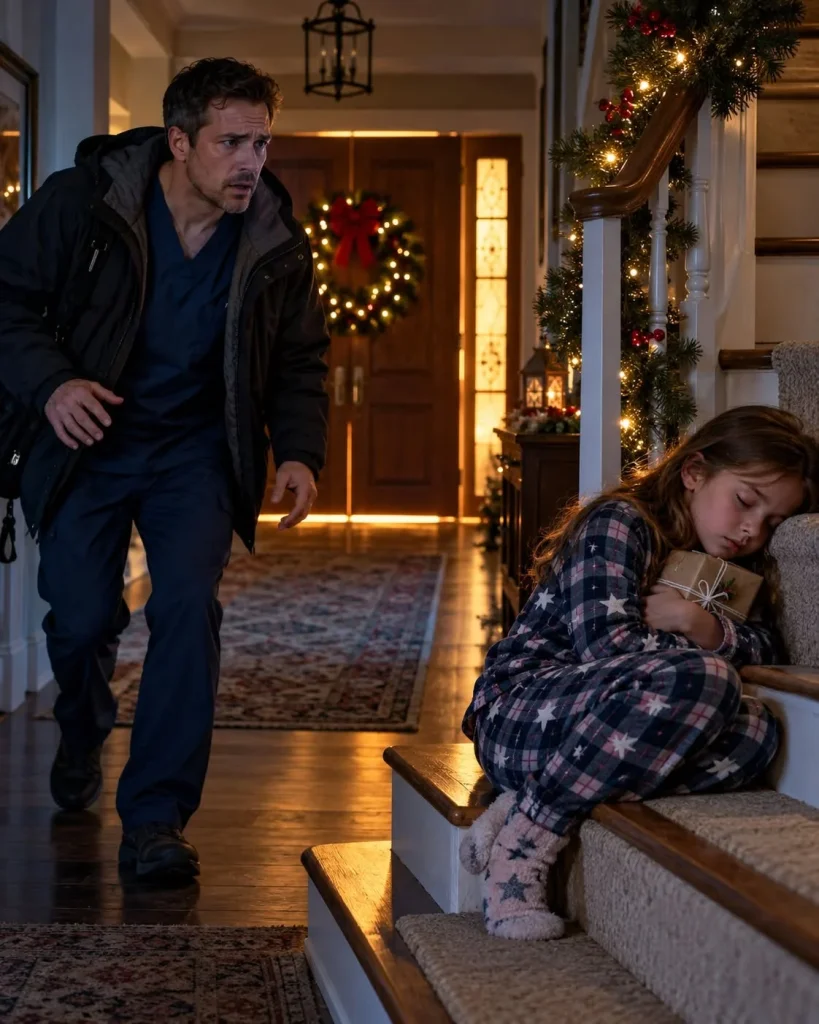
Marlene’s skin mottled with red patches along her throat. She thrust the silver box toward me, as if using it as a shield. “I did not *lock* her out! It was an accident if the latch caught! Why are you doing this right now? On Christmas morning? In front of the children?”
From inside the living room, Forrest’s console chimed a cheerful 8-bit fanfare, completely oblivious. Coral, however, stood up. She let the discarded wrapping paper slide off her lap and stood near the doorway, her hands nervously picking at the hem of her oversized holiday sweater.
“Mom…” Coral muttered, her voice trembling. “You told her she couldn’t come in until eight. You told her to wait on the stairs.”
Marlene whirled around, her eyes flashing with a sudden, vicious panic. “Coral, go back to your brother. Right now.”
“No, Coral, stay right there,” I said, holding out a single hand. Coral looked at me, her eyes brimming with tears. She wasn’t a bad kid. She was twelve, caught in the tractor beam of a mother who treated love like a finite currency to be hoarded and traded. “Did your mother tell Ivy she couldn’t come in?”
“Peter, stop interrogating my daughter!” Marlene shrieked, dropping the silver box onto the hall runner. The impact made a hollow *thud*. “You do not get to come in here after an overnight shift, smelling like antiseptic and exhaustion, and play the righteous martyr! I manage this house! I have kept this family running while you play hero in the ER sixty hours a week! If I made a scheduling mistake on Christmas morning because I was trying to manage three over-stimulated kids, you don’t get to treat me like a criminal!”
“A scheduling mistake?” I laughed, a short, ugly sound that startled even myself. “You told my motherless daughter that she should be grateful she has a bed to sleep in because some children don’t have houses on Christmas.”
Marlene stopped. The color drained from her cheeks, leaving behind a waxy, sickly gray. She glanced down at Ivy, whose small face was pressed firmly into my hip, refusing to look at her.
“I… that was context,” Marlene stammered, the smooth facade finally splintering into jagged pieces. “She was whining, Peter. She was banging on the glass. Forrest was having a sensory overload from the noise. I told her that she needed to have perspective. It was a teaching moment about gratitude!”
“You taught her, all right,” I said, bending down smoothly to pick up the two duffel bags with my right hand, keeping my left firmly wrapped around Ivy’s trembling fingers. “You taught her that in this house, she is a second-class citizen. You taught her that her grief is an inconvenience, her presence is tolerated, and her place is on the other side of a locked door.”
“Where do you think you’re going?” Marlene moved to block the front door, her arms outstretched, her emerald robe billowing like the wings of a predatory bird. “Peter, put those bags down! It is Christmas Day! My parents are driving in from Fort Collins at noon! We have a prime rib in the refrigerator! You are not walking out of this house and making a scene!”
“The scene is already made, Marlene. You set the stage at six o’clock this morning.”
“If you walk out that door, we are done!” she screamed, her voice hitting that shrill, piercing register that bounces off drywall. “Do you hear me? You walk out on your wife and your stepchildren on Christmas morning, and there is no coming back! I will tell everyone what you did! I will tell the hospital board! I will tell our neighbors that you had a psychotic break after a shift and abandoned your family!”
I looked at the woman I had married three years ago.
When Natalie died of metastatic breast cancer four years prior, I had been an empty shell walking through a gray world. Marlene had appeared in my life eighteen months later like a blast of primary colors—vibrant, decisive, organizing my chaotic pantry, bringing home-cooked meals to the hospital, telling me that Ivy needed a mother’s touch and that blending our families would give Ivy the siblings she never had.
I had been so desperate to give my daughter a whole world again that I had ignored the subtle erosion of Ivy’s space. The way Natalie’s photographs had slowly migrated from the living room mantel to the upstairs hallway, then into storage boxes in the basement. The way Ivy’s bedroom was moved to the smaller room at the end of the hall so Forrest could have the corner room with two windows. The way Marlene always bought Coral the name-brand sneakers while finding Ivy’s clothes on clearance racks, claiming Ivy “outgrew things too fast anyway.”



