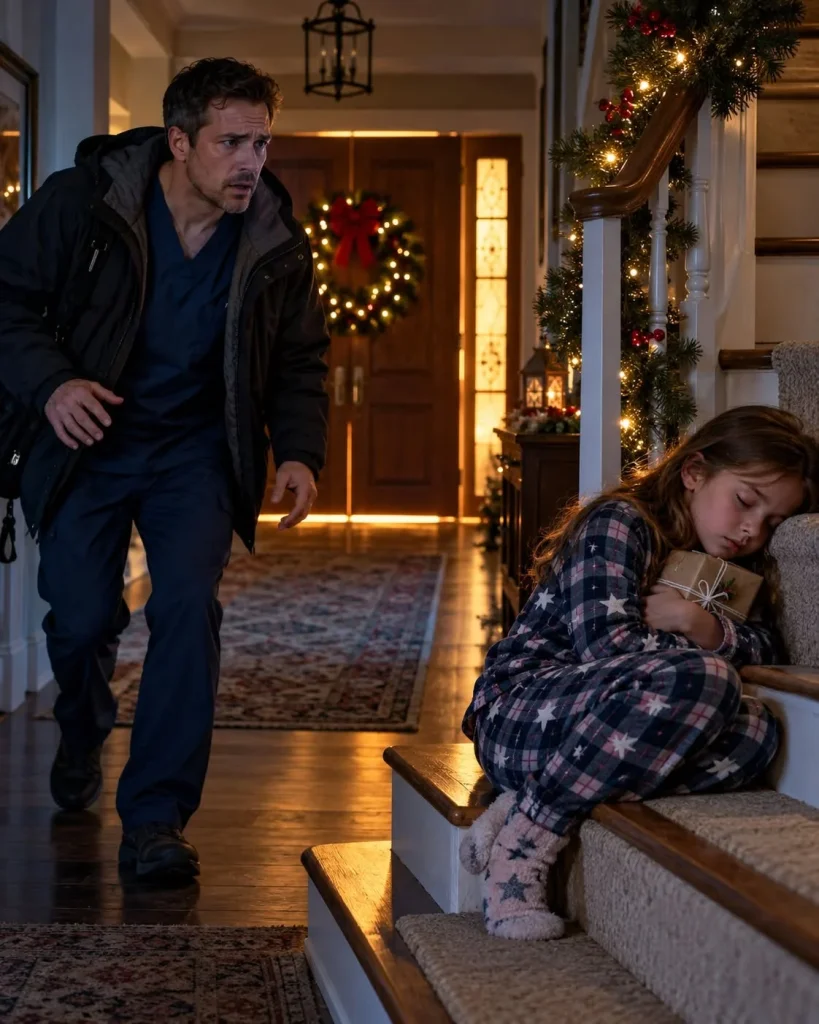
Andi immediately stripped Ivy of her boots and damp socks, wrapping her feet in a pair of giant, fleece-lined slipper socks that belonged to my niece. Blair handed Ivy a mug of hot cider topped with a cinnamon stick, while Beverly placed a plate containing three pieces of French toast and four strips of bacon onto the low coffee table in front of her.
“Eat first, star,” Beverly said, kissing the top of Ivy’s head. “No talking until there’s food in that belly.”
Ivy looked at the plate, then looked up at me as I sat down on the floor beside her knees. Her eyes were wide, almost startled by the abundance, by the total absence of conditions. In our house with Marlene, breakfast was a scheduled event, synchronized with the precision of a military parade, and Ivy had spent the last two years learning that taking seconds was an imposition on Marlene’s meal planning.
She picked up a fork with shaking fingers and took a bite of the French toast. A tiny, muffled sob escaped her nose, but she caught it, quickly wiping her face with the back of her wrist.
“It’s good, Grandma,” she whispered.
“Of course it’s good, I made it,” Beverly said briskly, though her own eyes were suspiciously bright. “Now, where is that package you’ve been guarding like a dragon with an egg?”
Ivy looked down at the brown paper box resting beside her on the rug. She picked it up, turned it over in her hands, and then held it out toward me with both arms.
“It’s for you, Dad. Merry Christmas.”
The room went completely silent. Andi leaned against the doorframe, crossing her arms; Blair sat quietly at the edge of the sofa; Howard stood by the hearth, poker in hand, motionless.
I took the package. The brown paper was rough butcher paper Beverly kept in her craft room, and the string was tied in three lumpy, determined knots. I carefully worked my fingers under the twine, refusing to tear the paper, peeling back the folds with clinical care.
Inside was an eight-by-ten frame crafted from gray, weathered pieces of river driftwood, smoothed by years of water and stones. Embedded into the corners were jagged, beautiful pieces of sea-green river glass, catching the golden flicker of the fireplace.
And inside the glass was the photograph.
Natalie was sitting on a hay bale, her dark curls tumbling over the shoulders of a red flannel shirt, holding a five-year-old Ivy on her shoulders. Natalie was laughing so hard her head was tilted back, her nose scrunched in pure, unadulterated joy, while I stood next to them, holding an absurdly misshapen gourd over my face like a mask.
Underneath the photo, written in Ivy’s careful, looping fifth-grade cursive, was a single line:
*We remember together.*
A tear slipped from my eyelashes and hit the glass right over Natalie’s shoulder. I didn’t wipe it away. I pulled the frame against my chest, closed my eyes, and let out a breath I felt like I had been holding since seven-forty that morning.
“It’s the best present I have ever received in my entire life, Ivy,” I whispered, opening my eyes to look at her. “The absolute best.”
Ivy didn’t say anything. She just leaned forward, threw her arms around my neck, and buried her face into the collar of my scrub shirt. I wrapped my arms around her back, holding her so tightly that I could feel the rapid, steady beat of her small heart against my ribs.
“Now,” Blair’s voice cut through the emotional quiet, clear, crisp, and lethal. She closed her leather-bound notebook with a quiet snap. “Peter. Drink some coffee. Take a breath. And then tell me every single word that woman said to my niece, because by tomorrow morning at nine o’clock, I am filing for an immediate ex-parte order of exclusive occupancy for that house.”
—
Chapter 3 – The Digital War & Marlene’s Smear Campaign
By ten-thirty that morning, the adrenaline that had carried me through the night shift, the confrontation in the hall, and the drive to Longmont began to metabolize into leaden, crushing fatigue.
Howard took Ivy downstairs to the finished basement to play vintage board games with Andi’s kids, who had just woken up and were tearing into stockings with the unbridled chaos of healthy children. The sounds of their laughter, muffled through the floorboards, sounded like music from another planet.
I sat at the kitchen table, wrapped in an old wool blanket of my father’s, holding a thick ceramic mug of black coffee that Beverly kept refilling the moment it dropped below half.
Blair was sitting opposite me, her MacBook open beside her legal pad. Her reading glasses were perched on the end of her nose, her pen tapping a rhythmic, aggressive cadence against the yellow legal lines.



