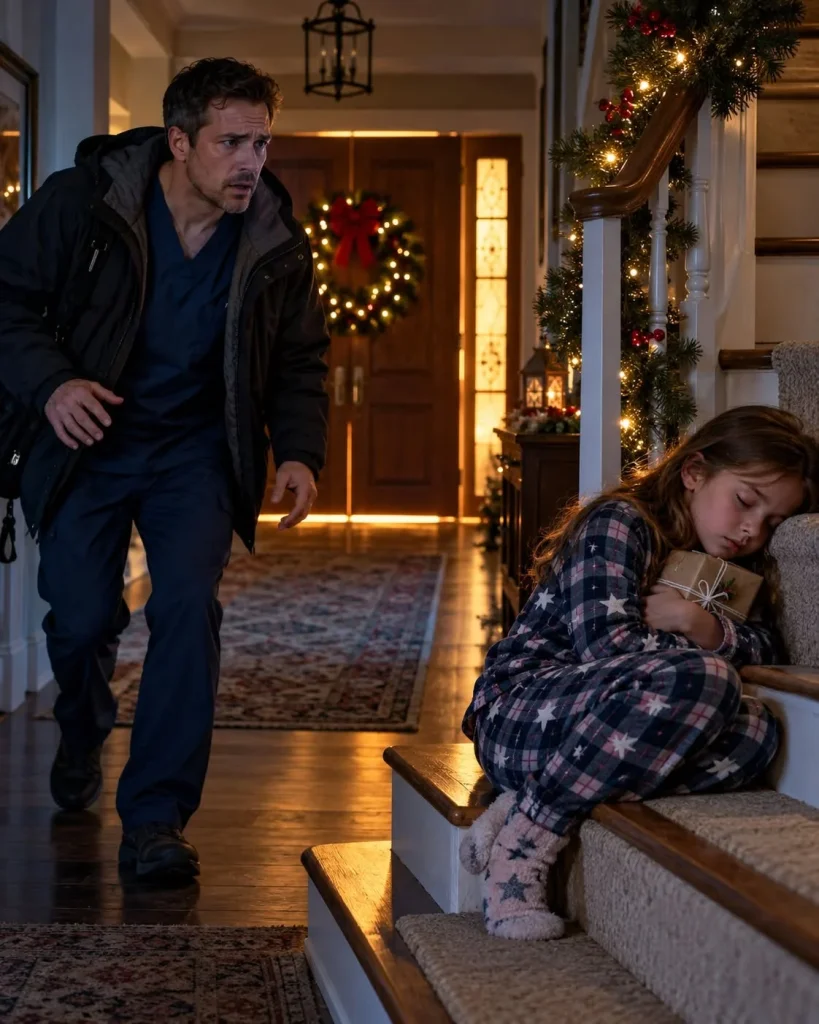
I had told myself it was just the friction of blending. I had told myself I was being overly sensitive, hyper-vigilant, grieving.
I had been an idiot.
“I don’t care who you call,” I told her, my voice dropping into that terrifying calm that made Marlene step back half an inch. “I don’t care what you tell the neighbors. But you will move away from that door right now, or I will call the sheriff’s department from my cell phone, put it on speaker, and report that you are physically preventing a physician and a minor child from leaving the premises.”
Marlene’s chest heaved. Her eyes were wide, glittering with a mixture of rage and genuine shock. She wasn’t used to me pushing back. In our marriage, I had always been the peacemaker, the one who apologized for being tired, the one who smoothed things over to avoid a fight in front of the kids.
She slowly stepped to the side, her arms dropping to her sides.
“You’re a coward,” she hissed. “Running home to your mommy because you can’t handle a real family.”
I didn’t answer her. I opened the heavy front door. The icy Colorado mountain air hit our faces like a slap of clean water, cutting through the stagnant warmth of the house. I guided Ivy out onto the porch.
“Dad?” Coral’s voice came from the threshold.
I turned back. The twelve-year-old was standing there in her socks on the cold wood, her face wet with tears. “Are you coming back?”
My heart tore slightly for her. Coral wasn’t Marlene, but she was trapped in Marlene’s orbit.
“I don’t know, Coral,” I said honestly. “Have a Merry Christmas with your brother. Make sure he eats something besides candy.”
I closed the door behind us.
The silence of the morning descended instantly. The neighborhood was dead quiet; pristine, glittering snow blanketed the lawns, and smoke rose in gentle, straight pillars from the chimneys of our neighbors’ houses. It looked like a postcard of suburban bliss. It looked like a lie.
I walked Ivy down the front steps, holding her hand firmly so she wouldn’t slip on the ice I hadn’t had time to salt. I opened the passenger door of my Subaru Outback, lifted her into the seat, and buckled her in. She was so light. At ten years old, she should have felt heavier, more grounded, but she felt like a sparrow—fragile, hollow-boned, terrified of making a sound.
I tossed the duffel bags into the rear cargo area, right next to the large, flat box hidden beneath the yellow emergency blanket.
I slid behind the steering wheel, turned the key, and let the engine roar to life. The dashboard clock read 8:12 AM.
Beside me, Ivy sat with her hands clasped in her lap, her eyes fixed straight ahead through the frosted windshield. She still hadn’t let go of the brown paper package.
“Ivy?” I said gently, shifting into reverse.
“Are we bad?” she asked. Her voice didn’t shake. It was worse; it was resignated. “Did I ruin Christmas for Coral and Forrest?”
I backed out of the driveway, the tires crunching loudly over the crust of snow, and swung the car onto the street. As we passed our house, I saw Marlene standing in the living room picture window, the sheer curtains parted, her silhouette motionless and black against the glow of the Christmas tree lights.
“No, star,” I said, reaching over with my right hand and covering her cold, small fingers. “You didn’t ruin a single thing. You just helped me open my eyes.”
—
Chapter 2 – The Warmth of a Real Family
The drive from our subdivision in Lafayette to my parents’ home on the edge of Longmont usually took twenty-five minutes. On that Christmas morning, with the roads empty and the plows having cleared the main arterial through Highway 287, we made it in eighteen.
Neither of us spoke for the first ten miles. The only sound in the car was the hum of the heater fans blowing warm air over our boots and the quiet, rhythmic click of the windshield wipers brushing aside stray flakes of drifting snow.
Ivy kept her brown paper package pressed firmly against her stomach. Her thumb moved repetitively over the uneven white string, tracing the knots.
“What’s in the box, Ivy?” I asked softly as we passed the frozen expanse of the open space reserves.
She swallowed. “It’s a frame.”
“A frame?”
“Grandma Beverly helped me make it at her craft table. We took pieces of driftwood from the creek where we used to go with Mom. And I found some river glass. The green kind she liked. We glued them on.” She paused, her voice dipping so low I had to lean slightly toward her. “I put a picture in it. The one from the pumpkin patch when I was five. Where she’s holding me on her shoulders and you’re making the funny face with the gourd.”



