The following Monday, Kyle refused to sell the boat.
Dad told him they needed the money.
Kyle insisted it would recover its value if he waited until summer.
Marlene disagreed.
Then the bank requested updated financial statements and a meeting with both partners.
Dad called me afterward.
“Kyle says you’re behind this.”
“Behind what?”
“The bank asking questions.”
“Dad, I’m not involved with your lender.”
“I know.”
He sounded tired.
“I told him that.”
I could hear Kyle talking in the background.
Dad covered the phone, said something I couldn’t make out, then came back.
“I’m going to need a few more weeks.”
“For the rent?”
“For everything.”
I looked at my calendar.
“Take the time you need to review the options. Ruth will send you the paperwork confirming the arrears are forgiven. The existing lease remains in force.”
He exhaled.
“Thank you.”
Two words.
Not particularly dramatic.
But he said them without being prompted.
In April, Kyle sold the boat.
He got $31,000.
I’d never seen a person so offended by the concept of depreciation.
He used the proceeds to reduce the line of credit, and Dad negotiated a repayment plan for the remaining balance.
That didn’t solve all the problems.
The supplier debts still had to be paid.
The business needed better bookkeeping.
Customers who’d been pressured into unnecessary services weren’t going to return simply because Kyle stopped making promotional videos.
And Dad was exhausted.
One evening, I stopped by and found him sitting alone at the service counter.
He was staring at an estimate for a transmission job.
“What’s wrong?” I asked.
“Nothing.”
I waited.
Finally, he said, “I don’t know if I can do this another five years.”
I’d never heard him say anything like that.
He’d always talked about retirement as though it were a disease other men caught.
“You don’t have to decide tonight,” I said.
He looked at me.
“You sound like your mother.”
I smiled.
“Don’t tell her.”
He chuckled.
Then he said, “I thought Kyle could take over the business side. I thought you’d stay in the bays. I figured I’d have both my boys here.”
I stared at him.
“You never told me that.”
“I thought you knew.”
“How would I know?”
He looked down.
“I suppose you wouldn’t.”
I wanted to ask why he’d given Kyle ownership and left me with nine dollars an hour.
I wanted to ask how long I was supposed to wait before I became more than the hands.
Instead, I asked a simpler question.
“Why didn’t you make me a partner?”
Dad rubbed his thumb over the edge of the estimate.
“Because I was afraid you’d leave the floor.”
I frowned.
“What?”
“You were the best mechanic I had. You could solve problems nobody else could. Kyle couldn’t do that. But he could talk to customers, and I thought if I gave him a reason to stay, he’d settle down.”
I stared at him.
“So you gave him the business because he wasn’t useful in the shop?”
Dad looked miserable.
“When you put it like that—”
“How else am I supposed to put it?”
He didn’t answer.
I stood up.
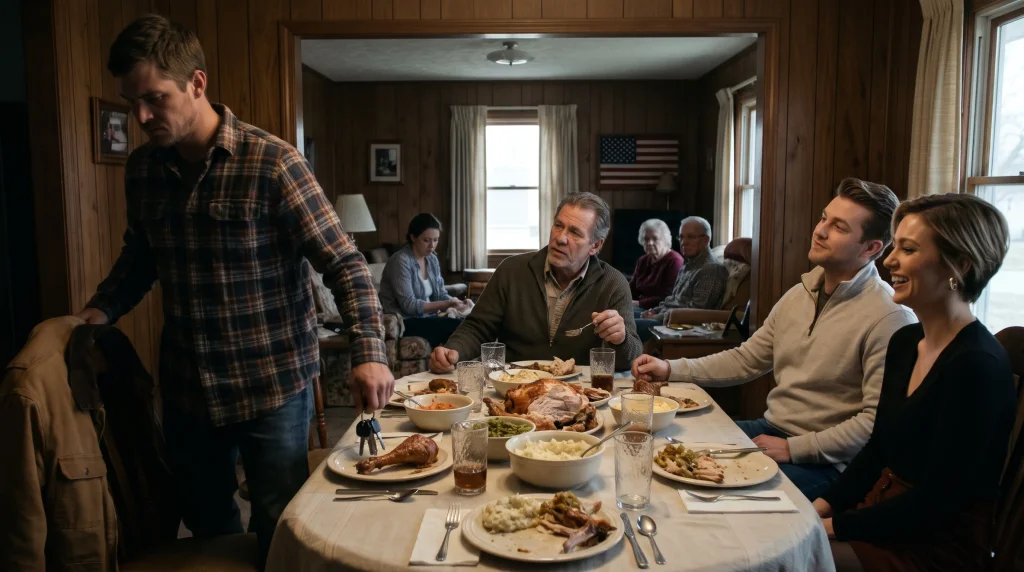
For a moment, I was twenty-five again, standing beside that Thanksgiving table.
Dad finally said, “I thought you understood how much I depended on you.”
I looked at him.
“Dad, you told me I was easy to replace.”
He closed his eyes.
“I know.”
“You said it in front of everybody.”
“I know.”
I waited for him to explain it away.
He didn’t.
“I was wrong,” he said.
Three words.
I had imagined hearing them for years.
I thought they’d feel bigger.
Instead, they made me tired.
I sat back down.
Dad stared at the old estimate.
“I wasn’t trying to tell you that you weren’t worth anything.”
“That’s what I heard.”
“I know.”
His voice was rough.
“I know that now.”
We sat there until the light outside the front windows began to fade.
Before I left, he asked about Owen.
Not as an afterthought.
He wanted to know what the boy liked, whether he was doing well, whether he still played with that little red tractor Mom had bought him.
I answered.
I didn’t invite him over.
Not yet.
But I answered.
The business negotiations continued through spring.
Marlene helped Dad and Kyle reach an agreement with the bank and reorganize the shop’s finances.
Kyle agreed to surrender his ownership interest as part of a documented separation arrangement.
It wasn’t instant.
There were lawyers, signatures, lender approvals, and a great deal of arguing about the value of equipment.
Dad discovered that owning a business with family didn’t make the paperwork any less important.
By the time everything was settled, Kyle no longer had authority to borrow against the shop’s assets or sign contracts on its behalf.



