Dad looked toward the sidewalk, where Owen was tugging on Tess’s sleeve.
“Turns out keeping a business going and keeping a family together aren’t exactly the same job.”
I didn’t have anything clever to say.
So I didn’t.
He looked at me.
“I owe you an apology, Gus.”
My throat tightened.
He’d apologized in pieces over the past several months.
A word here.
An admission there.
But he’d never said it quite like that.
“I should’ve paid you fairly. I should’ve kept my promises straight. And I should never have said what I said at Thanksgiving.”
I looked toward the dark windows across the street.
Dad continued.
“I thought because you were good at the work, you’d always be there. I figured you didn’t need much from me.”
He swallowed.
“That was a lousy way to treat a son.”
I could hear Ray’s radio playing faintly inside his car.
Some old country song.
A train horn sounded somewhere beyond the depot.
Dad waited.
He wasn’t asking me to say everything was fine.
For once, he seemed willing to let me decide what his apology meant.
“Thank you,” I said.
He nodded.
Then he held out his hand.
I looked at it.
Those hands had taught me nearly everything I knew about fixing engines.
Not through patient lessons, usually.
Mostly by making me watch, struggle, make mistakes, and try again.
They were rough, scarred, and permanently stained around the nails.
I shook his hand.
He gripped mine firmly.
Then he released it.
We stood there looking at the sign.
After a minute, Dad said, “I hear Eli’s been spending time with you.”
“Every Sunday he can.”
“He’s a good kid.”
“He is.”
Dad smiled.
“Not much interested in engines.”
“That’s okay.”
“Yeah,” Dad said.
He looked up at the blue letters.
“Guess it is.”
Kyle came over then, carrying a paper cup from the diner.
He looked up at the sign.
“Pretty good, Gus.”
“Thanks.”
He took another sip.
“You know, I’ve been thinking maybe the shop ought to have a neon sign again.”
I glanced at him.
Kyle grinned.
“Don’t worry. I’m not asking for a discount.”
Dad snorted.
“You better not.”
We all laughed.
It wasn’t the kind of laughter that erased seven difficult years.
It was ordinary.
A little awkward.
And that was enough.
Later, when everybody had gone home, I walked back across the street to check that the sign was still running properly.
Main Street was quiet.
The blue letters reflected faintly in the windows below.
I could see the old service bays at the rear of the building.
Bay Three’s new light was on.
Jordan was finishing a customer’s truck, and Dad was helping him put the tools away.
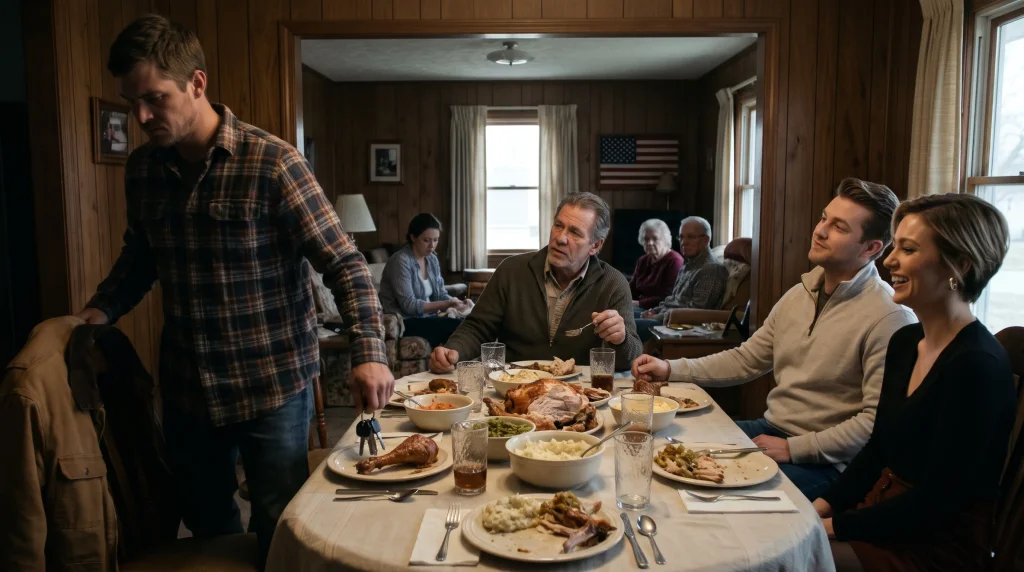
I stood there for a moment, thinking about the Thanksgiving dinner when I’d laid my keys beside a turkey leg.
I remembered Dad’s words.
You’re the hands. And hands are easy to replace.
For years, I’d carried that sentence around like a piece of metal lodged somewhere it didn’t belong.
I’d thought the only way to get rid of it was to prove him wrong.
To earn more.
Own more.
Build something big enough that he couldn’t ignore it.
And I had built something.
A business.
A family.
A place on Main Street.
But the best part wasn’t watching my father discover my name on a deed.
It was realizing that I no longer needed his permission to know what I was worth.
My phone buzzed.
A message from Tess.
Owen wants to know if you can fix the moon next.
I smiled.
Tell him I’ll need a taller ladder.
Then I looked up at the sign one last time.
Walt had asked me to keep it lit.
I intended to.
Down below, my father stepped out of Bay Three with his coffee.
He saw me standing across the street.
For a moment, neither of us moved.
Then he raised his cup.
Just a little.
I raised my hand.
That was my dad.
He’d never been good with speeches.
Neither had I.
Seven years earlier, he’d told a room full of people that I was just the hands, and hands were easy to replace.
Maybe he was right about one thing.
People can always hire another pair of hands.
But they can’t replace the years they waste overlooking the person those hands belong to.
And sometimes, if they’re fortunate, they get a chance to spend whatever years remain doing better.
I turned off my flashlight, climbed into my truck, and drove home to my wife and son.
Behind me, Main Street stayed bright.



