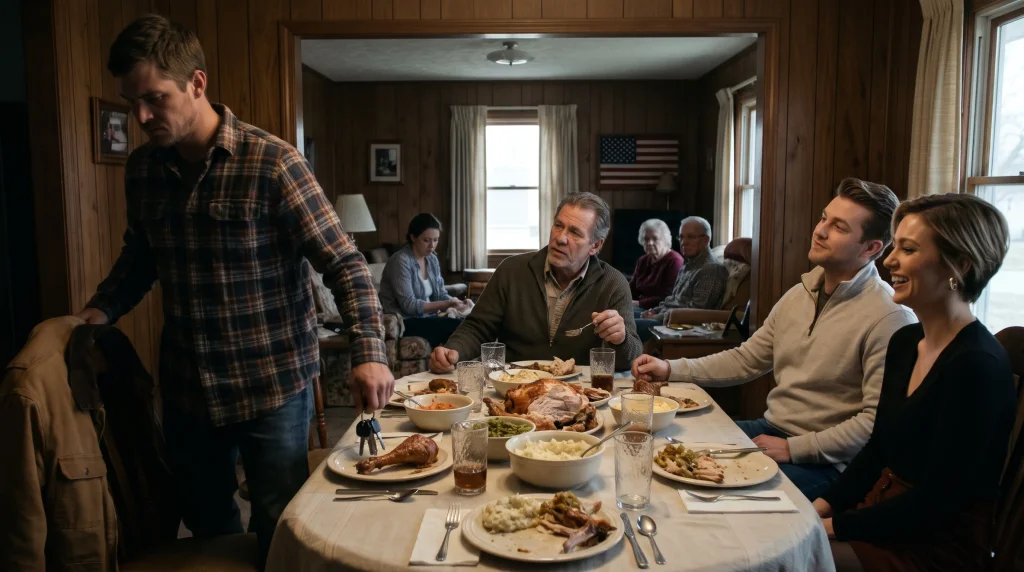
“He figured it was my business to tell.”
Dad gave a small nod.
Then he left.
I stayed behind with Ruth.
She gathered the papers into the folder.
“You handled that better than I expected,” she said.
“That’s a low bar.”
“I know your family.”
She looked at my binder.
“Are you sure about forgiving the rent?”
“Yes.”
“You should put it in writing.”
“I will.”
She closed the folder.
“And Gus?”
I looked up.
“Don’t confuse helping your father with taking responsibility for everything he’s done.”
I thought about that on the drive home.
I thought about it again when Tess asked how the meeting went.
I told her most of it while Owen sat on the kitchen floor building a tower from wooden blocks.
When I got to the part about the receipts, she stopped washing a plate.
“You brought the binder?”
“Yeah.”
“Did it help?”
“I don’t know.”
She dried her hands.
“Did it make you feel better?”
That was harder.
“For about thirty seconds.”
She came over and sat beside me.
“What happened after thirty seconds?”
“I looked at him, and he looked old.”
She rested her hand on mine.
I wanted to tell her that I’d finally won.
But it didn’t feel like winning.
It felt like finding out the other person hadn’t known you were fighting the same battle.
The next morning, Mom called.
She’d apparently spent most of Thursday evening listening to Dad and Kyle argue.
“Your father didn’t sleep,” she said.
I was loading supplies into my truck.
“I’m sorry to hear that.”
“Gus, he’s scared.”
“I know.”
“He thinks you want him out of the shop.”
“I told him I don’t.”
She hesitated.
“Maybe you could come to dinner Sunday. Just you and him. Talk things through.”
I looked at the toolbox in the truck bed.
“Mom, I spent years coming to family dinners hoping somebody would listen to me.”
“I know.”
“No, I don’t think you do.”
She went quiet.
I regretted how sharp I’d sounded.
But I didn’t take it back.
Finally, she said, “I should’ve stopped your father that Thanksgiving.”
I sat on the tailgate.
She’d never said anything like that before.
“I should’ve stopped a lot of things,” she continued. “The money when you were sixteen. The rent. I told myself we were helping Kyle until he got settled.”
“He never got settled.”
“No.”
I waited.
There was more I wanted her to say.
She didn’t say it.
Instead, she asked how Owen was doing.
I told her he’d learned to ride his little bicycle without training wheels.
She sounded genuinely pleased.
We talked another few minutes.
Before hanging up, she said, “I’m glad you answered the phone.”
That Sunday, Kyle came to my house.
It was the first time he’d ever visited since Tess and I moved in.
He parked the wrapped truck in front of our driveway.
Tess saw it through the window.
“Your brother’s here.”
I looked outside.
He was standing beside the truck, checking his phone.
“Want me to stay?” she asked.
“No. I’ve got it.”
I went outside and shut the door behind me.
Kyle didn’t bother with hello.
“You embarrassed me in front of Dad.”
“I showed him documents.”
“You knew what was going to happen.”
“I knew he needed to understand the financial situation.”
Kyle laughed.
“Listen to you. Like some big-shot businessman.”
I leaned against the porch railing.
“What do you want, Kyle?”
He looked past me toward the garage.
“I want you to stay out of our business.”
“Then pay the rent and manage the debt.”
“That’s what we’re trying to do.”
“With a forty-eight-thousand-dollar boat?”
His jaw tightened.
“You don’t know what it’s like trying to keep a place running when every customer wants a discount and every employee thinks he deserves a raise.”
I thought of Lonnie.
And Pete.
And the man from Red Oak.
“You had good mechanics.”
“They were stuck in their ways.”
“They knew how to fix cars.”
Kyle waved a hand.
“That’s your problem. You think everything is about fixing cars. Business is about growth.”
“Growth into what?”
He looked annoyed.
“A second location. Fleet accounts. Better branding.”
“Did any of those plans produce enough money to cover the loan?”
He didn’t answer.
Then he said something I hadn’t expected.
“Dad always liked you better in the shop.”
I stared at him.
“What?”
“He could talk to you for hours about engines. With me, all he ever talked about was what I ought to be doing next.”
I didn’t know what to say.
Kyle kicked a little piece of gravel off the driveway.
“You think being the golden boy was so great? Every time something went wrong, he told me I was wasting my potential.”
I considered that.



