His payment was $588 a month.
Mine was $600.
That was the first time I understood something about my family: Kyle’s dreams were investments. Mine were expenses.
Still, I stayed at the shop for seven years.
I thought hard work would count for something eventually.
Dad encouraged that belief. Sometimes he’d stand beside me in Bay Three and say, “Someday, Gus, this’ll all be yours.”
I believed him because I wanted to.
There were plenty of mornings when it almost felt true.
We’d open the bay doors before sunrise, drink terrible coffee from the same stained pot, and listen to the weather report on the radio.
He’d hand me a wrench before I asked for it. I’d know which part he wanted without him saying.
For an hour or two, we could work together like a father and son.
Then a customer would arrive, and Dad would introduce me as his helper.
I was twenty-three years old, rebuilding transmissions, and still his helper.
There were two other mechanics, Lonnie and Pete. They earned twice what I did.
Lonnie told me accidentally one afternoon, then spent the next ten minutes apologizing.
I told him it was fine.
It wasn’t fine.
But I was still waiting for the day Dad would decide I’d earned my place.
Then came Thanksgiving.
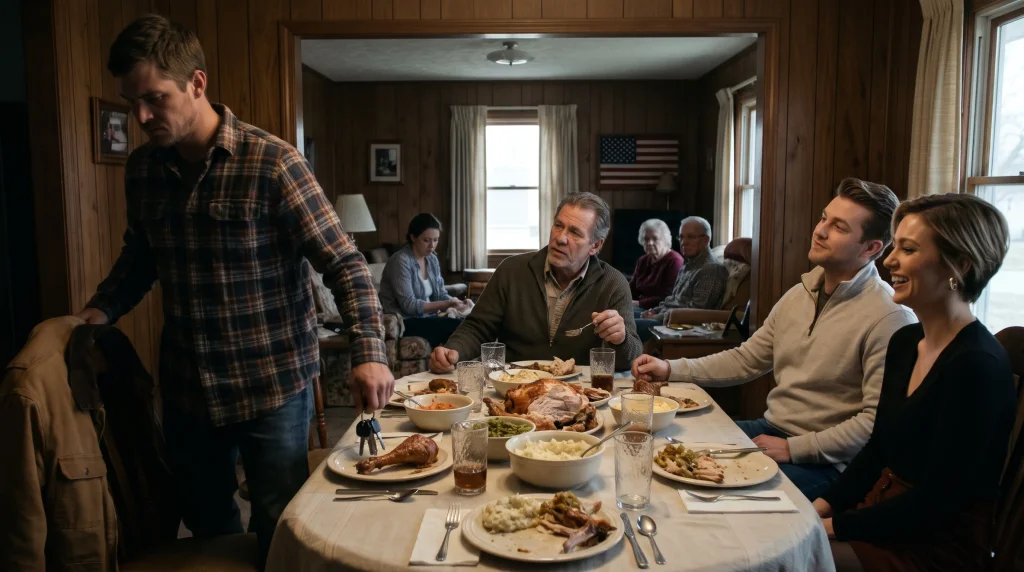
Dad stood up after dinner, tapped his glass, and announced Kyle was becoming his business partner.
Kyle had spent the previous several years selling cars, insurance, and cell phones. He’d never lasted long enough at one job to stop explaining why he left the last one.
Dad said Kyle had the business sense the shop needed.
Everybody applauded.
Kyle shook Dad’s hand like a man accepting an award.
When I asked where that left me, Dad smiled.
“Kyle’s the face of this shop. You’re the hands. And hands are easy to replace.”
My sister-in-law Ashlyn laughed.
“Don’t worry. Somebody still has to carry the extension cords.”
I remember the turkey getting cold on my plate.
I remember Mom looking down at her napkin.
Mostly, I remember taking my shop keys off my belt and laying them beside Dad’s turkey leg.
“Then replace them,” I said.
For a moment, Dad looked more offended by the keys on his dinner plate than by anything I’d said.
“Don’t be dramatic, Gus.”
I thanked Ashlyn’s mother for the green bean casserole.
It really was good.
Then I got my coat and walked out.
Behind me, I heard Dad tell somebody I’d be back Monday.
I wasn’t back Monday.
And I never worked another shift for him.
What Dad didn’t know was that I’d been learning electrical work from an old tradesman named Ray Kessler.
Ray had wired half the farms in Union County. He was the kind of electrician who could look at a breaker panel and tell you which previous owner had been too cheap to hire a professional.
I’d met him when I repaired his riding mower.
He needed somebody young enough to crawl through attics and grain bins. I needed somebody willing to pay me what my labor was worth.
Ray gave me fifteen dollars an hour to start.
That was nearly twice what Dad paid.
He taught me electrical work, made me study the code, and corrected me whenever I tried to do something the easy way instead of the right way.
He also introduced me to neon.
In the back of his workshop, underneath an old canvas tarp, he kept a glass-bending table, a ribbon burner, and boxes of tubing.
I’d loved neon signs since I was little.
Creston used to glow after dark. The old drugstore, the Rialto theater, and the Pin Palace bowling alley all had signs you could see from blocks away.
By the time I was grown, most of them were dark.
One Sunday, Ray showed me how to heat a glass tube until it softened, then bend it without collapsing the walls.
My first letter was an S.
It looked like a snake that had been stepped on.
Ray examined it carefully and declared it the finest first S he’d ever seen.
Years later, I discovered he’d said the exact same thing to at least four other apprentices.
I still appreciated it.
After Thanksgiving, I went to work for Ray full-time.
Within two years, I earned my journeyman certification and then my master electrician’s license.
I started taking my own customers.
Farmers needed wiring for grain dryers, hog barns, irrigation equipment, and shops. Once word got around that I showed up when promised and stood behind my work, the calls kept coming.
But the neon signs were what people noticed.
The first one I restored on my own belonged to the Pin Palace.
The bowling alley had been closed for years. A woman named Dorothy Bauer ran a flea market in the building now.



