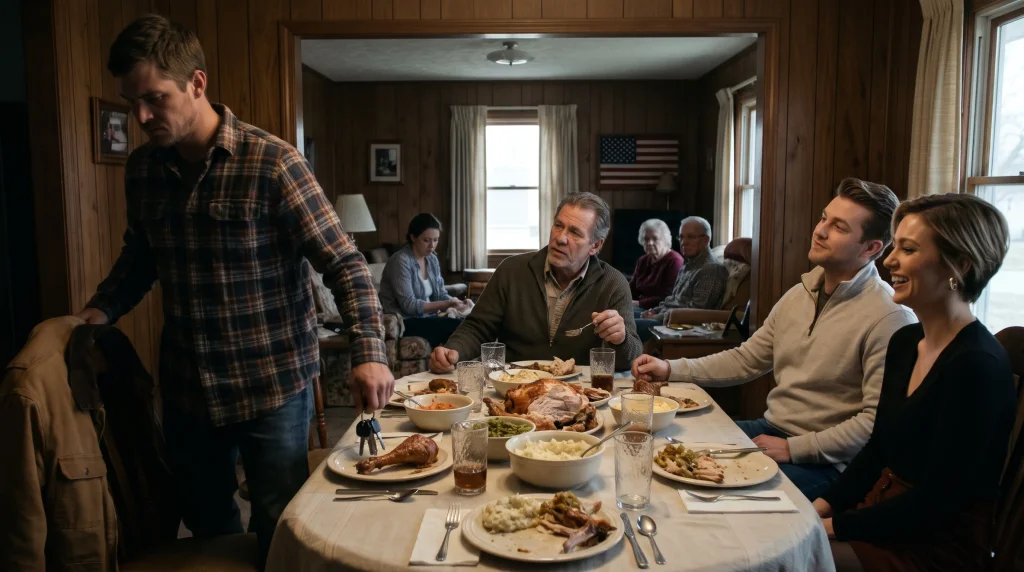
I stood in the kitchen watching.
Tess came beside me.
“You okay?”
“Yeah.”
She leaned against the counter.
“He’s trying.”
“I know.”
“Doesn’t mean you have to forget anything.”
“I know that, too.”
Dad stayed for an hour.
Before leaving, he thanked Tess for the coffee.
Then he looked at me.
“You got a nice family, Gus.”
I nodded.
“I do.”
He seemed to understand there was more in that answer than the words themselves.
He didn’t ask me to come back to work at the shop.
He didn’t tell me how things ought to be.
He just shook my hand and left.
The next week, I had the electrician from my crew replace the light in Bay Three.
Dad insisted on paying the invoice.
I let him.
Some things are worth doing properly.
That summer, the shop began to recover.
Slowly.
There were no miracles.
Dad had to call former customers and acknowledge that some of the service recommendations made under Kyle’s management had been inappropriate.
A few came back.
Others didn’t.
He hired a younger mechanic named Jordan who’d trained at the community college and wanted to learn transmission work.
Dad paid him a competitive wage.
When Jordan asked about overtime, Dad gave him a written policy instead of telling him they were all family.
I heard about that from Ruth.
She sounded amused.
“Your father’s learning paperwork can be useful.”
“Imagine that.”
The rent started arriving on time.
Every check came with a receipt attached.
Paid, D.
Ruth filed them.
One afternoon, she showed me the folder.
“Your father signs every one now.”
I looked at the familiar handwriting.
For a second, I was eighteen again, standing at the kitchen table waiting for him to initial my rent receipt.
Then I closed the folder.
“Good.”
In September, the transformer in the old Ostrander Ford sign failed.
Ruth called me first.
“Your sign’s dark.”
“I’ll take a look.”
I went up on the roof that Saturday.
The brick was still warm from the afternoon sun.
I found the bad transformer and checked the rest of the wiring.
The sign had held up well, considering its age.
I replaced the failed equipment, inspected the glass, and cleaned the mounting points.
By the time I finished, the sun was dropping behind the buildings on the west side of Main Street.
Ray drove down to watch.
He was eighty-one now.
He didn’t climb ladders anymore, although he occasionally threatened to if I didn’t stop treating him like an antique.
He parked his old Chevy across the street, in almost the same spot where Walt had watched his sign come back to life years earlier.
Tess stood on the sidewalk with Owen.
Eli was beside her, hands in his pockets, pretending he wasn’t excited.
Mom had brought folding chairs.
Ruth was standing near the office door.
I looked down toward the service bays.
Dad was there with a cup of coffee.
Kyle stood a few feet away, talking to Jordan.
For a moment, I watched them.
My father looked older than he had seven years before.
His shoulders weren’t as straight.
He moved more slowly.
But the shop was open.
The name above the door was his again.
And he was finally letting other people help him carry the load.
I checked the last connection.
Then I climbed down to the switch box.
Ray rolled down his window.
“You gonna make us stand here all night, boy?”
“Just checking your patience.”
“Used up most of that teaching you to bend glass.”
Tess laughed.
I threw the switch.
The first blue letter came on.
Then the next.
A soft electrical hum ran through the sign as the old script lit up across the roof.
OSTRANDER FORD.
The same blue letters that had watched over Main Street since 1959.
Owen pointed upward.
“Daddy made the lights!”
“Repaired them,” I called back.
Tess shook her head.
“Just take the compliment, Gus.”
Ray lifted a hand from his steering wheel.
Eli stared at the glowing letters.
“Could I learn to make something that big someday?”
“Sure,” I said. “If you’re willing to practice.”
He nodded seriously.
Then Dad walked over.
He stood beside me, looking up at the sign.
For a while, we didn’t speak.
Finally, he said, “Walt would’ve liked that.”
“Yeah.”
Dad took a sip of coffee.
“You know, I used to think this building was the best thing I had.”
I looked at him.
He kept his eyes on the roof.
“Thirty years. Every dollar I could scrape together. Every Saturday I missed things because somebody needed a transmission fixed.”
He stopped.
I waited.
“I figured if I kept the doors open long enough, that meant I’d done right by everybody.”
The sign hummed softly above us.



