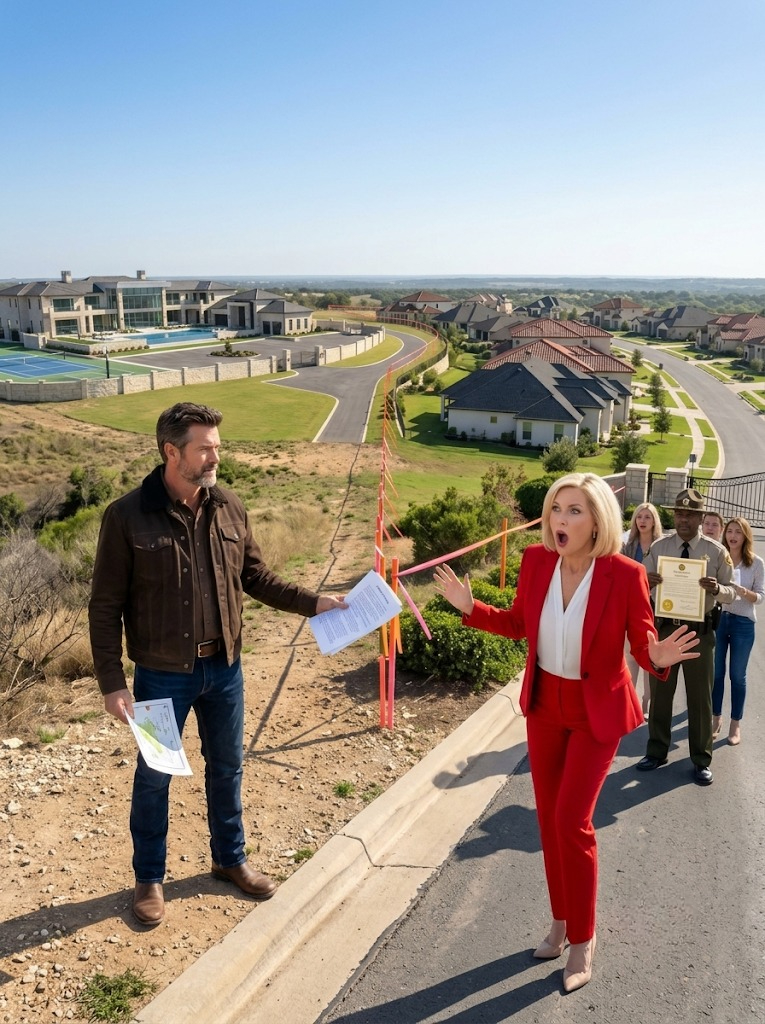
The security guard asked for my name before he would let me drive onto my own ranch.
That was the moment I knew the twelve mansions behind him were not some terrible mistake.
Someone had planned this.
My name is Aaron Cole. I was forty-one years old, an Army logistics specialist, and I had just returned to Colorado after thirteen months overseas.
Thirteen months earlier, Cole Creek Ranch had been 226 acres of pasture, cottonwoods, an old farmhouse, and a private spring-fed lake my grandfather dug out with a dozer in 1968.
Now a stone entrance stood across my east road.
ASPEN RIDGE RESERVE
Beyond it were twelve enormous houses.
Slate roofs.
Three-car garages.
Landscaped lawns.
Balconies overlooking my lake.
I counted them twice.
The guard stepped from his booth.
“Sir, residents and approved guests only.”
“I own this road.”
He stared at me.
Then a silver SUV came through the gate.
A woman stepped out wearing sunglasses and a cream-colored jacket.
“I’m Lydia Hart,” she said. “HOA president.”
“Aaron Cole.”
Her face changed.
Only for a second.
Then the smile returned.
“We were told you were still overseas.”
That sentence stayed with me.
I pointed toward the nearest house.
“Who built those?”
“Aspen Ridge Development.”
“On whose land?”
She frowned.
“This is Aspen Ridge property.”
“No. This is Cole Creek Ranch.”
Lydia opened a folder and removed a subdivision map.
A thick boundary line swallowed nearly forty acres of my eastern pasture.
It included the houses.
The access road.
And half my lake shoreline.
“The county approved everything,” she said.
“Who was the developer?”
“My husband.”
There it was.
Victor Hart.
I had heard the name before.
He had tried to buy part of the ranch three years earlier.
My father refused.
After Dad died, Victor tried again.
I refused.
Then I deployed.
Apparently he found a third answer.
Lydia closed the folder.
“You’ll also need to bring the ranch property into compliance.”
“With what?”
“Aspen Ridge architectural standards.”
I looked at my old barn in the distance.
Then at my dusty truck.
Then at her.
“You built houses on my land and now you want to fine me for the barn?”
“You should speak with our management company.”
I almost laughed.
Instead, I drove around through the western ranch entrance and went home.
That night, I found the Aspen Ridge website.
The photographs made my stomach turn.
PRIVATE RESIDENT LAKE.
My lake.
EXCLUSIVE TRAIL SYSTEM.
My cattle road.
SECURE GATED ACCESS.
My eastern entrance.
I printed everything.
The next morning I called property attorney Maya Ellis.
She spent two hours reviewing my deed, survey, tax records, and Aspen Ridge plat.
Then she pointed to one strange notation.
“Temporary construction easement.”
I remembered it.
Years earlier, Dad had allowed Victor’s original company to use a strip near the eastern boundary while utilities were installed for the first phase next door.
“What does it say?”
“We need the recorded original.”
County records produced it that afternoon.
The easement was eight pages.
The online copy Aspen Ridge relied on was five.
Maya placed them side by side.
Three clauses were missing from the development version.
No residential access.
No recreational use.
No water rights.
Then came the expiration clause.
The construction right terminated when the original utility project was completed.
That had happened four years earlier.
Aspen Ridge had built twelve luxury homes using an easement that no longer existed for the purpose they claimed.
But that still didn’t explain how their subdivision map had absorbed forty acres of my ranch.
Surveyor Carl Dunn found that answer.
A later boundary adjustment had been filed while I was deployed.
Attached was something called a landowner consent.
My signature appeared at the bottom.
I had never signed it.
Maya asked where I had been on the date.
I checked my records.
“Kuwait.”
She looked at me.
“The document says you signed this in Colorado.”
The notary acknowledgment claimed I had personally appeared before a local notary at 3:15 that afternoon.
I was roughly seven thousand miles away.
Maya told me not to contact Lydia or Victor.
“Let them keep explaining themselves.”
They did.
The HOA sent me a demand for $6,800 in assessments and violations.
Another letter claimed Aspen Ridge had permanent recreational rights to the lake.
A contractor appeared at my dam road and tried to install a keypad gate.
I stopped him without touching his equipment.
“Who authorized this?”
“Lydia Hart.”
I photographed everything.
Three days later, Victor came to the ranch.
He wore expensive boots and carried a purchase offer.
“I’d like to solve this professionally.”
“You built twelve houses on land you now want to buy?”
“We disagree about the boundary.”
“My deed doesn’t.”
He offered me $1.4 million.
I never looked past the first page.



