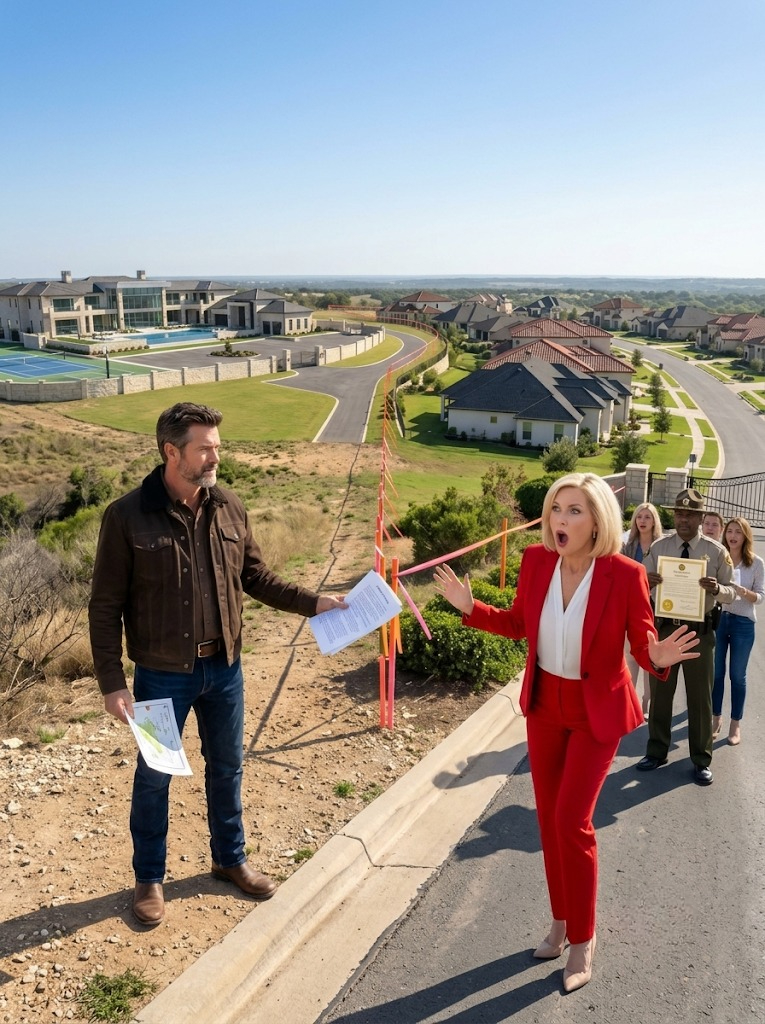
“You already sold homes on it.”
“Aaron, those families bought in good faith.”
“I know.”
“You could destroy them.”
“I didn’t build their houses.”
His jaw tightened.
“You were gone.”
“What does that mean?”
“Development moves fast.”
I watched him.
“You knew when I was coming home.”
He said nothing.
That silence bothered me enough to keep digging.
Then Maya found Victor’s preliminary county package.
It had been submitted eight months before construction started.
Attached to it was the complete easement.
All eight pages.
All three restrictions.
Victor had possessed the correct document before the first foundation was poured.
The altered five-page version appeared later.
That was bad.
But what came next was worse.
A former Aspen Ridge records administrator named Ellen Brooks contacted Maya.
She had left the HOA four months earlier.
We met at a diner thirty miles away.
Ellen brought a brown envelope.
“I kept copies of things Lydia told me to remove.”
Inside were emails, closing packets, and internal board notes.
One title memo stated clearly:
Cole Creek Ranch remains privately owned. No permanent lake or residential access has been established.
Lydia had written across the top:
Do not include in homeowner packet. Creates unnecessary confusion.
Then I found an email from Victor.
It was dated nine months into my deployment.
Aaron rotates home in September. We need all twelve closings completed before then. Once owners is in possession, unwinding this becomes practically impossible.
I read it again.
Maya took the page from me.
“This is no longer about a survey mistake.”
Ellen slid one final document across the table.
It was a development strategy note.
One sentence had been highlighted.
If Cole refuses post-construction settlement, occupancy pressure should force a ground arrangement on favorable terms.
Victor had not accidentally built twelve houses on my ranch.
He had expected me to come home, see twelve innocent families living there, and decide fighting for my land was too cruel.
He was counting on my conscience to protect his fraud.
And for the first time since I came home, I knew exactly what I was going to do.
I wasn’t tearing down a single house.
I was going to let the court decide who owned the ground underneath them…
Maya filed a quiet-title action and asked the court to invalidate the boundary adjustment, the disputed consent, and every HOA claim against Cole Creek Ranch.
The twelve homeowners received notice.
Panic spread immediately.
Lydia told them I intended to evict everyone and bulldoze the subdivision.
So I met them myself.
“I’m not asking anybody to leave tonight,” I said. “I’m asking the court to determine who owns the land.”
One homeowner named David Keller looked exhausted.
“If you win?”
“Then we find a lawful solution.”
That changed the room.
Meanwhile, the title insurer began reviewing the closings. Their records contained the full eight-page construction easement—the same version Victor had received before building.
Then an internal developer email surfaced:
Close homes first. Easement can be cured with Cole afterward. Occupied homes give us leverage.
The title company froze every pending Aspen Ridge transaction. The lender suspended Victor’s next phase. The HOA stopped sending me fines. Then the county confirmed something even simpler. The notarized consent carrying my signature showed me appearing in Colorado on a date military records placed me overseas.
At the first hearing, Judge Caroline Mercer compared the documents and asked Victor’s attorney one question.
“Do you have any authentic instrument signed by Mr. Cole transferring these forty acres?”
The attorney asked for time. The judge gave him ten days. On day nine, Maya called me.
“They found another document.”
“Real?”
“Very.”
My stomach tightened.
“What is it?”
“A title-company memo written before construction.”
“And?”
She paused.
“It says Victor was specifically warned that the land still belonged to you.”
Then she added the part that made the coming hearing unavoidable.
“Victor signed underneath it acknowledging that he understood.”
The courtroom was full before nine.
All twelve Aspen Ridge homeowners came.
Lydia sat beside Victor.
Neither looked toward me.
Maya placed three binders on our table.
“Today is about sequence,” she said quietly.
“Not emotion.”
Judge Caroline Mercer entered.
Everyone stood.
Then Maya began with the oldest document.
My grandfather’s deed.
Then the transfer to my father.
Then the transfer to me.
No sale.
No conveyance.
No break in ownership.
Next came the temporary construction easement.
Eight pages.
The restrictions appeared on the screen.
No residential access.
No recreational use.
No water rights.
Expiration after completion of the utility project.
Maya asked Carl Dunn to explain the survey.
He showed the original Cole Creek boundary.
Then Aspen Ridge’s later development line.
The difference was nearly forty acres.
One homeowner whispered something behind me.
Carl continued.
“The physical monuments agree with the Cole deed.”



