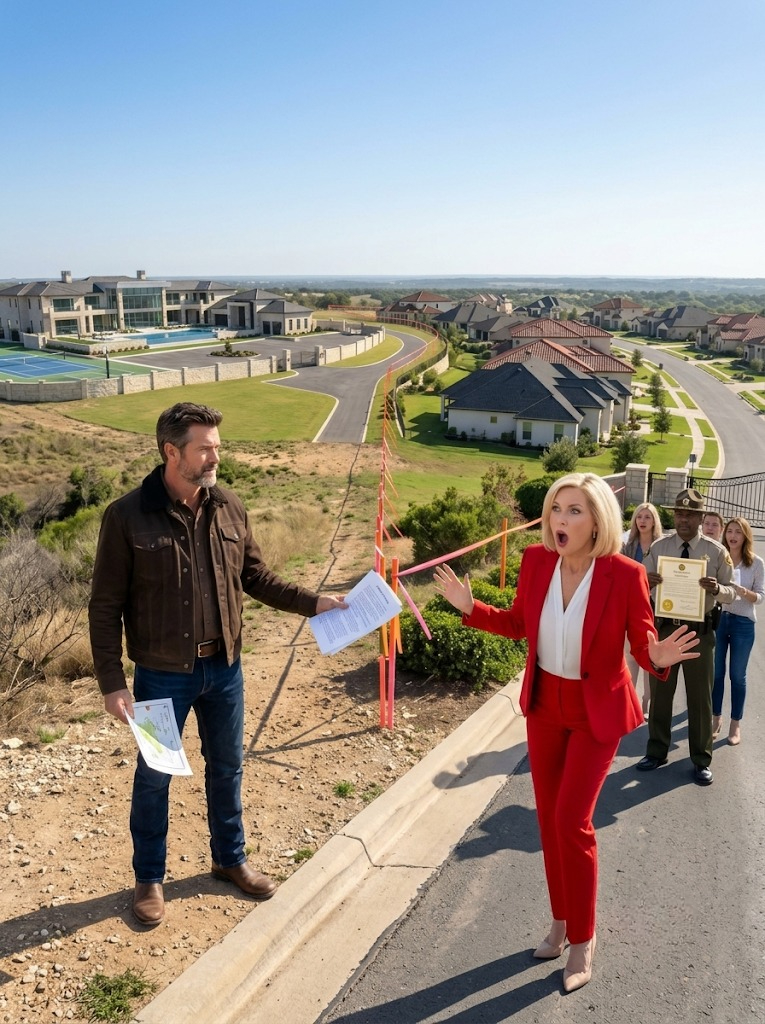
“Do you have any reliable survey evidence showing the disputed acreage belonged to Aspen Ridge?”
“No.”
Victor’s lawyer stood.
He argued that modern planning records had superseded older descriptions.
Carl nodded.
“Modern surveys can correct older inaccuracies.”
The lawyer smiled.
Then Carl added:
“But you need evidence to correct them. You don’t simply move a line because the new subdivision works better that way.”
The smile disappeared.
Then came the disputed consent.
My signature.
The Colorado notary.
The date.
Maya entered my deployment records showing I had been overseas.
Judge Mercer looked toward Victor’s table.
“Is anyone seriously claiming Mr. Cole appeared before this notary in Colorado?”
Victor’s attorney stood.
“We are investigating the circumstances of execution.”
“That sounds like no.”
Silence.
Maya moved to the title memo.
This was the document found nine days earlier.
It had been prepared by a title consultant before construction.
The conclusion was straightforward:
Cole Creek Ranch retains title to the eastern tract. Recorded construction easement does not support permanent residential access. Acquisition or new easement required before residential development.
Beneath it:
Acknowledged: Victor Hart.
His signature.
Dated six months before the first foundation permit.
Maya asked Victor to take the stand.
He did.
His attorney looked unhappy.
“Mr. Hart, did you receive this memo?”
“Yes.”
“Did you understand it said Aaron Cole owned the eastern acreage?”
“It identified unresolved title concerns.”
“Did it recommend acquiring the property before development?”
“Yes.”
“Did you acquire it?”
“We believed later approvals resolved the matter.”
“From whom?”
Victor paused.
“The county approved the subdivision.”
Maya shook her head.
“The county approved plans. Who transferred Mr. Cole’s land to you?”
He did not answer.
She displayed the five-page easement.
“Did you know the original contained three additional pages?”
“I knew there were multiple versions.”
“Did you possess the complete version?”
“Yes.”
“Before construction?”
“Yes.”
“Did you know it prohibited residential access?”
Victor looked toward his attorney.
Judge Mercer said, “Answer.”
“Yes.”
A woman behind me began crying.
She owned the third house from the gate.
Maya continued.
“Did you tell buyers?”
“I relied on the closing process.”
“That wasn’t my question.”
“No.”
“Did you tell the HOA?”
“I discussed access matters with Lydia.”
Lydia’s expression changed.
Maya displayed Ellen’s preserved records.
The title memo.
The removed homeowner packet.
Lydia’s handwritten note:
Do not include. Creates unnecessary confusion.
Then Victor’s email:
Aaron rotates home in September. We need all twelve closings completed before then. Once owners is in possession, unwinding this becomes practically impossible.
Nobody moved.
Maya asked:
“What did you mean by ‘practically impossible’?”
Victor answered slowly.
“I believed completed development would encourage settlement.”
“Because twelve families would already be living on Mr. Cole’s land.”
“I believed all parties would benefit from resolution.”
“You built first so he would have less freedom to say no later.”
His attorney objected.
Judge Mercer allowed Victor to answer.
He looked at me for the first time.
“We expected to negotiate after completion.”
That was it.
The entire strategy in one sentence.
Build.
Sell.
Occupy.
Negotiate afterward.
Maya sat down.
Victor’s attorney tried to recover.
He emphasized the homeowners’ innocence.
On that point, I agreed with him.
The families had bought through ordinary closings.
They had mortgages.
Title policies.
Recorded deeds describing lots they were told existed.
They had not altered easements.
They had not forged my signature.
They had not waited for me to deploy.
Judge Mercer understood the distinction.
“This court can determine title,” she said. “It cannot pretend innocent purchasers are responsible for the conduct that created the defect.”
Then she ruled.
The disputed forty acres belonged to me.
The boundary adjustment based on the false consent was invalid.
The temporary construction easement had never granted residential access, lake rights, or recreational rights.
The lake remained part of Cole Creek Ranch.
The dam remained mine.
The old ranch road remained subject only to whatever valid rights actually existed—not whatever Aspen Ridge wished had existed.
And the HOA had no authority over my farmhouse, barn, vehicles, fencing, or ranch operations.
Lydia closed her eyes.
Victor stared at the table.
But Judge Mercer was not finished.
The houses were physical improvements built by purchasers whose rights now had to be resolved through settlement, title-insurance claims, or further proceedings.
The court ordered mediation.
Outside, David Keller approached me.
“So we’re on your land.”
“Yes.”
He looked toward his wife.
“What are you going to do?”
“Nothing today.”
“You could make us leave.”
“Maya says the legal answer is more complicated than that.”
He nodded.
“What do you want?”
I looked at the twelve homeowners standing near the courthouse steps.
“I want Victor to stop deciding that for everybody.”
Mediation began two weeks later.
There were lawyers everywhere.
Mine.
The homeowners’.
Victor’s.
The HOA’s.
The title insurer’s.
The lender’s.
At first, proposals were absurd.



