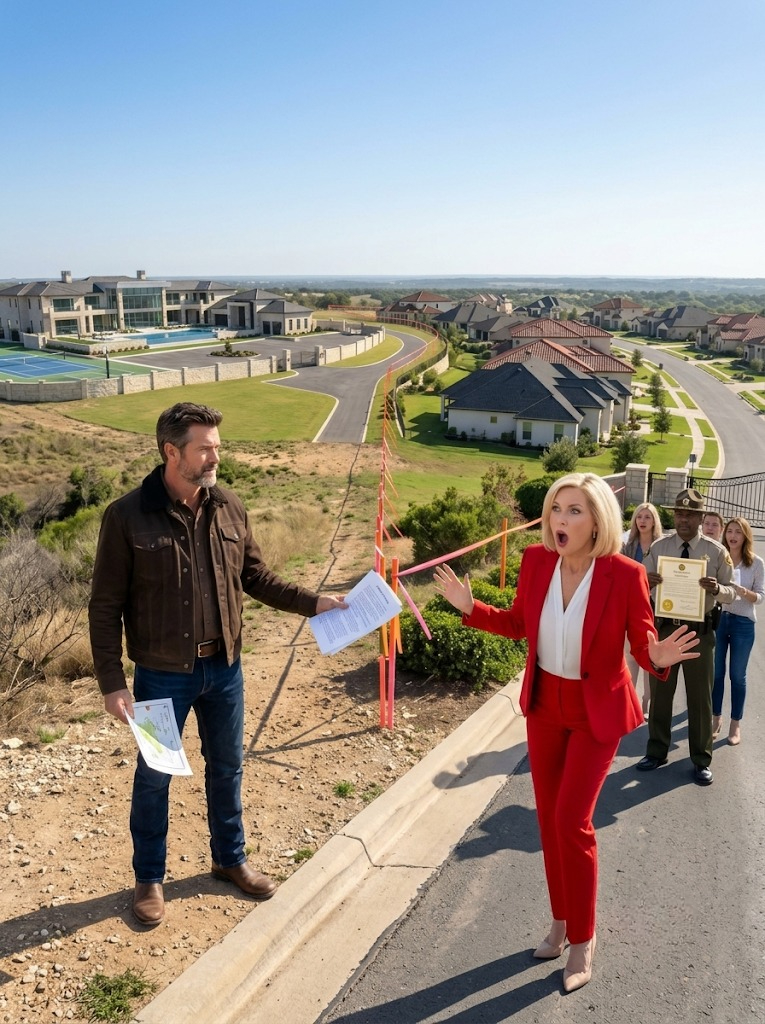
There was a kind of justice in that.
Not dramatic justice.
Useful justice.
The homeowners gradually became neighbors.
Actual neighbors.
David helped me repair fencing after a spring storm.
His wife brought food when Hannah and I spent three days dealing with a sick cow.
Another homeowner, Marcus Lee, turned out to be a veterinarian.
He never charged me for checking my cattle.
I stopped charging him when his kids fished the lake.
Rules became relationships.
That was something Victor and Lydia never understood.
They thought control created community.
It doesn’t.
Trust does.
The first anniversary of the court ruling arrived quietly.
I drove the eastern road early that morning.
No security guard stopped me.
No one asked for credentials.
Aspen Ridge children were waiting for a school bus near the entrance.
David waved from his driveway.
At the lake, mist floated above the water.
The old dock my grandfather built was still there.
I sat at the end and thought about the day I came home.
I had been furious that twelve houses existed.
For months, I imagined them as monuments to theft.
Now I saw lights coming on in kitchen windows.
Families eating breakfast.
Children getting ready for school.
People who had been deceived just as surely as I had.
Removing the houses might have proven my power.
Finding a way for everyone to live with the truth proved something more important.
Ownership gave me the right to decide.
It did not require me to choose destruction.
Victor had counted on that distinction.
He assumed compassion would make me surrender ownership.
He was wrong.
Compassion and surrender are not the same thing.
I could protect the families without rewarding the fraud.
I could keep the land without taking their homes.
I could charge rent without pretending the houses belonged to me.
Once the documents were honest, the solutions became easier.
That may be the strangest lesson I brought home from the whole fight.
People talk about property disputes as if there must be one winner and one loser.
Sometimes there are more choices.
The developer lost the ability to profit from land he did not own.
The HOA lost authority it never had.
The homeowners gained legal security.
I kept my ranch.
And the land now produced enough income to help preserve itself.
Every January, twelve rent payments arrive.
I still notice them.
Probably always will.
Not because of the money.
Because every payment contains the same quiet acknowledgment:
Cole Creek Ranch still owns the ground.
A few years ago, somebody believed building fast enough could make that fact irrelevant.
They poured foundations.
Recorded documents.
Installed gates.
Sold houses.
Created an HOA.
They surrounded the lie with so much expensive construction that they assumed nobody would dare unwind it.
But concrete does not outrank a deed.
A gate does not move a boundary.
An HOA does not manufacture ownership.
And occupied houses do not erase the rights of the person who owned the ground first.
Victor was right about one thing.
By the time I came home, demolishing everything would have been practically impossible.
Fortunately, I never needed to.
I only needed the truth placed back into the record.
The rest followed.
One autumn evening, Hannah and I sat beside the lake watching the sun fall behind Aspen Ridge.
The mansions glowed orange across the water.
She nudged me.
“Still weird?”
“Every day.”
“Would Grandpa hate them?”
I thought about him.
The cattleman who measured fence lines by footsteps.
The man who kept every deed in a metal box beneath his bed.
“I think he’d hate how they got here.”
“And now?”
I watched two neighborhood kids carrying fishing poles toward the shoreline under their family’s access agreement.
“I think he’d charge them rent.”
Hannah laughed so hard she nearly dropped her coffee.
I laughed too.
Then we sat quietly.
The houses were still there.
So was the ranch.
So was the lake.
So was my grandfather’s old dock.
For thirteen months, Victor Hart had treated my absence like an opportunity.
He believed the safest time to take someone’s land was while that person was too far away to stand on it.
He forgot something simple.
Coming home changes the equation.
I came back.
I read the papers.
I found the missing lines.
And in the end, nobody tore down twelve mansions.
The people living in them simply started paying rent to the man whose land had been underneath them all along.
The end
Disclaimer: This content is entirely AI-generated for fictional and entertainment purposes only. Any resemblance to actual persons, living or dead, events, or locations is purely coincidental, and the creator assumes no liability for any interpretation of this content.



