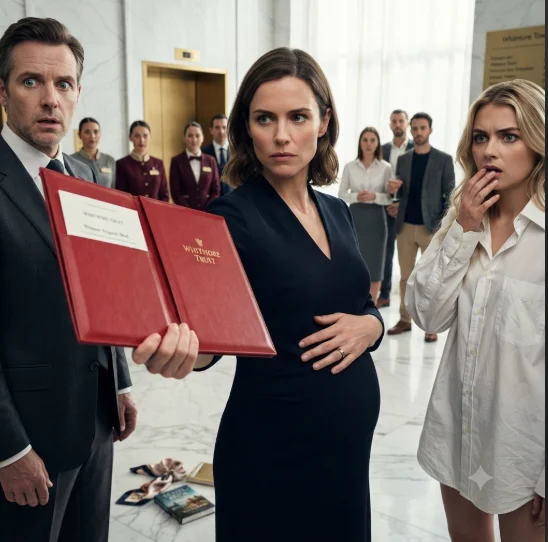
“I stopped practicing,” he said.
“You made choices, Andrew. Don’t turn them into something that happened while you weren’t looking.”
He nodded. “You’re right.”
Then he looked toward the nursery door. “May I see it?”
I hesitated. The nursery was our daughter’s space, not a prize I could withhold to punish him. I walked beside him and waited in the doorway. He touched the back of the rocking chair and stared at the books stacked on the shelf. One book, a collection of stories about brave girls, had a dedication from him on the inside cover. He had written, For our daughter, so she always knows her mother is the bravest person I have ever met.
He picked it up, read the words, and put it down without speaking.
“I don’t know whether you’ll be at the delivery,” I said. “I don’t know what we’ll be when she’s older. But if you want to be her father, you must learn how to be honest when honesty costs you something.”
“I will.”
Promises were easy in a quiet room. I wanted to see whether he could keep one in a crowded boardroom, where protecting me might cost him his standing. I walked him to the door without touching him. When the elevator closed, I remained there for a long moment, holding the empty box against my chest.
My phone rang. Rebecca’s voice was urgent but controlled.
“Grace, the audit team found Northstar’s payments to Vanessa. There’s also a calendar entry linking a Damian Cross to Sterling’s largest minority shareholder. We cannot yet tell whether the connection is improper, but this is no longer just a family matter.”
I looked toward my daughter’s nursery. I had hoped the scandal might shrink once the truth appeared. Instead it was growing, spreading from a lobby photograph into the offices where decisions worth hundreds of millions of dollars were made.
And for the first time, I wondered whether Vanessa had chosen Andrew because she wanted him, or because she needed someone powerful enough to destroy.
6 | The Price of a Perfect Scandal
The next morning, a courier delivered a letter from Vale Strategic Communications. It accused me of defamation, harassment, and interfering with Vanessa’s business relationships. I had not spoken publicly about her except through the limited security statement released by Rebecca. Yet here was a document suggesting I had orchestrated a campaign against the woman who threw my belongings onto a marble floor.
Leah read the letter and put it down. “Do not answer this yourself.”
“I wasn’t planning to.”
“Good. Angry people can say true things in the wrong way. The evidence matters more than the most satisfying response.”
That became our rule. We would not leak private medical records, invent accusations, or use access to money to frighten witnesses. I wanted Vanessa held accountable, but I did not want to become a different version of her.
Leah prepared a response preserving my right to seek remedies and directing her counsel to communicate through attorneys. She also advised me to stay out of the corporation’s investigation. If I became the person collecting and distributing confidential documents, even with good intentions, I could complicate both the inquiry and my own case.
I returned to the foundation because it was the one place where I still understood what needed to happen. A shipment of books was delayed, and I could solve that problem with a phone call. Volunteers needed a new sign-up form, which Simone and I created over lunch. A small school in Queens asked whether the mobile reading bus could visit earlier because its after-school program was being reduced. I said yes and found a way to pay for the additional driver hours.
These ordinary tasks steadied me. Children who needed books did not care whether Andrew Whitmore’s wife had become a trending topic. Their needs were not less important because my life had suddenly become loud.
While we worked, a board trustee named Julian Reed arrived unannounced. He had donated generously to the foundation for years and believed that generosity entitled him to express opinions without being asked.
“Grace,” he began, settling into the conference chair, “I know this is painful. But there are ways to handle a marriage privately. Donors don’t like uncertainty.”
I set down the list of schools. “Are you asking me to withdraw from the foundation?”
“Only until the coverage settles. Eleanor believes that would be wise.”
“Does the foundation’s mission require me to be married to Andrew?”
“Of course not.”
“Then tell me which volunteer visit, grant approval, or financial report I’ve mishandled.”
Julian looked offended. “That’s hardly the issue.”
“Then it shouldn’t be used as the excuse.”



