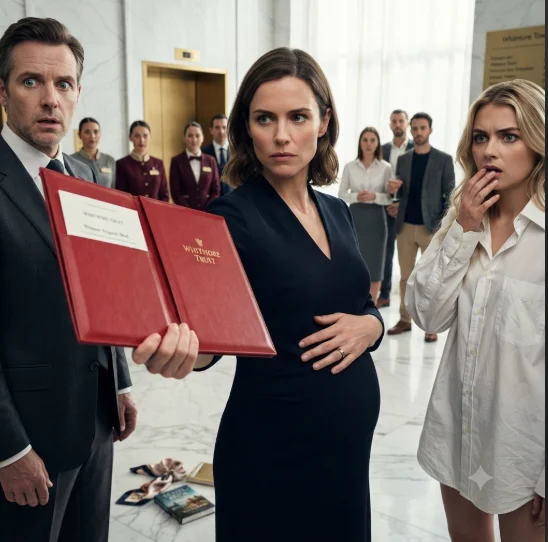
The first pages concerned emergency medical authorization. The next granted access to the residential elevators and the penthouse during any period when I needed them. Then I reached a blue cover sheet, stamped and recorded, with a county seal at the top.
I had never seen it before.
Andrew saw it, too. His jaw tightened. I traced the first line with my finger, trying to understand why a legal description of our home would be inside my emergency folder. Vanessa laughed, but the sound was thin.
“What is that supposed to be?” she asked.
“Andrew?” I whispered. “What is this?”
He looked at me, then at the floor. “The recorded deed.”
The lobby seemed to tilt. I read the name on the document once, twice, and then a third time. The owner was not Andrew Whitmore. It was not Whitmore Holdings, and it was certainly not Eleanor Whitmore.
The owner of the penthouse was Grace Ellis Whitmore.
Vanessa was still speaking when I finally lifted my eyes. But now she was the one who looked as though the marble might open beneath her feet.
And the most terrible truth was that I had only discovered the first secret Andrew had kept from me.
2 | Seven Confessions and Forty-Three Missed Calls
The first thing I did after learning that I owned the penthouse was refuse to go back to it. That surprised everyone, particularly Vanessa, who had apparently imagined I would wave the deed above my head and demand that security escort her into the rain. For a brief, bitter instant, the idea appealed to me. Then my daughter turned beneath my ribs, and I remembered that winning an argument in a lobby was not the same thing as knowing where I stood in my marriage.
I went to the forty-sixth-floor conference room instead. Andrew followed. Rebecca Shaw, Whitmore Holdings’ general counsel, arrived twenty minutes later carrying a notebook and a face so carefully composed it might have been carved from marble.
Vanessa had been escorted off the premises. Her private elevator credentials were revoked immediately, although I learned later that no one had yet considered all the other ways she had been allowed into our lives.
The room overlooked Manhattan in the rain. Across the table, Andrew looked exhausted. I hated that I knew how to read his tiredness. I could still tell when his left shoulder tightened because he had missed lunch and when his voice grew rough from speaking all day. Those intimate observations felt stolen from another woman’s life.
Rebecca’s eyes settled on the red folder. She did not look surprised.
“You knew about the deed,” I said.
“I helped arrange the transfer,” she answered. “Andrew requested it earlier this year. The recording was completed and the documents were placed in your emergency packet.”
“And no one told me?”
Andrew leaned forward. “I tried.”
“When?”
He counted them on his fingers. Once during my first miserable month of morning sickness, when I could barely keep down toast. Once after I missed a foundation dinner because my ankles had swollen. Once two weeks earlier, when he came home with champagne I couldn’t drink and said he had good news.
“Then Vanessa called,” I said, remembering that night with a clarity that made me sick.
He did not argue. Rebecca asked whether I wanted a physician. I told her I would decide after hearing the truth, and then I insisted she stay. Andrew said perhaps this should be private, but I was finished letting the definition of private change according to what protected him.
“How long?”
“Four months.”
“Where did it begin?”
“At the investor conference in Boston.”
“How many times?”
He stared at his hands. I waited. I thought about the evenings I had eaten alone, telling myself that the Sterling acquisition was consuming him. I remembered sending him photographs from our ultrasound while he said he was trapped in meetings. I had blamed myself for being suspicious when I found unfamiliar perfume in his car.
“Seven,” he finally said.
I heard Rebecca’s pen stop moving. It mattered that someone else was there, not because she was my friend, but because Andrew could no longer let his shame edit the conversation.
“Was it love?”
“No.”
“Then what was it?”
“An escape. There was so much pressure from the board, from the Sterling deal, from my mother. I wasn’t thinking clearly.”
“You don’t get to turn adultery into exhaustion,” I said. “You had seven opportunities to think clearly.”
His face changed. I had wounded him with the truth, and some foolish part of me almost apologized. I pressed my palms flat against the table until the impulse passed.



