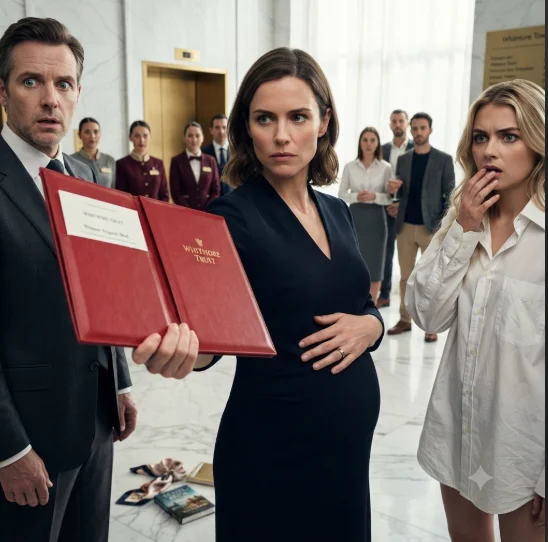
I looked toward the nursery. Tessa had been afraid to come forward because someone wanted to silence the people who knew how the spectacle had been arranged.
I checked the door locks even though Daniel had already confirmed they were secure. Fear was beginning to train my body in habits I disliked. I had to remind myself that I was not trapped in the lobby anymore. I could call my attorney, refuse an interview, spend an afternoon with schoolchildren, or tell my husband I wasn’t ready to see him. None of those decisions required approval from the Whitmore board. I put my shoes beside the door and laid a fresh notebook on the kitchen table. On its first page I wrote three words: facts, boundaries, daughter. They weren’t a strategy for defeating Vanessa. They were a way to recognize myself after an exhausting day. If I lost sight of them, the people who had made my life into a spectacle would have succeeded even if every accusation against them proved true.
The boardroom had finally heard the truth about Andrew. Now we had to find out whose plan had turned my family into a weapon.
10 | The Email That Turned a Marriage into a Strategy
The email from Tessa was not a confession wrapped in a ribbon. It was a draft with incomplete names, business language, and several sentences that could be interpreted in more than one way. That made it more disturbing, not less. Whoever wrote it had understood how to make cruelty sound like a professional deliverable.
One line described a possible public confrontation as a family pressure event. Another referred to destabilizing confidence in executive judgment. A third suggested using a sympathetic household figure to create controlled access friction. I read that phrase again and again. Controlled access friction. It meant my suitcase on the floor, Daniel hesitating to protect me, and my daughter moving beneath my ribs while someone prepared a headline.
The document was being reviewed by independent lawyers and the corporate auditors. Tessa’s attorney had authorized its release under a formal process. I received only a summary from Leah, not the complete confidential file. I was grateful for the boundaries even though I wanted to know every word.
“Do they know who wrote it?” I asked.
“Not conclusively. The draft moved between accounts associated with Vanessa’s firm and a Northstar contact. The metadata review is ongoing.”
“Is Damian Cross involved?”
“That’s one question the investigators are asking.”
I set down my coffee. My mother was watching me with the worried expression she used when I had a fever as a child. I told her the truth in plain words: someone may have used our marriage as leverage in a business dispute, but I did not yet know who had ordered what.
She took my hand. “And Andrew still chose to have the affair.”
“Yes.”
It mattered that she said it. The expanding corporate scandal could make Andrew appear as though he had been trapped in a scheme beyond his control. Perhaps Vanessa had approached him with motives he failed to see. Perhaps her relationship with Northstar gave her a reason to seek his trust. None of that erased his seven deliberate encounters with her or the access he gave her to our home.
Andrew had to carry his choices even if someone else had profited from them.
I met Rebecca later that week at an office outside Whitmore Tower. She was careful about what she could disclose, but she confirmed that the company’s audit committee was examining whether the Northstar relationship had been concealed during procurement reviews. The review was also considering whether communications materials prepared for Whitmore had been reused to influence opposing shareholders. All of this could create contractual and regulatory problems without my personal story proving any single allegation by itself.
The Sterling acquisition had been valued at approximately eight hundred forty million dollars. That number felt abstract until Rebecca explained what was at stake: facilities, jobs, logistics contracts, and long-term supplier arrangements. A delayed closing could benefit parties who wanted to renegotiate prices or pursue an alternative transaction. A public scandal could weaken Andrew’s negotiating position at precisely the wrong moment.
“Does the company need me to speak publicly?” I asked.
“Not unless you choose to,” Rebecca replied. “And you should discuss any request with Leah first.”
I remembered the day Eleanor had asked me to stand beside Andrew at a fundraiser because donors preferred seeing a stable family. Now I knew how quickly the same image could be used against me. I told Rebecca I would not become the corporation’s public proof of either innocence or recovery.



