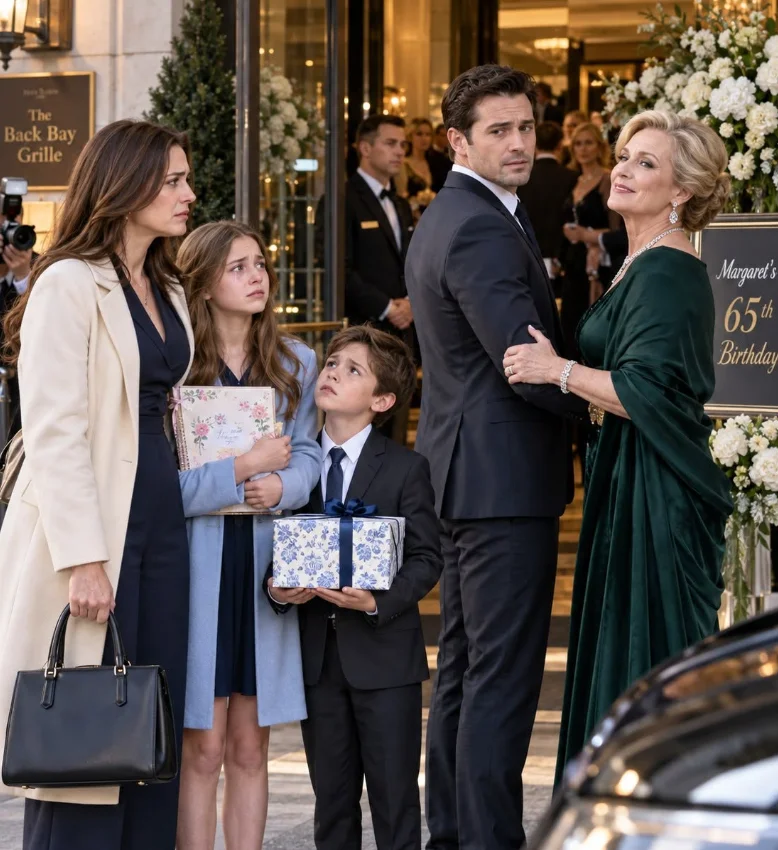
Chapter 1 – The Glass Partition
The chill coming off Boston Harbor always carried a cruel, metallic bite in mid-October, but inside the vestibule of L’Hiver, the air smelled exclusively of French butter, crushed eucalyptus, and money that had never known manual labor.
Margaret Cole stood beneath an arched trellis of white dendrobium orchids, her silk crepe gown the precise shade of fresh winter cream. Around her throat hung three strands of South Sea pearls—a sixty-fifth birthday gift she had picked out herself, charged to the platinum card resting quietly in my Goyard clutch. Her silver hair had been sculpted into a lacquered chignon by a stylist I had booked three weeks prior. She looked radiant, sovereign, and entirely without remorse.
“Only Nathan is coming inside,” Margaret said. Her voice possessed the cultivated, melodic hush she used when serving tea to the women of the Beacon Hill Historical Guild. “You and the children can wait somewhere else.”
Beside me, Caleb shifted his weight. My nine-year-old son was dressed in his navy blazer with the brass buttons, his dark cowlick tamed by half a tube of pomade he had let me apply without his usual protest. In his small, gloved hands, he balanced a square gift box wrapped in pale blue tissue paper. Inside was a fragile English porcelain tea set adorned with tiny forget-me-nots. He had spent four months collecting recycling, walking Mrs. Gable’s golden retriever, and saving every crumpled five-dollar bill from his weekly allowance to buy it from an antique shop on Charles Street because I had offhandedly mentioned in August that blue florals were his grandmother’s favorite.
“Grandma,” Caleb said, his voice piping upward against the low hum of the upright bass playing inside the private salon. He lifted the box toward her with arms that were already trembling from the weight. “I chose the blue floral pattern because Mom said it was your favorite. I saved for months.”
Margaret did not reach for the box. She did not even cast her gaze downward. Her pale eyes remained fixed on the middle button of my cashmere wrap coat.
“Put it away, sweetheart,” she murmured, her tone dripping with sweet, lethal condescension. “I want a peaceful evening without complications. Children Caleb’s age spill things, they fidget, and they simply do not belong at a four-course tasting menu with vintage pairings. Nathan, take the box and put it in the coat check.”
My daughter, Sophie, took half a step backward. At fourteen, she possessed her father Daniel’s observant, dark eyes and his devastating ability to read a room in a fraction of a second. Under her arm was an archival-grade scrapbook bound in forest-green leather. She had spent the last seven days locked in her bedroom, printing old photographs of Nathan as a toddler, Nathan graduating from prep school, and Nathan’s late father standing on the deck of their old sailboat in Marblehead. She had handwritten captions in gold calligraphy, working until two in the morning so Margaret would have something sentimental to show her guests.
Sophie’s knuckles turned white against the green leather. She understood long before I did.
“Margaret,” I said, keeping my voice level, though the blood had begun to thrum a steady, warning rhythm against my temples. “We reserved the entire private salon. The private terrace is enclosed and heated. We specifically coordinated with Chef Laurent for a children’s service during the first two courses so they could celebrate your milestone, present their gifts, and then my driver would take them home before the speeches. We went over this schedule three times on Tuesday.”
Margaret smoothed the silk over her hips and sighed, a sound of theatrical exhaustion. “Things change, Caroline. When the guest list filled out, several of Nathan’s father’s former partners accepted. True Bostonians. Men who remember when names meant something in this city. It is entirely inappropriate to crowd the room with unnecessary distractions.”
The restaurant’s maître d’ hovered six feet away, his tablet clutched to his chest, eyes tactfully fixed on the herringbone parquetry floor. Behind the frosted glass French doors, forty people—Nathan’s relatives from Rhode Island, Margaret’s social circle, the board members she desperately wanted to impress—were clinking crystal flutes of Dom Pérignon.
I had paid for that champagne.
I had authorized the twelve-thousand-dollar deposit on my American Express Centurion card six weeks ago. I had approved the custom floral arrangements when Margaret complained that local hydrangeas looked like “suburban weeds” and demanded imported Dutch orchids. I had personally settled the room minimum, the audiovisual setup for the retrospective video, and the five-hundred-dollar-an-hour jazz trio currently playing a muted rendition of Gershwin behind the doors.
Now, Margaret reached out, linked her gloved hand through my husband’s forearm, and pulled him toward the threshold.



