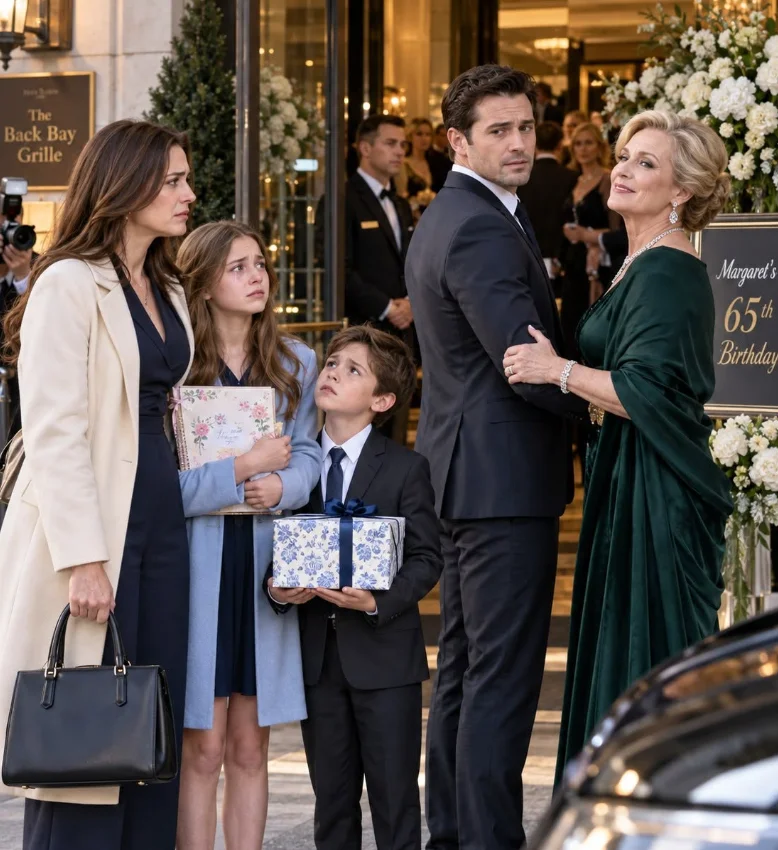
Nathan pulled his arm free of his mother, but he didn’t move toward his family. Instead, he straightened his lapels, his face hardening into that sullen, defensive mask he wore whenever he knew he was acting like a coward.
“I cannot ruin her birthday, Caroline,” he said, his voice flat, trying to sound authoritative and failing miserably. “We’ll talk about this at home. Take the children back.”
Then he turned on his heel. He didn’t look at Caleb’s trembling hands. He didn’t look at Sophie, whose tears were now falling silently onto the dark green leather of her scrapbook.
He walked through the glass doors.
Margaret paused on the threshold. She turned back to me, her lips curved into a triumphant, predatory smirk. She didn’t say another word; she merely let the heavy mahogany-and-glass door swing shut behind her, cutting off the warmth, the music, and the laughter.
I stood in the vestibule for five seconds. Caleb was crying now, pressing his face into the fabric of my coat, his shoulders shaking. Sophie had dropped the scrapbook onto a nearby leather bench, her arms wrapped around her own ribs as if she were trying to hold herself together.
I did not scream. I did not bang on the glass. I did not cause a scene in front of the waitstaff.
“Sophie,” I said, my voice entirely steady. “Pick up your book, sweetheart.”
“I don’t want it,” she choked out, her voice ragged. “I want to throw it in the trash.”
“You will not throw it in the trash,” I told her gently, picking up the heavy volume myself and placing it firmly under my arm. “You poured your time and your talent into this. It has value, even if the person it was meant for has none. Come.”
I took Caleb’s cold little hand in mine. With the other, I guided Sophie past the coat check and out into the biting harbor wind. The valet, recognizing me from my frequent visits to the restaurant’s building, brought my Range Rover around in less than two minutes.
I settled the children into the back seat, buckled Caleb in, and turned the seat warmers to high. I reached into the glove compartment, pulled out a box of linen tissues, and handed them to Sophie.
“Are we poor, Mom?” Caleb asked from the shadows of the leather interior, his voice muffled by sniffling. “Grandma said Nathan carries us. Did Daddy not leave us anything? Is Nathan paying for my school?”
I turned around from the front passenger seat, resting my knees on the leather, and looked both of them directly in the eyes.
“Listen to me,” I said, ensuring every word was stamped with undeniable certainty. “Your father, Daniel, built an empire so that you would never, for one second of your lives, have to bow your heads to anyone. Nathan Cole does not pay for your school. Nathan Cole does not pay for our apartment. Nathan Cole does not pay for the food on our table, the clothes on your back, or the fuel in this car. Nathan Cole does not carry us. We have been carrying him.”
Sophie wiped her face, her eyes narrowing as Daniel’s sharp intelligence sparked behind her tears. “Then why did she say that?”
“Because people who have nothing of their own must invent lies so they do not choke on their own shame,” I answered. “Now, sit back. We are going to have a proper dinner at the Bristol, and then we are going home to pack Nathan’s things.”
I closed the door, climbed into the front, and pulled my phone from my bag.
I did not call Nathan. I did not text him. I scrolled down my contacts to a name that had been at the top of my speed dial since childhood: James Monroe. My older brother, the senior managing partner at Monroe, Vance & Sterling, Boston’s premier commercial litigation and trust firm.
He answered on the second ring. “Caroline? Aren’t you supposed to be at Margaret’s coronation?”
“Start preparing divorce papers,” I said.
The line went completely dead for two seconds. In the background, I could hear the faint sound of papers shuffling in his downtown office.
“Where are you?” James asked, his voice instantly dropping the casual fraternal warmth and shifting into the cold, razor-sharp focus that made corporate boardrooms tremble.
“Sitting in my car outside L’Hiver,” I said, looking at the glowing chandelier visible through the restaurant’s second-story windows. “Margaret refused to let Sophie and Caleb through the door. She called them ‘another man’s children’ and told me Nathan was carrying us. When I gave Nathan a choice, he turned his back on them and walked inside.”
A long, slow exhalation came through the speaker. “Did he now?”
“Yes.”
“Are the kids alright?”



