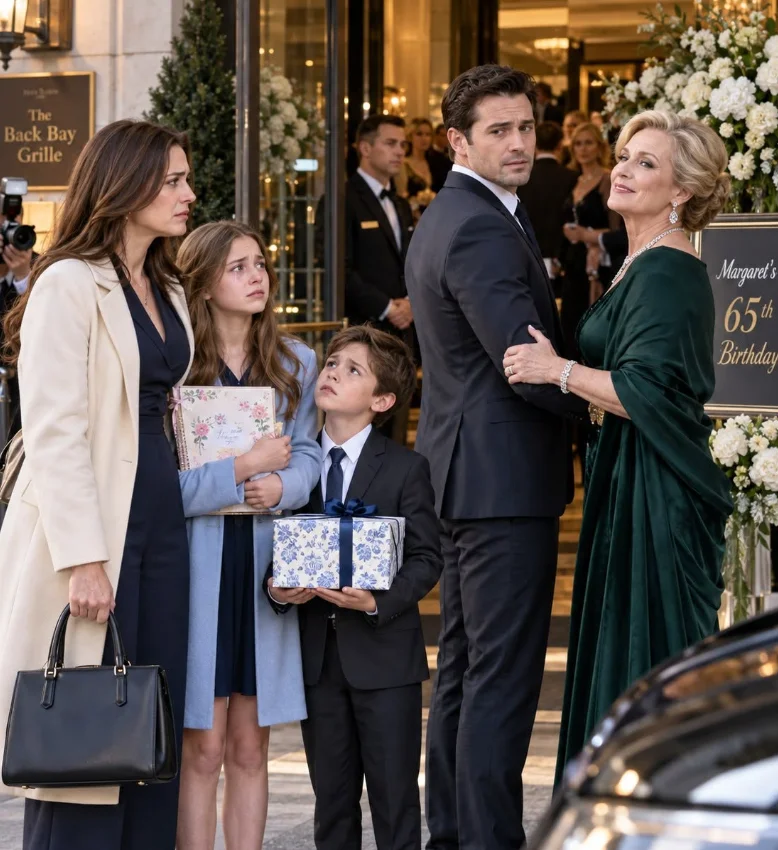
The heavy bronze doors slid open, and Nathan stepped into the foyer.
He was not wearing his tuxedo jacket; it was slung haphazardly over one shoulder, his bow tie undone and dangling like an uncoiled snake across his unbuttoned collar. His hair was disheveled, and his face was flushed with the dull, aggressive red of someone who had consumed far too much high-end liquor under an immense amount of sudden stress.
He stopped dead when his eyes hit the three duffel bags stacked beside the console table.
Slowly, he turned his head toward the kitchen, where a single architectural pendant light cast a cool, surgical glow across the stone island. I was sitting there, still wearing my dark slacks and a black silk blouse, an untouched cup of mint tea resting beside my laptop.
“What is this?” Nathan demanded. His voice was thick, missing its usual polished cadence, vibrating with an indignation that bordered on hysterical. “What the hell is this, Caroline?”
“Those are your clothes,” I said evenly. “The bespoke suits you had tailored this summer, your casual wear, your shoes, and your toiletries. Your watch collection is in the small velvet case on top. Your golf clubs are downstairs with the concierge.”
Nathan dropped his tuxedo jacket onto the foyer floor—a move that would have normally horrified his neat-freak sensibilities. He stomped into the kitchen, his leather soles slapping loudly against the hardwood.
“Have you completely lost your mind?” he shouted, slamming his palms down onto the cold basalt surface opposite me. “Do you have any idea what you did to me tonight? Do you have any earthly conception of the humiliation I just endured?”
“I know exactly what you endured,” I said, not blinking. “You had to pay a bill.”
Nathan’s jaw worked furiously. “Marc Fournier came over to our table at eleven-fifteen! In the middle of dessert! Right as Uncle Arthur was finishing his toast to my mother! He handed me an itemized invoice for twenty-four thousand, eight hundred dollars!”
“That sounds entirely accurate,” I replied calmly. “Your mother insisted on opening six bottles of the 2010 Château Margaux from the reserve list, which were not part of the package I approved. She kept the jazz trio two hours past their contracted time, and she demanded the waitstaff remain until midnight. In high-end hospitality, Nathan, overtime and reserve vintages require liquidity. Did you think the restaurant was going to eat the cost of your mother’s vanity?”
“You revoked the authorization!” he roared, leaning across the island, his breath smelling heavily of vintage wine and raw panic. “They declined your card because you specifically instructed them to! In front of Arthur! In front of the board members from the trust! I had to pull out three different personal credit cards to cover the balance, and two of them bounced because the credit limits were nearly maxed out from the summer trip to Nantucket!”
“Then it’s fortunate you had a third card,” I said, taking a slow sip of my tea. “Otherwise, you and Margaret might have had to wash dishes in your silk gowns.”
Nathan looked at me as if I had spoken in an ancient, forgotten tongue. The utter absence of guilt, the total lack of apology in my demeanor, seemed to terrify him far more than any shouting match would have.
“Caroline,” he said, his tone abruptly shifting, dropping the fury and trying to locate that smooth, manipulative charm he had used so effectively during our courtship. He ran both hands through his hair, pacing along the length of the basalt counter. “Look… tonight went sideways. I admit that. Mom was out of line. She was stressed, she had a couple of martinis before she arrived, and she got territorial. You know how older women from her generation get about their milestones. She feels irrelevant, she feels aging, and she lashed out.”
“She looked directly at my nine-year-old son, who spent his own allowance to buy her a gift, and told him he was a burden,” I said, keeping my tone so cold it seemed to lower the temperature in the room. “And then you agreed with her.”
“I didn’t agree with her!”
“You walked through the door, Nathan. You stood on that threshold, you looked at Caleb crying, you looked at Sophie standing in the cold with a book she poured her heart into, and you told me you couldn’t ruin your mother’s birthday. By walking through that door, you told my children that their presence was a nuisance, that their grief was an inconvenience, and that your mother’s shallow social standing mattered more than their dignity.”
Nathan closed his eyes, exhaling heavily through his nose. “I was trying to avoid a scene! If I had walked out with you, my mother would have had an absolute breakdown in the lobby! It would have been gossip at the Somerset Club by tomorrow morning!”



