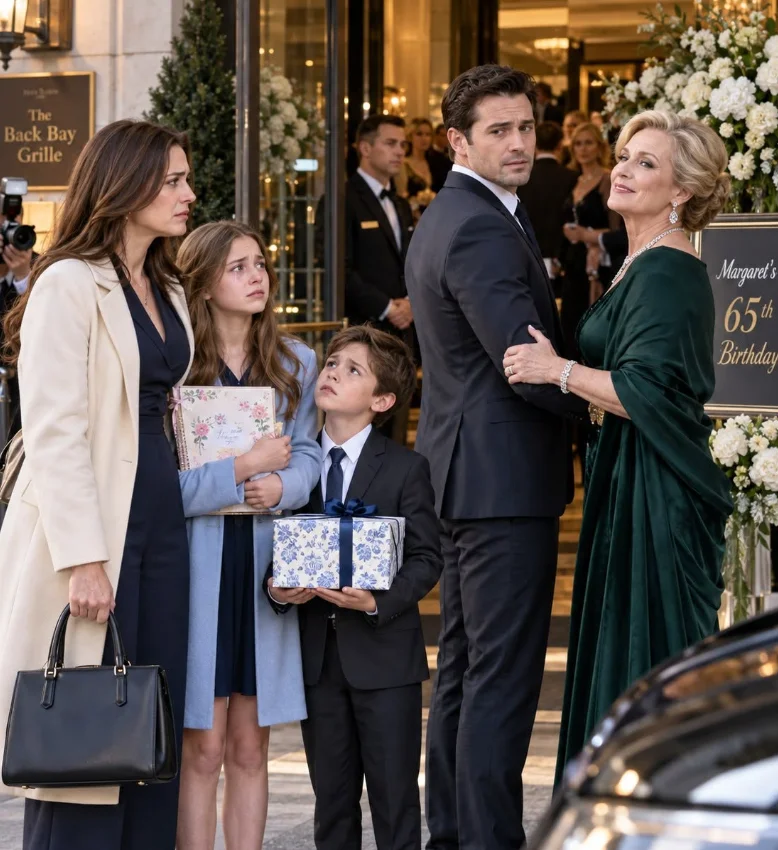
I stepped forward, my hand immediately dropping into my bag to dial the direct line for the Boston Police detail James had arranged. But before I could speak, Sophie did something that stopped all of us in our tracks.
She gently pushed past me, stepping directly to the edge of the sidewalk, her arms crossed over her school blazer. She did not look frightened. She did not look like a vulnerable fourteen-year-old girl. She looked like a Vance.
“Stop right there, Nathan,” Sophie said. Her voice wasn’t loud, but it cut through the afternoon chatter of the school sidewalk like a razor.
Nathan skidded to a halt ten feet away, breathing heavily, his hands outstretched in an exaggerated gesture of supplication.
“Sophie… please,” Nathan begged, looking around nervously at the parents who had stopped to stare. “You know me. I’ve helped you with your history homework. I took you to your sailing lessons. Your mother has completely misunderstood everything! She’s trying to destroy our family! Talk to her! Tell her she can’t do this!”
Sophie looked at him. Her gaze was so cold, so thoroughly devoid of the affection Nathan was begging for, that it seemed to physically push him back.
“You left Caleb on the sidewalk,” Sophie said, each word perfectly measured, perfectly clear. “You let your mother insult my father’s memory. And then you walked inside because you cared more about champagne than you did about us.”
“Sophie, it was her birthday—”
“My father died six years ago,” Sophie interrupted, her voice steady and razor-sharp. “I remember everything about him. I remember how he stood between us and anything that tried to hurt us. He would have torn down that restaurant with his bare hands before he let anyone make Caleb cry.”
Nathan’s jaw worked, but he had no words.
“You are not my father,” Sophie continued, stepping back toward the Range Rover and taking Caleb’s hand. “You never were. You were just a guest in our house who overstayed his welcome. Don’t ever come near my school again.”
Two Commonwealth Academy security guards, alerted by the commotion, stepped off the stone porch, moving with quick, purposeful strides toward Nathan.
“Sir, you need to step away from the students immediately,” the lead guard ordered, his hand resting firmly on his duty belt.
Nathan looked at Sophie, then at Caleb, who was staring at him without fear now, holding his sister’s hand tightly. Finally, Nathan looked at me.
I didn’t utter a single syllable. I simply held up my phone, showing him the glowing screen that displayed the local precinct’s dispatch unit connecting to the call.
Nathan cursed under his breath, turned on his heel, and sprinted back toward his rented car. He threw himself into the driver’s seat, hit the gas, and sped down Commonwealth Avenue, his tires screeching as he blew through a yellow light at the corner of Arlington Street.
The lead security guard walked over, his expression grim. “Are you alright, Mrs. Vance?”
“We are entirely fine, Officer,” I said, opening the car door for my children. “Just taking out the trash.”
Sophie climbed into the passenger seat, buckled her seatbelt, and looked out the window at the Public Garden. For the first time in twenty-four hours, the tension had vanished from her shoulders.
“Hot chocolate, Mom?” she asked quietly.
I smiled, putting the car in gear. “Extra marshmallows.”
***
Chapter 7 – The Society Gala Confrontation
By Thursday evening, Margaret Cole had reached the stage of desperation where shame no longer existed.
Deprived of her credit lines, facing a thirty-day eviction notice on her Brookline home, and unable to reach Nathan—who was currently hiding in a budget motel near Dedham trying to avoid process servers—Margaret decided to play the only card she had left: public sympathy.
The occasion was the annual Autumn Gala for the Boston Arts Preservation Trust, held inside the grand ballroom of the Copley Plaza Hotel. It was the premier society event of the fall season, attended by every prominent family from Beacon Hill to Cambridge.
Margaret had secured her ticket months ago—a ticket I had paid for when purchasing our family’s corporate table.
I knew she would be there. James had advised me to skip the event, but I had refused. Daniel Vance had served as the vice-chair of that trust for eight years before his death, and our family foundation was the primary donor for the evening’s restoration endowment. I would not allow a parasitic mother-in-law to run me out of my late husband’s philanthropic home.
I arrived at eight o’clock, dressed in an architectural column gown of midnight-blue velvet, Daniel’s grandmother’s diamond-and-sapphire choker resting at my throat. James accompanied me, looking impeccably formidable in his tuxedo.



