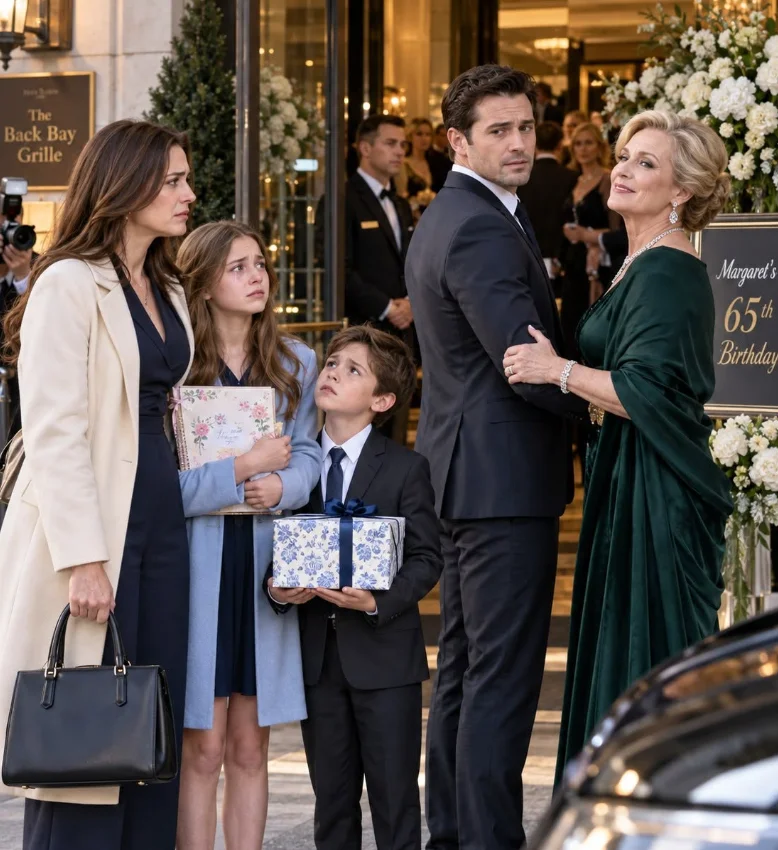
“My son knows how to treat his mother like a lady,” she said loudly enough for two arriving couples to hear as they handed their cashmere coats to the attendant. “He inherited his father’s elegance. Blood will always tell.”
I looked at Nathan.
My husband of three years was wearing a custom tuxedo cut from charcoal wool by an Italian tailor on Newbury Street—a tailor he had visited on my account. He was thirty-eight, handsome in the soft, slightly weathered way of men who had spent their youth on varsity squash courts and their thirties looking for someone to fund their lifestyle. His jaw was clenched, his gaze darting nervously between his mother’s manicured hand and the open dining room where his peers were drinking my wine.
“Nathan,” I said quietly. “Talk to your mother.”
Nathan swallowed. The color rose in his neck, blotchy and red against his crisp white collar. He didn’t look at me; he looked just over my left shoulder, focusing on the brass umbrella stand near the entrance.
“Mom,” Nathan muttered, his voice dropping into that wheedling, placating register he always used when her demands turned impossible. “Maybe we should not do this right here. Caroline planned the whole dinner. The kids worked on those gifts all week.”
Margaret’s smile vanished like frost wiped from a windowpane. Her chin lifted, and her voice lost every shred of its southern-tinged Boston Brahmin sweetness.
“This is my birthday, which means I decide who attends,” she hissed, leaning in so close I could smell the violet pastilles she chewed to hide the scent of her afternoon gin. “I am not rearranging my evening, nor am I compromising the dignity of this celebration, around another man’s children.”
Sophie flinched as if she had been struck across the mouth.
Their father, Daniel Vance, had died six years ago when an icy patch on Route 128 sent a semi-truck across the median. Sophie had been eight; Caleb had been three. Daniel had left behind a void that had taken us years of therapy, quiet tears, and fierce, unyielding family loyalty to survive. He had also left behind an immense, exquisitely structured industrial estate—a family shipping and logistics conglomerate that operated across seven ports on the Eastern seaboard.
Margaret knew how Daniel had died. She knew that the date of his accident was less than three weeks away. And she knew precisely where the blade would cut deepest.
“You will not speak about my children that way,” I said, my voice dropping so low it startled the maître d’ into looking up.
Margaret offered me a slow, dismissive once-over, taking in my plain emerald earrings and the dark tailoring of my coat.
“Nathan already carries you,” Margaret scoffed, her voice venomous. “He carries two children who are not his, and he provides that expensive Seaport apartment you all enjoy. Do not stand here pretending you are the one making sacrifices, Caroline. If you had any breeding at all, you would know your place.”
Caleb’s fingers slipped slightly on the blue box. He looked up at me, his brown eyes wide, glossy with unshed tears that threatened to spill over his dark eyelashes.
“Mom?” he whispered, his small voice cracking through the quiet vestibule. “Are we a burden?”
That question was a clean, jagged tear through my chest. Every instinct I possessed as a mother, every ounce of protective fury that had kept me alive after Daniel was buried, rose into my throat like liquid iron.
I turned away from Margaret and pinned my husband with my gaze.
“Nathan,” I said. “Look at your stepson. Look at Sophie. Are you coming outside to take them home with me, or are you going inside without us?”
Nathan’s eyes darted frantically toward the salon. Inside, someone tapped a butter knife against a crystal glass, calling for a toast. A burst of laughter drifted through the cracked glass doors. Through the opening, I could see his second cousin waving a hand to catch his attention.
“Caroline, please,” Nathan pleaded under his breath, taking a half-step toward me, though his arm remained firmly pinned under his mother’s elbow. “Be reasonable. She’s sixty-five. The whole family is here. If I leave right now, she’ll be humiliated in front of everyone. It will cause a scandal that will last for years. Let me just stay for the first hour. I’ll make the toast, cut the cake, and take an Uber back to the Seaport. Take the kids to that burger place they like near the wharf. We’ll celebrate with Mom privately next week.”
“Nathan,” I repeated, every syllable crystalline. “If you walk through that door, you don’t come home.”
Margaret laughed—a sharp, dry sound that rattled like dead leaves. “Don’t listen to her empty dramatics, Nathan. A real man doesn’t let his wife issue ultimatums on his mother’s birthday. A well-bred woman knows when to step aside.”



