“Don’t bother coming to the gala tonight, Nolan. You’re written out of the will. Don’t show your face and ruin it for everyone else.”
Thirty-two years old, and my father still knew exactly how to make me feel like a little boy being sent away from the dinner table.
My stepmother, Brenda, responded with a thumbs-up.
My older brother, Wyatt, added, “It’s for the best, little brother. You always make things awkward anyway.”
I stared at that last sentence longer than I should have.
Wyatt and I used to share a bedroom. When I was nine, he taught me how to ride a bike after Dad got tired of watching me fall. He’d held the handlebars all the way down our street, promising he wouldn’t let go.
Somewhere along the way, he’d stopped being that brother.
I typed three different replies. Deleted every one.
Then I set my phone facedown and went back to my coffee.
My father, Richard, was the CEO of Crestwood Industries, a company worth roughly $100 million. He loved reminding people he’d built it from nothing.
That wasn’t quite true.
My mother, Eleanor, had built the supplier relationships, managed the finances, and spent more evenings at her desk than I could count. Dad handled the handshakes and ribbon-cuttings. Mom handled everything that kept the doors open.
She died five years ago.
Six months later, Dad married Brenda.
By the following Christmas, Mom’s photograph had disappeared from the corporate lobby. Her name was quietly removed from company materials. And I was encouraged to find employment somewhere else.
I became a supply chain manager at a smaller firm. Decent job. Modest apartment. A used sedan that needed new brakes.
At family dinners, Dad introduced Wyatt as his vice president.
He introduced me as “the one who went his own way.”
I used to pretend that didn’t bother me.
Three weeks before New Year’s, I received an email from Crestwood’s HR department.
Brenda wanted my mother’s old office cleared out so she could turn it into a private lounge.
I went on a Tuesday afternoon.
The room smelled like dust and old paper. Mom’s ceramic coffee mug was still sitting on the windowsill, with a faint brown stain inside. I remembered teasing her about never washing it properly.
I was wrapping it in newspaper when Brenda appeared.
“Still hanging on to all this junk?” she asked.
“It’s Mom’s stuff.”
“Nolan, your mother has been gone five years. At some point, you have to move forward.”
She glanced at the boxes.
“And please don’t damage the furniture. Some of it is being donated.”
I wanted to tell her that my mother had paid for every piece of furniture in that building.
Instead, I kept packing.
After Brenda left, I opened the bottom drawer of Mom’s heavy oak cabinet. It jammed halfway, just as it had when I was a kid.
I pulled harder.
The drawer came off its tracks and landed against my shoe.
Behind it, a thin wooden panel had slipped loose.
I knelt to straighten it and noticed something tucked into the space behind the cabinet.
A small brass lockbox.
I recognized it immediately.
Mom used to keep that box beside her bed. After she died, Dad searched the house for it for weeks, insisting it contained important family documents.
Apparently, he’d never thought to look in her office.
I took it home.
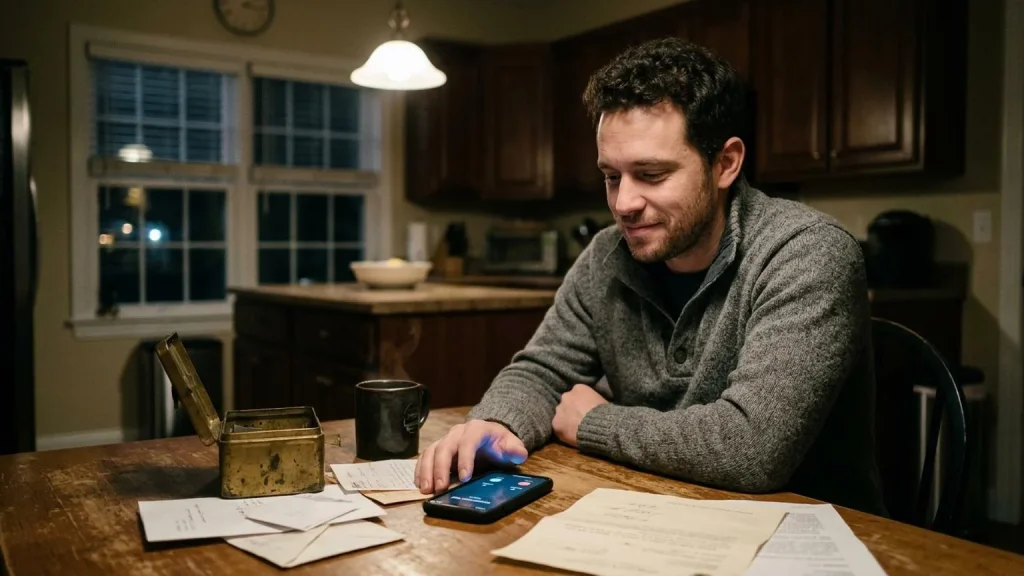
That evening, I finally managed to open it.
Inside were several thick legal documents and a cream-colored envelope with my name written across the front.
I knew that handwriting.
I sat at my kitchen table for a long moment before breaking the seal.
The first line read:
“My dearest Nolan, if you’re reading this, I need you to understand something about your father.”
I stopped there.
Mom had been dead for five years, but hearing her voice in my head was still painfully easy. She had a way of saying my name when she was worried about me, drawing out the first syllable as though she could soften whatever came next.
I kept reading.
“Your father is a gifted man in certain ways. He knows how to make people believe in him. Unfortunately, he has always confused their belief with his own entitlement.”
I almost laughed.
Even in a letter written for after her death, Mom couldn’t bring herself to be entirely cruel about him.
She explained that Crestwood had grown beyond what she and Dad originally imagined. She was proud of that. But she worried about what would happen when she was no longer there to question his decisions.
Then I reached a paragraph that made me put the letter down.



