Not because I wanted to punish everyone who’d worked under Dad, but because I knew how easily bad decisions could hide inside familiar routines.
Some executives left.
Others stayed and helped rebuild the company’s controls.
Several longtime employees returned after Martha contacted them.
One was a warehouse operations director named Helen who had worked with Mom for eighteen years.
She shook my hand on her first day back.
“Your mother used to walk the loading dock in those ridiculous red shoes,” she said.
I laughed.
“I remember those.”
“Nearly broke her ankle twice.”
“She refused to stop wearing them.”
Helen smiled.
“She said the men in the boardroom were already uncomfortable with her being smarter than them. She might as well give them something else to complain about.”
I hadn’t heard that story.
For the rest of the afternoon, I found myself smiling whenever I thought about it.
The company gradually stabilized.
We reassured suppliers, renegotiated some contracts, and made sure the employees knew their jobs weren’t being treated as collateral in a family dispute.
I kept my old job until we had arranged a proper transition.
Luis threw me a small farewell lunch.
He presented me with a coffee mug that read WORLD’S MOST ANNOYING SPREADSHEET GUY.
I still use it.
In late March, I went back to Mom’s old office.
Brenda’s contractors had never completed the renovation.
The carpet had been removed in sections, and expensive modern furniture sat under plastic covers.
I stood in the doorway looking at the mess.
Then I called maintenance.
“Can we get the old oak cabinet back in here?”
The supervisor frowned.
“It’s in storage. Heavy thing.”
“I remember.”
“Why do you want it?”
I thought about the drawer that had come off its tracks.
“Because it belongs here.”
We restored the room gradually.
Mom’s framed photographs returned to the walls. Her original ledgers went into protective display cases. The ceramic coffee mug went back onto the windowsill, brown stain and all.
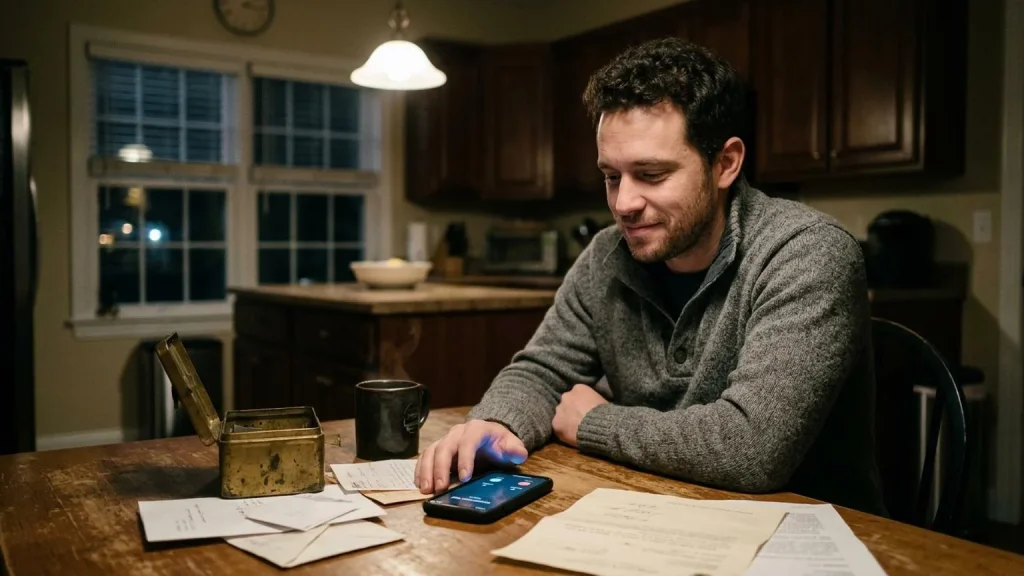
I kept the brass lockbox in a cabinet beside my desk.
Not because I expected another secret to appear.
Because I wanted to remember how easily a life could be changed by something overlooked.
One Friday afternoon, Marshall visited.
He walked around the room, inspecting the photographs.
“Your mother would’ve hated this carpet,” he said.
“I know. We’re replacing it.”
He nodded approvingly.
Then he handed me an envelope.
“Your father asked me to give you this.”
I stared at it.
“From him?”
“Yes.”
I didn’t reach for it.
Marshall placed it on the desk.
“You don’t have to read it.”
“Does he apologize?”
“I haven’t opened it.”
I looked at the envelope for a long time.
Then I set it in the drawer.
I didn’t read it that day.
Or the next.
It took me another week.
When I finally opened it, Dad’s handwriting was stiff and uneven.
He wrote that he regretted how things had happened.
He said he’d felt pressured after Mom died.
He said he’d worried that I wasn’t prepared to manage Crestwood and that the business needed stable leadership.
He described Brenda as having encouraged certain decisions.
He suggested Wyatt had misunderstood instructions.
There were explanations for almost everything.
But nowhere did he write the words I stole from you.
Nowhere did he say I’m sorry I hurt you.
At the bottom, he asked whether I would consider visiting him.
I folded the letter.
For the first time, I understood why Mom had written that Dad loved the crown but hated the responsibility.
Even after losing his position, he was still trying to distribute the blame.
I didn’t answer.
A few days later, however, I wrote to Wyatt.
It took me an entire evening to finish four sentences.
I told him I’d received his letter.
I told him I appreciated his willingness to tell the truth.
I told him that didn’t mean I trusted him.
And I told him I wasn’t ready to see him.
He replied a week later.
“I understand.”
Nothing else.
Strangely, that was the first response from him in years that didn’t feel like an attempt to manage me.
By spring, I had settled into a routine.
Board meetings on Tuesdays.
Operations reviews every Thursday.
Coffee in Mom’s office most mornings.
Sometimes I worked late, though I tried not to repeat her habit of treating exhaustion like proof of dedication.
Martha reminded me frequently.
“Your mother would’ve told you to go home.”
“Mom worked until midnight.”
“Yes,” Martha replied. “And she regretted missing things.”
One evening, I found an old photograph tucked between two of Mom’s ledgers.
Wyatt and I were standing beside her in the backyard.
I was missing a front tooth.
Wyatt had one arm around my shoulders and was making a ridiculous face.
Dad had taken the picture.



