He stared at the microphone in my hand.
“Nolan,” he said, barely audible. “I didn’t think it would go this far.”
I felt my throat tighten.
“How far did you think it would go?”
He looked at Dad.
Then Brenda.
Then back at me.
“I didn’t think you’d ever find out.”
The room seemed to stop moving.
Dad stepped away from the podium.
“Wyatt, not another word.”
But Wyatt had already started.
“You told me it was necessary,” he said to Dad.
Brenda moved toward him.
“Sweetheart, you’re upset. Come sit down.”
“Don’t call me sweetheart.”
It was the first time I’d ever heard him speak to her that way.
He looked at me again.
“They said you didn’t want anything to do with Crestwood. They said you would destroy it if you got control.”
I could barely get the words out.
“So you signed?”
He wiped his mouth with the back of his hand.
“I was supposed to witness a signature. Dad showed me the form. He said you had already agreed.”
Marshall stepped closer.
“Wyatt, you should speak with independent counsel before saying anything further.”
Wyatt gave a shaky laugh.
“Yeah. I probably should’ve done that two years ago.”
Dad’s face had gone gray.
“You ungrateful little fool,” he whispered.
And there it was.
Not fear for his sons.
Not grief over what our family had become.
Anger that Wyatt had stopped protecting him.
For the first time, I understood that my brother and I had spent our entire lives competing for something Dad could withdraw whenever he pleased.
I’d lost that competition years ago.
Wyatt was only now discovering that winning hadn’t made him safe.
Whitcomb signaled to his team.
“Richard, Global Logistics will not proceed with the merger discussions until these matters are resolved.”
Dad turned toward him.
“Dan, don’t do this.”
“We have obligations to our shareholders.”
“We’ve spent eighteen months negotiating.”
“I know.”
“You can’t walk away because of a family argument.”
Whitcomb’s expression hardened.
“This stopped being a family argument when the company represented that its controlling ownership was undisputed.”
He gathered his papers.
His team followed him out.
Dad watched them leave.
Then he looked at me.
Something in his expression made me step back.
“You did this,” he said.
I didn’t answer.
“You walked in here and destroyed everything I’ve worked for.”
“Dad—”
“Don’t call me that.”
The words hit harder than I expected.
He moved toward me.
Marshall stepped between us.
“Richard, that’s enough.”
For a moment, I thought Dad might push past him.
Instead, he stopped, breathing heavily.
One of the event security officers approached.
“Sir, perhaps we should step outside.”
Dad stared at the officer as though he couldn’t understand why anyone would speak to him that way.
Brenda began arguing with Martha.
Wyatt sank into his chair, his hands covering his face.
The investors’ conversations grew louder.
The party was over, even though the orchestra continued playing quietly in the corner because nobody had thought to tell them to stop.
I looked at my family.
I’d imagined this moment so many times.
Dad admitting he’d lied.
Brenda finally unable to smile her way out of trouble.
Wyatt looking at me and understanding what he’d done.
But standing there, I didn’t feel triumphant.
I felt tired.
Marshall touched my shoulder.
“You’ve said what you needed to say.”
I handed him the microphone.
Dad was sitting now, one hand pressed to his chest.
For a moment, I worried about him.
Then he looked up.
“You’ve ruined us, Nolan.”
I stared at the man who’d taught me to shake hands firmly and never complain when life was unfair.
“No,” I said quietly. “You made decisions. I’m asking you to answer for them.”
He looked away.
I turned and walked toward the exit.
Martha followed me into the lobby.
Outside the ballroom, the hotel staff were still arranging trays of desserts.
A young waiter asked whether I wanted a glass of champagne.
I almost laughed.
“No, thanks.”
Martha stood beside me.
“Your mother would be proud you spoke up.”
I looked at her.
“Would she?”
“Yes.”
“Even like that?”
She considered the question.
“She wouldn’t have enjoyed watching her family fall apart.”
I nodded.
“But she would have wanted the truth.”
That was probably the closest thing to comfort I could accept.
I hugged her.
She smelled faintly of lavender.
Then I went home.
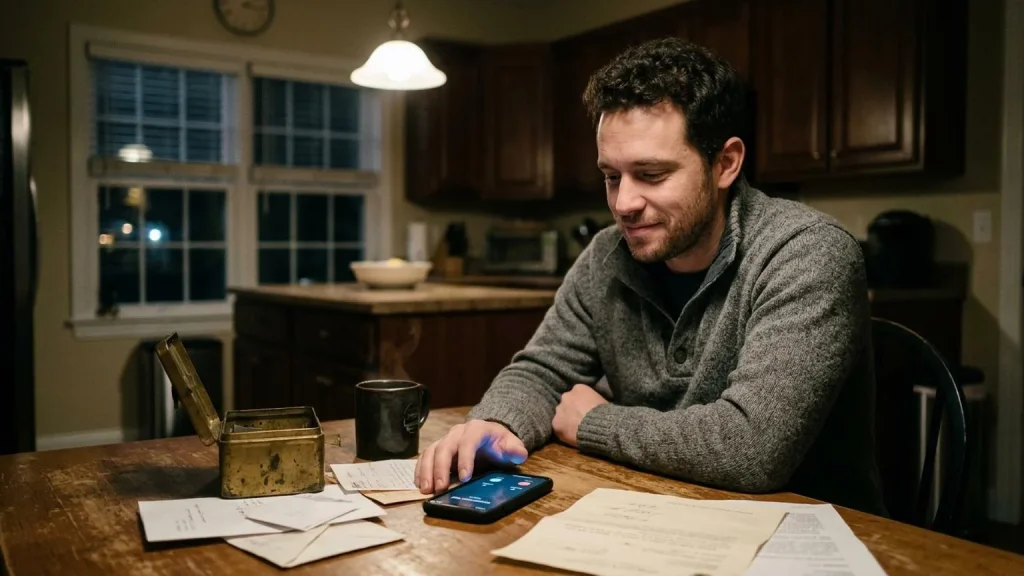
I arrived at my apartment at 11:45.
I loosened my tie, took off my shoes, and put water on for tea.
The kitchen looked exactly as I’d left it.
Coffee cup in the sink.
Grocery list on the refrigerator.
A box of Mom’s belongings beside the table.
It seemed absurd that a person’s entire life could be rearranged while his apartment remained so stubbornly ordinary.



