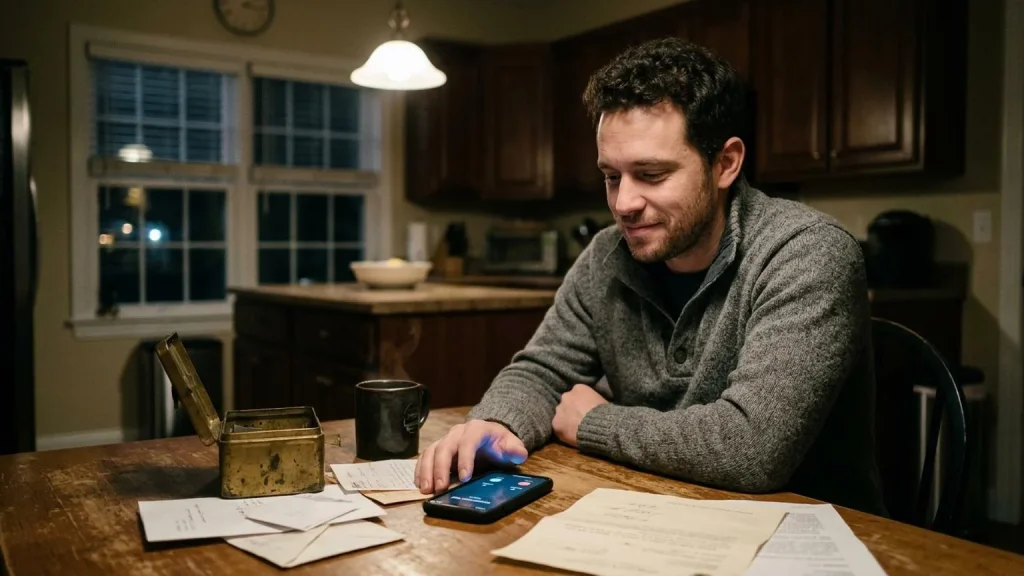
I sat looking at it for a while.
I couldn’t make the happiness in that photograph disappear simply because I knew what happened later.
And I didn’t want to.
That was the hardest part of everything.
The people who betrayed me hadn’t always been strangers wearing familiar faces.
They’d also been people I loved.
People who once loved me in whatever incomplete ways they knew how.
Their betrayal didn’t erase every decent memory.
But the memories couldn’t excuse what they’d done.
I placed the photograph on my desk.
A few weeks later, I visited Mom’s grave.
It was a quiet Saturday morning.
The cemetery grass was still wet, and someone had left fresh flowers beside the headstone.
I brought her favorite yellow roses.
For several minutes, I stood there feeling foolish.
Then I sat on the low stone bench nearby.
“I found your letter,” I said.
A bird called from somewhere behind me.
“I wish you’d just told me.”
I laughed a little.
“You probably thought I wasn’t ready. Maybe you were right.”
I told her about the company.
About Martha.
About the old cabinet.
About how difficult the first board meeting had been.
And finally, about Dad and Wyatt.
“I don’t know if I’ll ever forgive them,” I admitted.
I waited, as though there might be an answer.
There wasn’t.
Only the sound of traffic beyond the cemetery wall.
But sitting there, I realized something I’d been avoiding since New Year’s Eve.
For years, I’d measured my worth by whether Dad approved of me.
Every holiday invitation, every job title, every compliment he gave Wyatt had seemed like evidence that I was somehow less deserving.
Even after I discovered the trust, part of me wanted the company because I imagined it would finally force him to respect me.
It hadn’t.
He’d lost control and still refused to admit what he’d done.
I could spend the rest of my life trying to make him understand.
Or I could stop asking him to be the person I needed.
I stayed at the cemetery until the morning warmed.
Then I went home.
That evening, I took the watch Dad had given me on my thirtieth birthday out of the drawer.
I hadn’t worn it since finding Mom’s letter.
It was an expensive watch.
A beautiful one, actually.
For a while, I’d hated it because of what it represented.
Dad had handed it to me on the very birthday when I was supposed to receive control of my mother’s shares.
He’d looked me in the eye and told me to make something of myself.
I turned the watch over.
There was an inscription on the back.
To Nolan. Make your own way. Dad.
I sat with it in my palm.
Then I put it back in the box.
Not because I had forgiven him.
Not because I wanted to forget.
But because I no longer needed to destroy every object connected to him in order to move forward.
Two months after New Year’s Eve, the most visible pieces of my old life had changed.
I was no longer the son everyone dismissed at family gatherings.
I had legal control of the voting interest my mother intended me to inherit.
The company was being rebuilt under independent management and stronger oversight.
The investigations into my family’s conduct continued, with consequences that none of us could fully predict.
Dad no longer controlled the business.
Brenda no longer had access to its accounts.
Wyatt was learning what life looked like without the protection of our father’s name.
And I was learning something different.
How to make decisions without wondering whether Dad would approve.
I hadn’t gained the loving family I wanted.
I hadn’t heard the apology I deserved.
I couldn’t pretend that uncovering the truth had made the pain of losing my mother any smaller.
But I had found something she wanted me to have.
Not just the company.
The ability to protect what mattered without surrendering myself in the process.
One afternoon, I was sitting in her restored office reviewing supplier contracts when Martha knocked.
“There’s someone here to see you.”
I looked up.
“Who?”
She smiled faintly.
“An old friend of your mother’s. He says he has a story about her first warehouse.”
I put down my pen.
“Send him in.”
The man who entered was nearly eighty, with a worn baseball cap in his hands.
He introduced himself as Frank, a retired delivery driver who’d worked with Crestwood when the company operated out of a rented building with a leaking roof.
He looked around the office.
“Eleanor would be pleased to see this,” he said.
I offered him a chair.
He declined.
“Bad knees. Easier to keep standing sometimes.”
Then he pointed at the old coffee mug.
“She still had that thing?”



