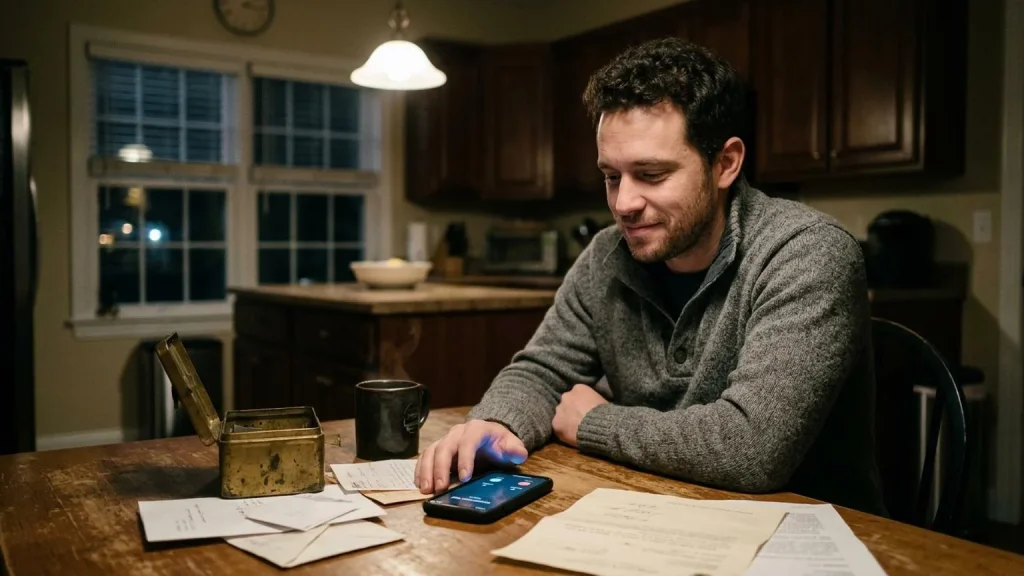
I laughed.
“Apparently.”
Frank smiled.
“Your mother once stayed up all night helping me find a missing shipment. Turned out the paperwork was wrong, and the freight was sitting in a warehouse three towns over.”
“That sounds like her.”
“She drove out there herself at five in the morning.”
I shook my head.
“Of course she did.”
Frank looked at me carefully.
“You’ve got her eyes.”
People had told me that before.
But something about the way he said it made my throat tighten.
“Thank you.”
He nodded toward the window.
“I heard what happened with your father.”
I waited.
“Didn’t come here to talk about that,” he said. “I came because your mother once told me something.”
“What was it?”
He rubbed the brim of his cap.
“She said she hoped her boys would grow up knowing that a person’s worth isn’t measured by the size of the office they sit in.”
I looked around the room.
The heavy oak cabinet.
The ledgers.
The photographs.
The desk where she’d spent so many evenings working while I waited at home.
Frank cleared his throat.
“Anyway. Just wanted you to know.”
After he left, I sat for a long time without opening another contract.
Then I picked up Mom’s photograph.
In it, she was laughing at something outside the frame.
I wondered what had been so funny.
I wondered whether Dad had made her laugh.
Maybe he had.
Maybe once, before money and pride and fear had twisted everything between them, they’d been happy.
I couldn’t know.
And for the first time, I didn’t feel compelled to solve every mystery.
I set the photograph down.
Outside my office, the company continued its ordinary afternoon.
Phones rang.
Employees walked past carrying files.
Somewhere down the hall, someone laughed.
A forklift alarm sounded faintly from the loading area below.
Crestwood was still a business.
It still needed work.
It still belonged to hundreds of people in ways that mattered more than their names appearing on legal documents.
I opened the supplier report waiting on my desk.
The first page contained a discrepancy in delivery costs.
I reached for my pen.
Then I stopped and smiled.
Mom would’ve found it in five minutes.
I took a sip of coffee from her old mug and got to work.
On New Year’s Eve, my father had told me to stay away because I was written out of his will.
He believed that was the worst thing he could take from me.
For years, I might have believed him.
But the inheritance he’d tried to hide was never simply about money.
It was about the choices my mother made, the trust she placed in me, and the life I’d been told I wasn’t good enough to deserve.
My father had wanted me to spend midnight alone, ashamed, waiting for permission to belong.
Instead, at 12:01 a.m., my brother called because the truth had finally reached the world outside our family.
I gave him an answer I still sometimes regret.
“And you think I care?”
The truth is, I did care.
I cared more than I wanted to.
I cared that my father was in an ambulance. I cared that my brother was frightened. I cared that the family I’d spent thirty-two years trying to belong to had finally broken apart.
But caring didn’t mean I had to rescue them from consequences they’d created.
And loving people didn’t mean allowing them to keep hurting me.
I still don’t know whether my father will ever understand that.
Maybe he won’t.
I can’t control it.
What I can control is what happens inside the company my mother built and what kind of man I become now that nobody else gets to decide my worth.
That morning, I looked at the photograph on my desk one last time.
Then I turned back to my work.
For the first time in years, I wasn’t trying to prove that I belonged in the room.
I knew I did.



