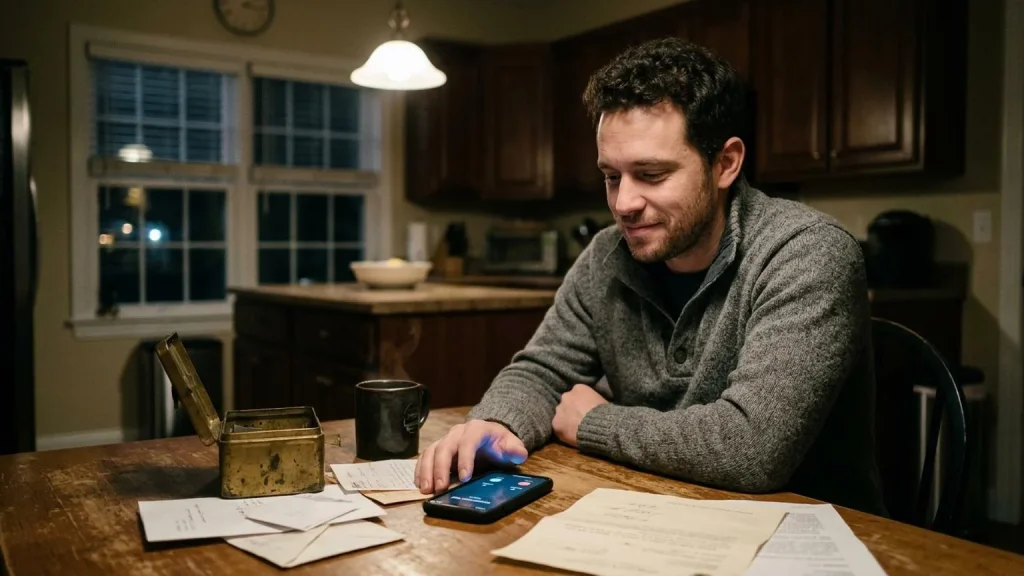
I rubbed my forehead.
“Unfortunately.”
He pulled up a chair.
“Man.”
“Yeah.”
He sat with me for a moment.
Then he said, “You still owe me that carrier report.”
I laughed so hard I had to cover my face.
It was the first proper laugh I’d had in weeks.
Two weeks after New Year’s, Marshall called.
The court had ordered a fuller examination of the disputed trust records, and the waiver’s authenticity was now central to the proceedings.
The trust administrator had located records indicating that my father had been notified of the impending transfer before my thirtieth birthday.
There was also correspondence concerning the supposed waiver.
The more documents emerged, the harder it became to believe that the signature had been reproduced by accident.
Wyatt, through his attorney, began cooperating with the investigation.
He admitted that Dad had presented him with the waiver and instructed him to sign as witness, despite Wyatt not having personally observed me sign it.
He also acknowledged approving the Oak and Iron invoices without verifying the services.
His attorney advised him to provide records and cooperate with the appropriate authorities.
That didn’t erase what he’d done.
But it clarified how it happened.
Dad had built a world in which saying no meant losing everything.
Wyatt had spent his adult life protecting his position in that world.
I had been pushed out of it.
Neither of us had known how to live with him any other way.
In early February, I received a letter from Wyatt.
Not an email.
An actual letter, forwarded through Marshall.
His handwriting looked different from the confident signature I’d seen on company documents.
Messier.
Less certain.
He wrote that he didn’t expect forgiveness.
He admitted he’d known the waiver wasn’t legitimate.
He’d told himself Dad would eventually make things right.
He’d believed that as long as Crestwood remained successful, the damage to me could somehow be justified.
Then he wrote something I wasn’t prepared for.
“I kept telling myself I was protecting the family. But mostly I was protecting my job, my house, and the way Dad looked at me when I did what he wanted.”
I read that sentence several times.
Near the end, he mentioned the bicycle.
“I remember teaching you to ride. I remember telling you I wouldn’t let go. I don’t know when I became somebody who would let you fall just to stay on Dad’s good side.”
I folded the letter.
I didn’t answer.
Not then.
By the end of February, the forensic and financial investigations had advanced considerably.
The contested waiver was determined to be invalid through the legal proceedings, and the court recognized the trust’s transfer provisions.
My ownership rights to the controlling voting interest were formally acknowledged.
Dad’s authority over those shares had expired when I turned thirty.
The business had been operating under an inaccurate ownership record for two years.
The separate financial investigation established that large payments had gone to Brenda’s company without adequate evidence of corresponding services. Investigators were examining who authorized the arrangements, who benefited, and whether criminal conduct had occurred.
Richard and Brenda faced serious civil claims, and the relevant authorities were reviewing evidence for potential charges.
Their attorneys denied some allegations and contested others.
The proceedings would take time.
Justice, I was learning, involved considerably more paperwork than television suggested.
Dad’s personal financial position deteriorated as litigation costs mounted. Certain assets became subject to legal restrictions, and the board terminated his employment for cause after completing its internal review.
Brenda’s relationship with Crestwood ended entirely.
Wyatt lost his executive role and the comfortable certainty that had come with it.
I didn’t celebrate any of that.
Not publicly, anyway.
There were moments alone in my apartment when I felt a sharp, guilty satisfaction imagining Dad opening his own legal bills.
Then I would remember Mom telling me not to confuse being right with being kind.
I wasn’t always kind.
I was trying to be fair.
Those weren’t the same thing.
In March, the board invited me to serve as chairman.
I accepted, on the condition that the interim chief executive remain responsible for daily operations until a permanent leadership decision could be made.
Martha supported the arrangement.
“You’re not your father,” she told me.
“I know.”
“Then stop worrying that you have to prove you’re better at everything he did.”
That was easier said than done.
My first board meeting lasted four hours.
I asked so many questions about supplier exposure, vendor payment terms, and inventory financing that one director finally smiled and said, “You really are Eleanor’s son.”
I wasn’t sure whether he meant it as a compliment.
I decided to take it as one.
I also insisted on an independent review of Crestwood’s procurement and consulting practices.



