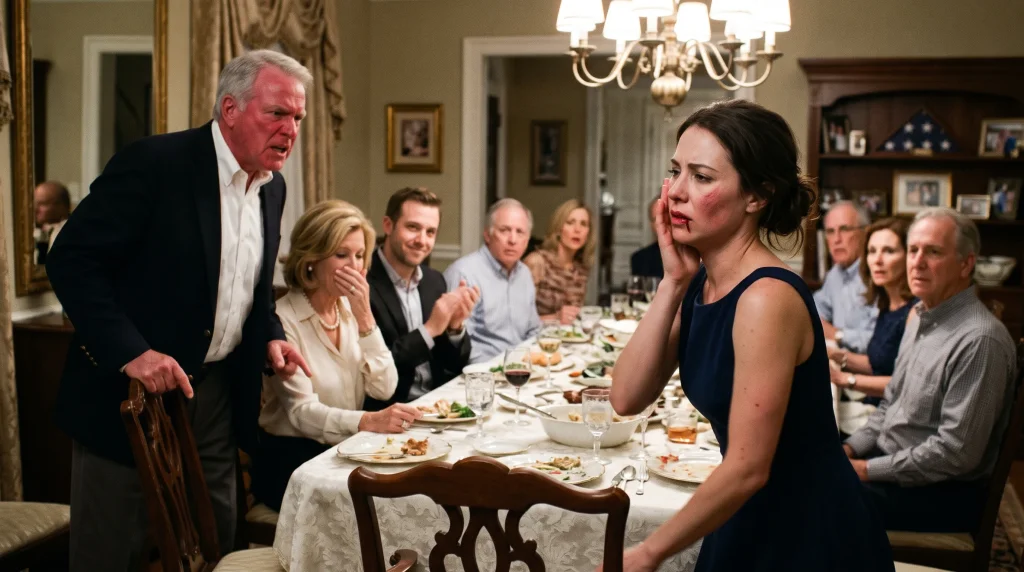
Dad shifted slightly in his chair.
“At our family reunion, I told him about a job I’d earned. He responded by punching me.”
I swallowed.
“I’ve been asked why I didn’t just apologize. Why I didn’t keep this private. Why I chose to involve the courts.”
I looked toward Mom.
She was staring at her hands.
“I kept things private for thirty-two years. Privacy didn’t make our family safer. It just made it easier for the same behavior to continue.”
I could feel myself starting to cry.
I hated it.
Then I realized nobody was going to punish me for crying.
So I continued.
“I don’t want my father humiliated for the sake of humiliation. I want him to understand that being angry doesn’t give him the right to hurt someone. Not an employee. Not a client. Not his daughter.”
I folded the paper.
“That’s all.”
Dad never looked at me.
But when I sat down, Aunt Jean reached for my hand.
She’d come despite Mom telling her it would only make things worse.
I held on to her fingers until the hearing ended.
Outside the courthouse, reporters gathered near the steps.
Dad’s attorney issued a brief statement.
My father expressed regret for the incident and said he wanted to move forward privately.
I watched from across the street.
He’d spent years commanding attention.
Now every word he spoke had been approved by someone else.
For a moment, I wondered whether he understood what he’d lost.
Then Diana touched my arm.
“Ready?”
“Yes.”
And we walked away.
The business consequences continued long after the criminal case ended.
The board removed Dad permanently from executive leadership.
Regulatory settlements imposed substantial financial penalties and required changes to the firm’s operations.
Civil claims from affected clients increased.
Gordon Financial was eventually sold to a larger financial services company in a transaction that preserved portions of its client business and some jobs while ending the Gordon family’s control.
The sale price was far below what Dad had once claimed the firm was worth.
After liabilities, settlement costs, and legal expenses, the family received much less than anyone had expected.
There were no dramatic scenes of furniture being carried from the mansion.
No sheriff’s auction on the front lawn.
The decline happened through legal invoices, difficult meetings, quiet withdrawals from bank accounts, and a series of increasingly desperate conversations with advisors.
That was somehow more unsettling.
Dad had always treated wealth as proof that he was right.
Now the numbers were telling a different story.
Mom’s life changed too.
Without the company, the charity circuit, and the social position she’d spent decades maintaining, she seemed to lose her sense of direction.
She canceled her annual garden party.
Stopped attending several committees.
Eventually, she filed for divorce after thirty-six years of marriage.
I learned about it from Aunt Jean.
“She’s staying with me for a few days,” Jean said.
I sat down.
“Mom?”
“Yes.”
“Is she okay?”
“She’s upset. But she’s safe.”
Jean hesitated.
“She’s also difficult.”
I laughed.
That sounded accurate.
Mom and Dad had been married so long that I couldn’t imagine them living separately.
She had defended him through every outburst.
Explained away every insult.
Smoothed over every ugly incident.
Part of me had believed she would do that forever.
But without the lifestyle she’d built around his success, she apparently began asking questions she’d avoided for years.
Their divorce proceedings revealed that she had known about some of the company’s questionable financial practices, though the extent of her involvement remained disputed.
She insisted she’d never understood the seriousness of the problems.
Maybe that was partly true.
My mother had spent decades choosing not to understand things that threatened her comfort.
That didn’t make her innocent.
But it made her more complicated than the woman I’d imagined when I was lying in that hotel room with a swollen face.
Justin didn’t fare much better.
He was not charged with the same misconduct as Dad, but his senior position and his unwavering public defense of the company’s practices damaged his professional reputation.
After the sale, he struggled to find comparable work.
Eventually, he moved to Pennsylvania and took a position with a relative’s insurance business.
I found out through a cousin.
For several days, I felt an ugly little thrill.
Justin had spent years mocking my career while enjoying opportunities handed to him.
Now he was starting over without the Gordon name opening doors.
Then I felt guilty for enjoying it.
Then I felt annoyed at myself for feeling guilty.
My therapist, Dr. Rebecca Hart, called that “being human.”
I started seeing her shortly after the assault.
At first, I treated therapy like another professional assignment.
I arrived early, brought notes, and tried to summarize my emotional development in organized bullet points.
Rebecca was patient.



