The tax authorities also began examining certain transactions, although not every suspicion led to a charge or finding.
The distinction mattered.
For the first time in my life, I wanted to be precise about what my father had actually done.
I didn’t need him guilty of everything.
I needed the truth to matter.
The firm established a fund to address certain client losses while negotiations continued.
Former employees described an environment where questioning senior management could damage a career.
Daniel Mercer, the former compliance analyst, contacted me through his attorney.
We met at a coffee shop in Stamford.
He was younger than I’d expected, maybe thirty-five, with tired eyes and a wedding ring he kept turning around his finger.
“Your father used to talk about you,” he said.
I stiffened.
“Oh?”
“At management meetings. He’d mention you were working at some big firm and then make a joke about how you were too idealistic to succeed.”
I looked at my coffee.
“That sounds like him.”
Daniel hesitated.
“One time, I challenged a billing practice. He told me I was starting to sound like his daughter.”
I laughed before I could stop myself.
Daniel smiled awkwardly.
“Sorry. I know that’s not funny.”
“No,” I said. “It actually is.”
He explained that he’d spent years trying to persuade management to improve its disclosures.
Sometimes the company complied.
Sometimes his concerns were buried.
Eventually, after a particularly ugly meeting, he’d resigned.
“Why didn’t you report it sooner?” I asked.
He rubbed his forehead.
“My wife was pregnant. We had a mortgage. Your father’s firm was my biggest professional reference.”
He looked embarrassed.
“I kept telling myself someone higher up must have approved everything.”
I understood.
Not because I’d faced his exact circumstances.
But because I’d spent decades telling myself that someone else would eventually make my father behave differently.
Daniel looked at me.
“You know what the worst part was?”
“What?”
“I started believing him. That I was difficult. That I wasn’t a team player. That maybe I didn’t understand the business.”
I thought about the number of times Dad had called me oversensitive.
“It gets into your head,” I said.
“Yeah,” Daniel replied. “It really does.”
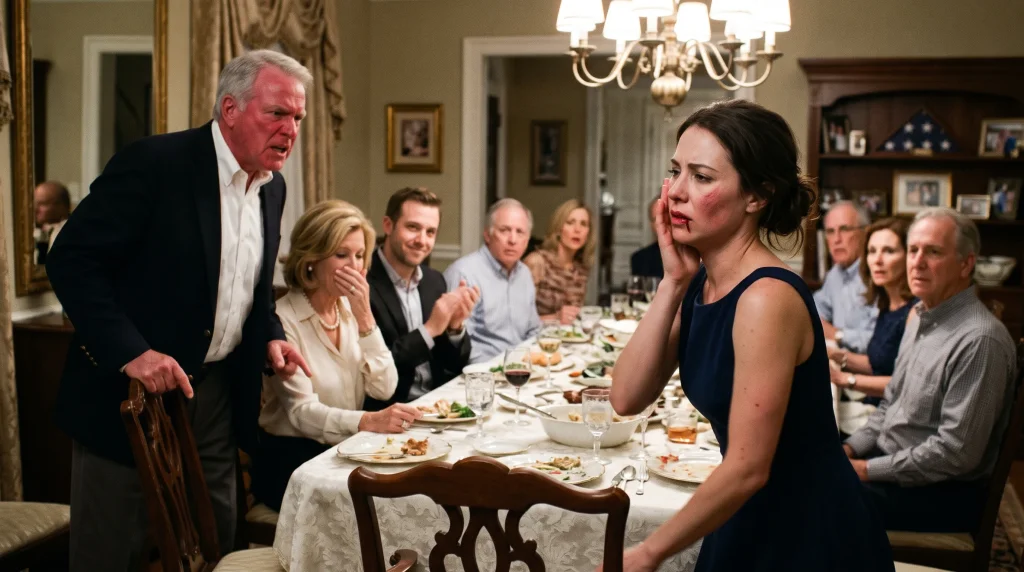
The criminal assault case moved on a separate timeline.
My father initially denied striking me intentionally.
Through his attorney, he characterized the incident as an unfortunate physical confrontation during a heated family argument.
Then Aunt Jean gave her statement.
Uncle Robert, after weeks of avoiding calls, eventually confirmed that he’d witnessed Dad strike me.
Two cousins also provided accounts.
Their descriptions weren’t identical.
One remembered Dad shouting before he stood up.
Another thought I’d been standing when he approached.
A third couldn’t recall the exact words exchanged.
But on the central fact, they agreed.
He had punched me.
And I hadn’t struck him.
When Diana told me, I felt a strange mixture of relief and humiliation.
I’d been so certain nobody would tell the truth that four people doing so seemed miraculous.
But they’d all watched me walk out injured.
It shouldn’t have taken lawyers to make them say what happened.
The hearing was scheduled for a rainy Monday.
I wore a gray suit and low heels.
Diana met me outside the courthouse.
“How are you feeling?”
“Like I might throw up.”
“Have you eaten?”
“Half a banana.”
She opened her bag and handed me a packet of crackers.
I almost smiled.
It reminded me of the things Aunt Jean used to carry in her purse.
Inside, the courtroom was smaller than I expected.
Dad sat beside his attorney wearing a navy suit and an expression of controlled irritation.
Mom sat two rows behind him.
Justin was beside her.
Neither looked at me when I entered.
The case had moved toward a negotiated resolution. Dad ultimately agreed to plead guilty to a reduced misdemeanor assault charge, with sentencing terms including probation, court-ordered counseling, and restrictions on contact.
There would be no full trial.
I was relieved.
Then I was furious.
Part of me had wanted him forced to sit through every detail.
Every photograph.
Every witness.
Every ugly moment.
But Diana reminded me that a criminal proceeding wasn’t designed to provide a perfect emotional reckoning.
The court could hold him legally accountable.
It couldn’t give me the father I’d wanted.
I was allowed to make a statement.
My hands shook as I unfolded the paper I’d written.
I had spent three evenings revising it.
The first version was twelve pages long.
Diana helped me cut it to two.
I looked at Dad.
He stared straight ahead.
“When I was a child,” I began, “I believed my father was the smartest person in every room.”
My voice sounded unfamiliar.
“I admired how hard he worked. I wanted to be like him. And I spent years believing that if I accomplished enough, he’d eventually be proud of me.”



