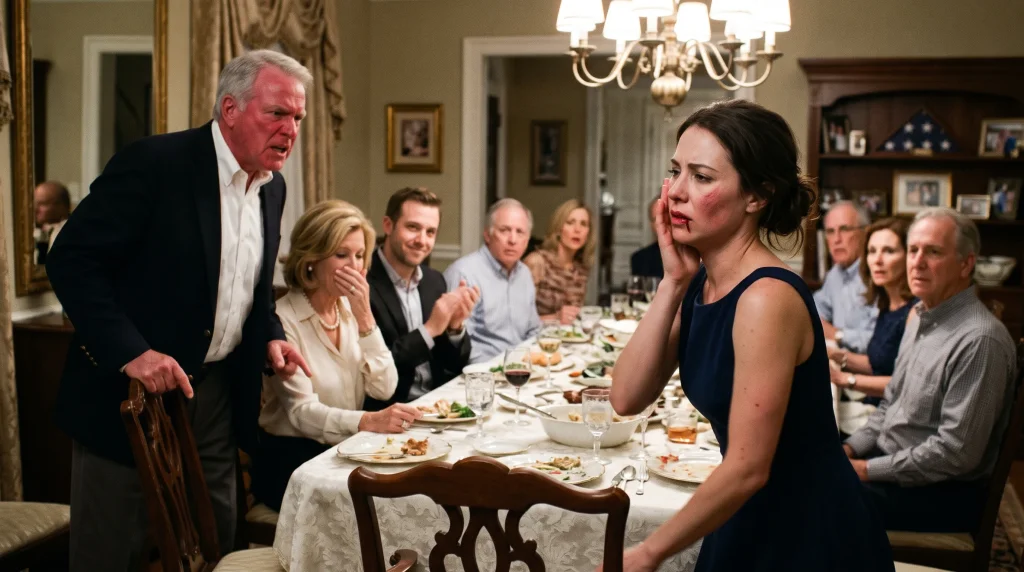
“I’m sorry it’s so late,” I said. “I wouldn’t call if it wasn’t important.”
“What’s happened?”
I opened my mouth, then closed it.
There were two separate things I needed to tell him. One was that my father had assaulted me. The other was that I had information suggesting his company had misled clients.
For some reason, saying either one aloud felt like stepping off a ledge.
“Amanda?”
“I think Gordon Financial Services has been misrepresenting investment performance. And I have records that may support it.”
He didn’t respond immediately.
“Your father’s firm?”
“Yes.”
“Are you somewhere safe?”
That question nearly undid me.
Not whether I understood the seriousness of the allegation. Not whether this was some family disagreement.
Whether I was safe.
“I’m in a hotel.”
“Did something happen tonight?”
“My father hit me.”
I heard movement on his end, followed by a door closing.
“Listen carefully,” he said. “First, you need medical attention. Second, don’t send me anything yet. We need to establish exactly what you obtained, how you obtained it, and which agency has jurisdiction. I’m not going to let you compromise a legitimate complaint by rushing.”
I sat there with the phone pressed against my ear, staring at a stain on the carpet.
“Okay.”
“We’ll speak properly in the morning. Do you understand?”
“Yes.”
“And Amanda?”
“Yeah?”
“If these records show what you think they show, this needs to be handled through official channels. Not as leverage in a family dispute.”
“I know.”
But after we hung up, I had to admit something uncomfortable.
An hour earlier, I’d been imagining the look on Dad’s face when someone finally told him no.
Michael was right to be cautious.
I didn’t want to become my father simply because I’d found a different way to hurt someone.
At 1:06 a.m., I made the second call.
Diana Winters, a Connecticut attorney recommended by a former colleague, had an emergency contact service for clients facing domestic violence.
I left a message explaining what had happened.
She called back eleven minutes later.
Unlike Michael, Diana didn’t sound surprised.
She asked whether I needed an ambulance, whether I was alone, whether my father knew my location, and whether he had ever threatened me before.
Then she said something I hadn’t expected.
“You do not have to decide what happens to your family tonight. But you should protect yourself tonight.”
She directed me to seek medical care, preserve photographs, and prepare to report the assault. We arranged to meet later that morning.
By then my hands were trembling so badly I could barely hold my phone.
The third number belonged to James Wilson.
James was an investigative journalist who covered financial misconduct for a national business publication. We’d met the previous year when he’d interviewed me about gender discrimination in finance.
I had spoken to him anonymously because I didn’t want to jeopardize my job.
He’d honored that agreement.
At 1:32 a.m., I called him.
He answered with the unmistakable irritation of someone who’d been awakened by a ringing phone.
“This better be good.”
“It’s Amanda Gordon.”
A pause.
“Finance Amanda?”
“Yes.”
“What’s going on?”
“I may have a story involving Gordon Financial Services.”
“Your father’s company?”
“Yes.”
His tone changed.
“Are you calling as a source?”
“I think so.”
“Then before you say anything else, we need to establish what you’re willing to put on the record.”
I almost laughed.
Three phone calls. Three people immediately concerned with procedures, boundaries, and responsibilities.
For 32 years, I’d lived in a family where the rules changed depending on what my father wanted.
It was strangely comforting to encounter people who actually respected them.
James agreed to meet later that day, after I’d received medical attention and spoken with my attorney.
I hung up at 1:49.
The room was quiet.
Outside, a delivery truck backed toward the hotel loading dock, beeping steadily.
I’d done it.
Three calls.
Nothing had happened to my father yet.
No police officers had arrived at his door. No regulators had opened his books. No reporters had exposed his secrets.
But three people now knew things the Gordon family had spent years keeping private.
And I couldn’t take those conversations back.
I finally fell asleep shortly before three.
When I woke at seven, my face looked worse.
The swelling had spread beneath my left eye, and my cheekbone was turning purple. My lower lip was split at the corner.
I took photographs, as Diana had instructed.
Then I drove to an urgent care clinic.
The nurse who checked me in had a small silver cross around her neck and a habit of tapping her pen against the counter.
“How’d this happen, honey?”
I had rehearsed a dozen answers during the drive.
I fell.
I walked into something.
An accident.



