I stayed in a hotel until she’d helped me assess my safety, then returned to my apartment after making some practical changes to the building’s access arrangements.
I bought groceries.
I washed the navy dress.
The stain on the collar didn’t come out.
I almost threw it away, then folded it into a drawer because I couldn’t decide what else to do with it.
During those quiet days, my family continued behaving as though the real problem was my refusal to come home and apologize.
Mom left voicemails.
Some were furious.
Others were sweet enough to make me feel six years old.
“Amanda, sweetheart, this has gone on long enough. I made your favorite lemon cake. Come by Sunday and we’ll talk.”
Then, two hours later:
“Your father is under tremendous stress because of you. I hope you’re satisfied.”
Justin was less subtle.
He sent me a photograph from the family reunion.
Everyone was smiling.
Even Dad.
I stood near the edge, holding a glass of iced tea.
Underneath the photo, Justin wrote:
Remember when we were a normal family?
I stared at it for a long time.
Then I noticed something.
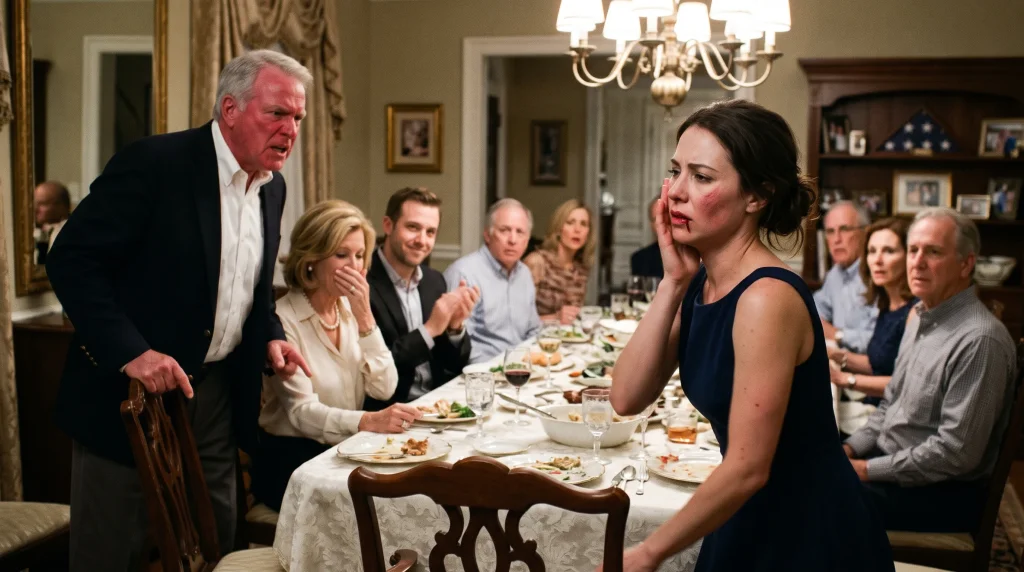
The photograph had been taken roughly forty minutes before Dad hit me.
Forty minutes.
That was all the distance between the family he wanted to remember and the family we actually were.
I didn’t answer.
On the tenth day, Diana called.
My father had been contacted concerning the criminal complaint.
His attorney wanted to discuss the situation.
“Discuss what?” I asked.
“At this stage, I expect they’ll explore whether the matter can be resolved without a contested court proceeding.”
“Does that mean he admits what he did?”
“No. It means his attorney is doing his job.”
I was quiet.
Diana continued, “You need to be prepared for your father to deny, minimize, or reframe the assault.”
“He punched me in front of thirty-nine people.”
“Yes.”
“How can he deny that?”
“You’d be surprised what people will say when they have something to lose.”
The first family member to contact me without demanding an apology was Aunt Jean.
She called on a Thursday evening.
I nearly ignored it.
Then I remembered how she’d smiled when I announced my promotion.
I answered.
“Hello?”
“Amanda?”
“Hi, Aunt Jean.”
Her breathing sounded uneven.
“I’ve wanted to call.”
“Okay.”
“I should have called sooner.”
I sat down on the couch.
For a moment, neither of us spoke.
Then she said, “I saw what happened.”
“I know.”
“I keep thinking I should have done something.”
I watched a woman across the street struggle to close the trunk of her car.
“You could have.”
Jean made a small sound.
“I know.”
My aunt was sixty-one, a retired elementary school teacher who still mailed birthday cards and kept a tin of peppermints in her purse.
She’d always been kind to me in small ways.
When I was twelve, she gave me a book about women mathematicians after Dad mocked my interest in economics.
When I graduated from Northwestern, she sent flowers.
But kindness at a safe distance was something I’d had plenty of.
“I was afraid of him,” she admitted.
I didn’t answer.
“That’s not an excuse.”
“No,” I said. “It isn’t.”
She began crying.
The younger version of me would have comforted her immediately.
I would have told her it was fine, that she shouldn’t feel guilty, that none of it mattered.
Instead, I let her cry.
Finally, Jean said, “If someone asks me what happened, I’ll tell them the truth.”
“Even if Dad gets angry?”
“Yes.”
I wanted to believe her.
I also knew fear doesn’t disappear because someone makes a promise.
“Thank you,” I said.
Two days later, Diana told me Aunt Jean had agreed to provide a witness statement.
I sat on my bedroom floor with my back against the bed and cried for the second time that week.
This time, I wasn’t entirely sure why.
Maybe because someone had finally stood beside me.
Maybe because it had taken so long.
The first public article appeared on a Tuesday morning.
James hadn’t written it.
A regional business publication reported that Gordon Financial Services was facing regulatory scrutiny related to client billing and investment disclosures.
The article used cautious language.
Alleged discrepancies.
Questions surrounding fee practices.
A company spokesperson denied wrongdoing.
There was no mention of me.
By lunchtime, the story had circulated through the local financial community.
By dinner, Justin had called fourteen times.
His fifteenth voicemail began without a greeting.
“What the hell did you do?”
I deleted nothing.
The next day, Dad called from a number I didn’t recognize.
I answered before realizing who it was.
“Amanda.”
My stomach tightened.
“Don’t contact me directly,” I said.
“You’re going to listen to me.”
It was the voice he used when someone had challenged him in a meeting.



