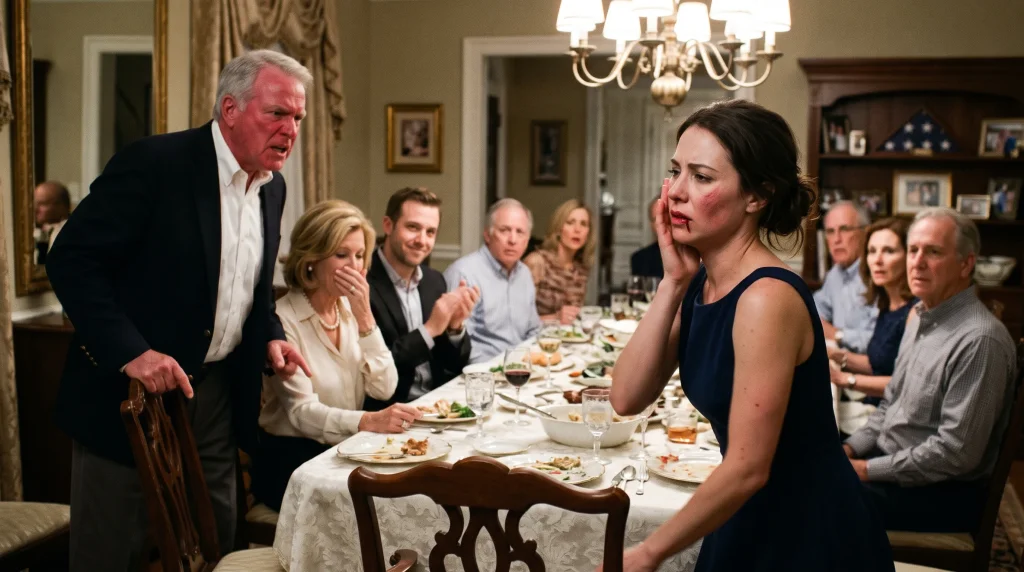
Instead, I said, “My father punched me.”
Her pen stopped moving.
“All right,” she said gently. “Let’s get you looked at.”
The physician examined my injuries, assessed me for signs of concussion, and documented the bruising. Nothing appeared broken, but he gave me instructions about symptoms that would require immediate emergency care.
He also asked whether I wanted information about domestic violence resources.
I said yes.
I was thirty-two, financially independent, and hadn’t lived with my parents in years.
Until that moment, I’d never considered that I might need those resources.
Afterward, I sat in my car holding the discharge papers.
My phone finally buzzed.
It was Mom.
Amanda, where did you disappear to? Your father was very upset last night. You owe him an apology.
I read the message three times.
Not one word about my face.
Not one question about whether I was okay.
I typed:
Dad punched me.
Then I deleted it.
I typed:
I’m safe. Please don’t contact me right now.
That I sent.
Her answer arrived almost immediately.
Don’t be dramatic. We need to talk about how you embarrassed him.
I switched off my phone.
When I met Diana that morning, she looked at my face before she looked at my paperwork.
“Does he know where you live?”
“Yes.”
“Does he have a key?”
“No.”
“Has he ever done this before?”
“Not like this.”
She waited.
I realized what I’d said.
Not like this.
My father had never punched me before. But he’d grabbed my arm hard enough to leave fingerprints when I was sixteen. He’d thrown a glass against the kitchen wall when I refused to quit a summer job he considered beneath us.
At twenty-seven, he’d called a managing director at my firm and told him I wasn’t ready for promotion.
I hadn’t known about that call until six months afterward.
When I confronted Dad, he’d said he was protecting me from failure.
Diana listened without interrupting.
When I finished, she said, “We’re going to address the assault first. The business issues are separate. They may eventually intersect, but they need their own evidence and their own process.”
We discussed reporting the incident to police, preserving the medical records, and seeking appropriate protective measures.
I worried about Dad’s connections.
He golfed with judges, attended fundraisers with elected officials, and had enough money to make ordinary problems disappear behind expensive lawyers.
Diana didn’t pretend those things were irrelevant.
“Resources can complicate a case,” she said. “But they don’t erase evidence.”
That afternoon, I gave a formal statement to the police.
The officer asked whether anyone had witnessed the assault.
“Thirty-nine people.”
He looked up.
“Thirty-nine?”
“My entire extended family.”
“And nobody intervened?”
“No.”
Writing their names took almost half an hour.
I had to stop midway through because I couldn’t remember whether Cousin William had brought his wife or whether she’d arrived separately.
It was such an absurd detail to get stuck on.
Who attended the dinner.
Who sat where.
Who had watched.
I could remember the pattern on my mother’s china more clearly than I could remember whether anyone had looked concerned.
By evening, I had a police report number, medical documentation, and a headache that wouldn’t go away.
I also had seventeen missed calls from Justin.
His messages became progressively nastier.
Dad says you’re making a huge mistake.
Answer your phone.
This is a family matter.
You seriously think you can embarrass him and walk away?
Then, at 6:18 p.m.:
You wouldn’t be anything without us. Remember that.
I forwarded everything to Diana.
She replied with four words.
Keep saving the messages.
The following morning, I met Michael Chen in a quiet conference room at his office.
He had two coffees waiting.
“Didn’t know what you drink,” he said. “So I guessed badly.”
He’d bought me black coffee.
I normally took mine with cream and two sugars.
I drank it anyway.
Michael explained that any formal investigation would require independent review and proper referral to the agencies with authority over the company’s activities.
He couldn’t simply take possession of everything because we knew each other.
He also couldn’t promise what investigators would find.
“Start from the beginning,” he said.
So I did.
Six weeks before accepting Blackwood’s offer, I’d been reviewing public filings and potential conflicts involving several firms operating in the same market.
Gordon Financial had caught my attention because I knew its reputation—and because I’d occasionally encountered its former clients throughout my career.
One former client, Margaret Ellis, had approached me months earlier after moving her investments away from Dad’s company.
Margaret was sixty-eight, a retired school administrator whose husband had died the previous winter.
She’d wanted a second opinion about fees and performance figures on her retirement accounts.
I had reviewed the statements she was authorized to share.



