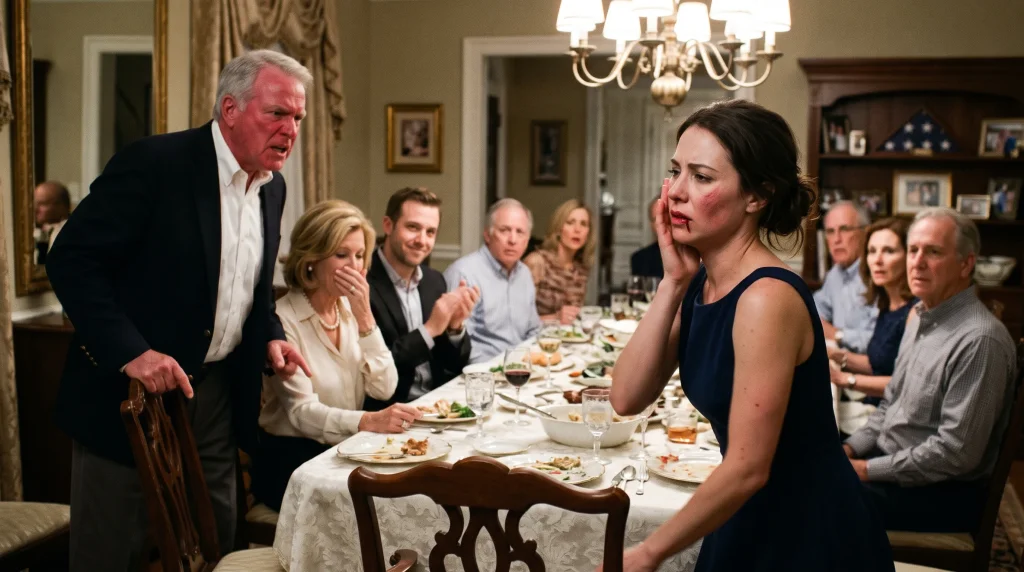
Two words.
No explanation attached.
I waited for the inevitable qualification.
It didn’t come.
Finally, I said, “You hurt me, Justin.”
“I know.”
“You laughed when Dad hit me.”
His voice cracked slightly.
“I know.”
“Why?”
There was a long silence.
Then he said, “Because if he was angry at you, he wasn’t angry at me.”
I pressed my fingers against my forehead.
It was a terrible answer.
It was also probably the most truthful thing my brother had ever told me.
I didn’t forgive him that day.
I told him I needed time.
He said he understood.
Before hanging up, he asked whether he could send me the old email.
I told him to send it to Diana.
Not because I wanted another fight.
Because I was finally learning to keep important things in the proper hands.
The one-year anniversary of the reunion arrived on a warm Saturday in June.
I didn’t realize the date until I opened my calendar.
There it was.
One year.
I thought about spending the day alone.
Then I called Aunt Jean.
“Are you busy?”
“That depends. Are you calling to help me clean the garage?”
“No.”
“Then I’m free.”
We had lunch at a little restaurant overlooking the water.
Afterward, we walked along the harbor.
Jean complained about her shoes.
I bought us ice cream.
We sat on a bench watching a family try to convince a golden retriever to get back into their car.
The dog was having none of it.
Jean laughed so hard she nearly dropped her cone.
I looked at her and realized something.
For the first time, I was enjoying a family gathering without monitoring anyone’s mood.
Nobody was testing me.
Nobody was ranking accomplishments.
Nobody was waiting for me to say something that could be turned into an insult.
We were simply two women eating ice cream on a beautiful afternoon.
That evening, I went home and opened the drawer where I’d kept the navy dress.
The bloodstain was still there, faint but visible.
I held the fabric in my hands.
For months, I’d treated it like evidence.
Proof of what had happened.
Proof that I hadn’t imagined it.
Proof that my father could hurt me and my family could watch.
But I didn’t need the dress to remember anymore.
There were police records.
Medical records.
Court documents.
Witness statements.
More importantly, there was the life I’d built afterward.
I put the dress in a donation bag.
Then I changed my mind.
I took it back out, folded it carefully, and placed it in a storage box with some old photographs and college papers.
Maybe someday I’d throw it away.
Maybe I wouldn’t.
I no longer needed every decision to represent a dramatic breakthrough.
A few days later, an envelope arrived from my father’s attorney.
Inside was a brief letter concerning the conclusion of certain outstanding matters.
There was also a separate handwritten note from Dad.
Only four sentences.
Amanda,
I regret what happened at the reunion. I never intended for our family to end up this way. I hope someday we can put this behind us. I am still your father.
I read it twice.
Then a third time.
There was no acknowledgment of the years of humiliation.
No admission that his business decisions had harmed clients.
No recognition that I’d been entitled to choose my own career.
And no direct apology for punching me.
I thought about writing back.
I thought about telling him exactly what he’d done.
I thought about listing every birthday, every dismissal, every accomplishment he’d mocked.
Then I realized I’d spent most of my life trying to convince him to see me clearly.
I didn’t have to keep doing it.
I placed the letter in the same box as the dress.
I didn’t respond.
The following Monday, I attended a meeting at Blackwood.
We were reviewing a new investment strategy for a client with a complicated set of financial goals.
One of the senior partners asked a question about risk exposure.
I answered.
He challenged my assumptions.
I explained my reasoning.
The discussion continued.
Nobody raised their voice.
Nobody took disagreement personally.
When the meeting ended, Elaine stopped beside my chair.
“Excellent work, Amanda.”
“Thank you.”
She smiled.
“You should be proud of what you’ve built here.”
For once, I didn’t minimize the compliment.
“I am,” I said.
And I meant it.
That evening, I called Margaret Ellis to check how she was doing.
Some of her financial claims had been resolved through the broader settlement process, although the outcome hadn’t restored all the time and trust she’d lost.
She told me she’d finally taken the trip to Maine that she and her husband had planned before his death.
“I stood on the beach in the rain for twenty minutes,” she said. “Everybody thought I was crazy.”



